



EcoHouse
In Brief
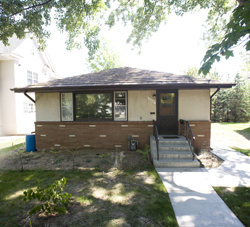
Project EcoHouse at Macalester College in St Paul, Minnesota, kicked off in Fall 2007 with the move-in of four student residents. The 1950s-era house underwent significant “green” renovations in summer 2007, including the installation of a domestic solar hot water system, a recyclable steel roof, wall insulation, and high efficiency energy star appliances. While developmental work is continuing, this project has already gained significant attention in the local media, including stories in the Minneapolis Star Tribune, The Villager, Channel 9 News, Minnesota Public Radio, and various Macalester publications.
The Vision
The EcoHouse gives students a unique opportunity to explore practical green-living lifestyles, to test the effectiveness of new green technologies, and to work with community partners to develop better resources on green renovations and sustainable lifestyles. In addition, once it is equipped with a planned state-of-the-art energy monitoring system, the house will function as a “live-in” laboratory for testing the energy savings and cost-effectiveness of various renovations and green technologies. Such a system will allow the EcoHouse to provide empirical data on the performance of various house systems that we can then share with many others. The house is also rapidly becoming an information clearinghouse, fostering discussions about sustainability by connecting interested homeowners with relevant community organizations and efficiency resources. In the future, EcoHouse residents will host various events, skill-shares, and workshops, and will develop a comprehensive web site to help build connections between on and off-campus resources. Project EcoHouse is in continual development and guided by an ambitious vision.
Beginning with the 2024-2025 school year, the EcoHouse will be administered through Residential Life and the Sustainability Office.