





By Abraham Swee / Photos by Kurt Stepnitz
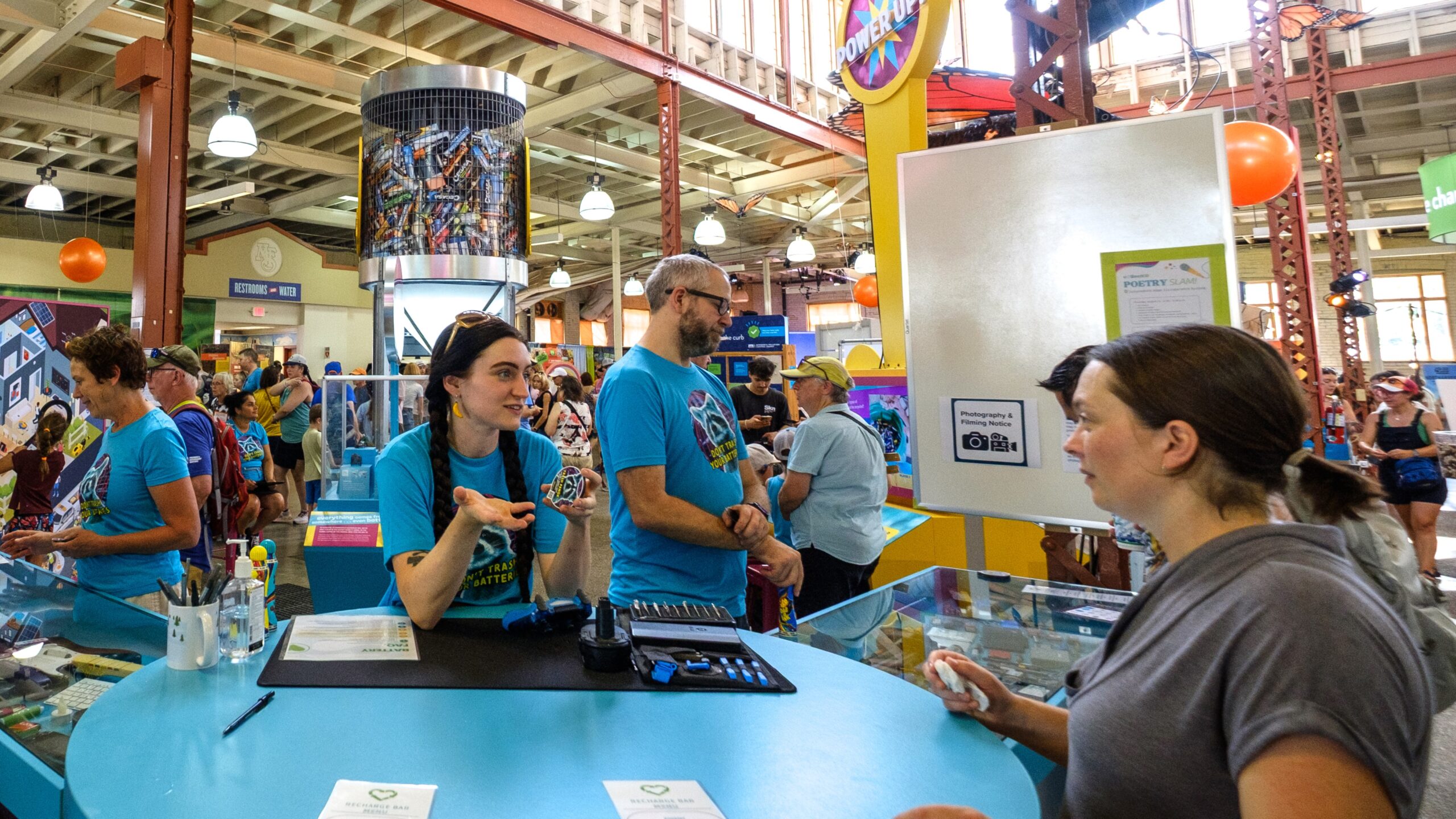
In between the crop art, carnival rides, and fried food, the Great Minnesota Get-Together unveiled a new kind of exhibit this year–one that’s all about powering the future. Visitors to the state fair’s Eco Experience building were met with a power-packed, interactive experience from Macalester College’s CollectED project, a new initiative aimed at educating the public around battery recycling.
With a giant basket of recycled batteries suspended overhead, fairgoers fanned out across the colorful exhibit. They tested their knowledge about e-waste in an animated “Power Play” trivia contest. Visitors charged their phones at the “Recharge Bar.” Kids searched an interactive mural for batteries using special magnifying glasses. And, in a literal show of strength, Minnesotans were challenged to play “Power Up,” spinning a wheel to see if they could generate the equivalent power of a battery (hint: It’s harder than you think).

The experience is the brainchild of Macalester environmental studies professor and self-described “battery lady” Dr. Roopali Phadke. “People just bring me batteries,” says Phadke. “Whether they’re in my neighborhood or at work, people just drop them off at my doorstep.”
An expert on energy and climate policy, the professor came up with the idea to establish CollectED when she noticed used batteries starting to pile up around her home. “I thought to myself, ‘I don’t know what to do with these. I know they’re valuable. I know they’re toxic. So how can I better understand this, and how can I help my communities understand this as well?’”
The problem itself is threefold. First, batteries pack a toxic punch. In landfills they slowly leak chemicals into the soil, water, and air. That often leads to a second issue: Tossed batteries are fire hazards, sparking multimillion-dollar blazes at recycling facilities every single day. Finally, there’s the waste of precious resources: the cobalt, lithium, and nickel inside your watch battery or electric vehicle battery can be recycled again and again, powering everything from laptops to solar farms—but that’s only if it’s recycled properly.

Phadke’s dream to deliver the ultimate lesson in battery recycling was recently buoyed by a $1.77 million grant from the US Department of Energy. The agency’s Battery Recycling, Reprocessing, and Battery Collection program was impressed by CollectED’s plan to increase consumer participation in collection programs across the nation.
In addition to its state fair exhibit, CollectED launched the REcharge Academy, which has been training educators across the nation to explore creative ways to teach about batteries and energy systems. The project has also been developing a digital StoryMap, an interactive platform where users can explore stories from communities engaged in battery recycling, locate the nearest recycling facilities, and learn safe disposal practices.
To help lead the world into a new era of battery recycling, Macalester faculty, staff, and student researchers are collaborating with community partners, including the Minnesota Pollution Control Agency and Upstream Exhibits, which designed the new fair exhibit. Local poets were even commissioned to write works themed around batteries and delivered their pieces at the fair.

Recycling Electronics for Climate Action, a nonprofit focused on developing creative e-waste solutions, is also a partner, and its co-director, Maria Jensen, was a regular volunteer staffing CollectED’s Recharge Bar and enjoyed testing fairgoers on their battery knowledge.
“What we’re really doing is addressing an education gap,” Jensen says. “Being here at the fair, I’ve had so many great conversations with people who say they still have all their old batteries in a plastic bag in their basements. This is a great chance to get those batteries out of their homes and to reclaim those precious metals.”
According to the International Energy Agency, up to 30 percent of the nickel, cobalt, and lithium needed to build new batteries between now and 2050 could come from recycled batteries. CollectED believes a strong circular economy powers a bright future.
So what should someone do with their old batteries? The answer varies depending on where someone lives. Find a drop-off site near you at call2recycle.org.
No matter what: “Do not throw your batteries in the trash,” Phadke says. “Get them to a hazardous waste center, and then from that point forward, they can start doing work for everybody.”