





By Abraham Swee / Photos by Laichee Yang
When the lights came up at the Southern Theater in Minneapolis on June 9, 2005, Alessandra Williams ’07 sat stunned in her seat. The Macalester student had just witnessed Ananya Dance Theatre’s inaugural performance, Bandh: Meditation on Dream. As applause began to build, Williams didn’t know what to think. The performance—which featured a new company of transnational feminist artists exploring issues around social justice—had defied everything she had come to know about movement, identity, and art.
“I sat there and thought, ‘What in the world was that?’” Williams recalls. “There was nothing like it.”
For Dr. Williams, who earned her PhD in culture and performance at UCLA and is now an associate professor of dance at Rutgers University-New Brunswick, the moment was quietly revolutionary. It is a moment that has since shaped her movement through the world, encouraging Williams to embrace dance as a conversation between body, land, and community.
Her trip to the Minneapolis theater that night was no accident. Williams was part of the Mellon Mays Undergraduate Fellowship Program, led then by professor Peter Rachleff, who brought his students to the performance as part of their exploration of race, history, and the arts. Williams, a dance minor and American studies major, was no stranger to the power of dance at Macalester. A Black woman on a predominantly white campus, she had worked to create community and founded Bodacious, the college’s first hip-hop collective featuring Black students, women and queer persons of color, and those of the African diaspora.
And yet, what she saw on the Southern Theater stage on that evening in June—an ensemble of people of color and queer artists, who performed fast and intricate footwork while tackling subjects like women’s empowerment and generational healing—expanded the boundaries of what dance could mean. “I just didn’t know what to think,” she said. “And I didn’t really know if I ever wanted to see it again, as I didn’t have anything to connect it to.”
Confusion would soon give way to clarity. While studying away at the University of Cape Town, Williams interned for a youth dance organization, Jikeleza Dance. The project uses movement to help children in South Africa’s most undervalued communities shed the weight of daily constraints and express themselves freely. The experience, once again, expanded her understanding of dance and what it could be.
Back home in the Twin Cities, Williams returned to the Southern Theater and, with a broadened worldview, watched a fresh work from Ananya Dance Theatre. “I felt connected as a person of African descent whose ancestors were enslaved on this land in America,” Williams says. “I was weeping, and I felt touched.”
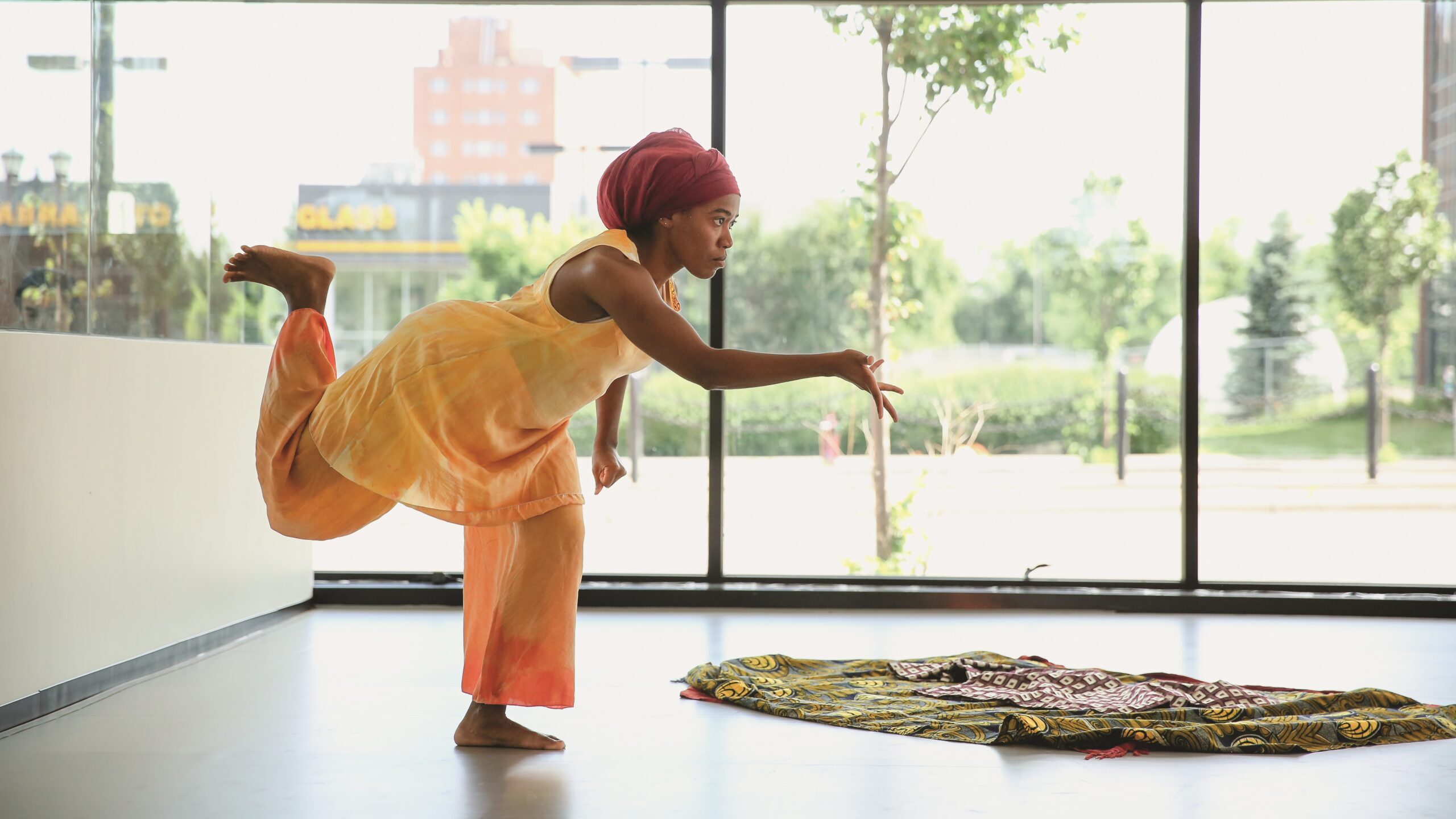
She would join the company as an artist during her senior year at Mac, performing with the group and studying Yorchhā, its signature technique. With the use of spirals and curvilinear
extensions of the spine, the movement practice combines principles from traditional Indian dance and the martial art form Chhau. For its practitioners, Yorchhā demands total presence and an awareness of one’s connection to the Earth.

“The dancing is an intense aliveness and an unwavering concentration on one’s body and all others in the movement space,” Williams says. “There is never a moment of dropping your energy, your focus, or your rootedness to the ground.”
Williams has spent much of the past two decades either studying Yorchhā as a member of Ananya Dance Theatre or sharing the technique with others. In 2016, she joined her fellow company members at Standing Rock, where they offered up the movement practice to Indigenous communities protesting the Dakota Access Pipeline.
“Every dance we must think about the land on which we dance,” Williams says. “When we work with communities and offer the Yorchhā practice, we give them energy and send them vitality. That’s social justice and that’s artistic excellence intersected.”
The dance scholar explored that intersection as coeditor of the anthology Dancing Transnational Feminisms: Ananya Dance Theatre and the Art of Social Justice. Joining her on the project were company founder Ananya Chatterjea and fellow company member Dr. Hui Wilcox, now the dean of the Kofi Annan Institute for Global Citizenship at Mac.

“Alessandra has this incredible vision, and she will not give up on it,” Wilcox says. “Our book took twelve years to complete. There were times we thought it wouldn’t happen, but Alessandra kept us going. That book exists because she kept reminding us of the dream.”
As a faculty member at Rutgers, Williams now shares her vision with the next generation, teaching dance history, theory, and the Yorchhā technique as part of the university’s curriculum. Yorchhā became the first non-European-derived form taught at Rutgers as formal technique, rather than as a rotationally taught form. It can pose an uncomfortable challenge for students, as it once did for Williams.
“Inspiring my students to broaden their horizons, to understand the possibilities of what dance looks like, what technique looks like, and what excellence looks like—it’s always an eye-opening experience for them,” Williams says.
Two decades after that first performance left her quietly contemplating in a darkened theater in Minneapolis, Williams plans to return home again in 2026 to perform with Ananya Dance Theatre. For the dance scholar, to come home and dance again is a return to family and purpose. “Dancing feels like the hardest thing I’ve ever had to do—and one that is most illuminating.”