





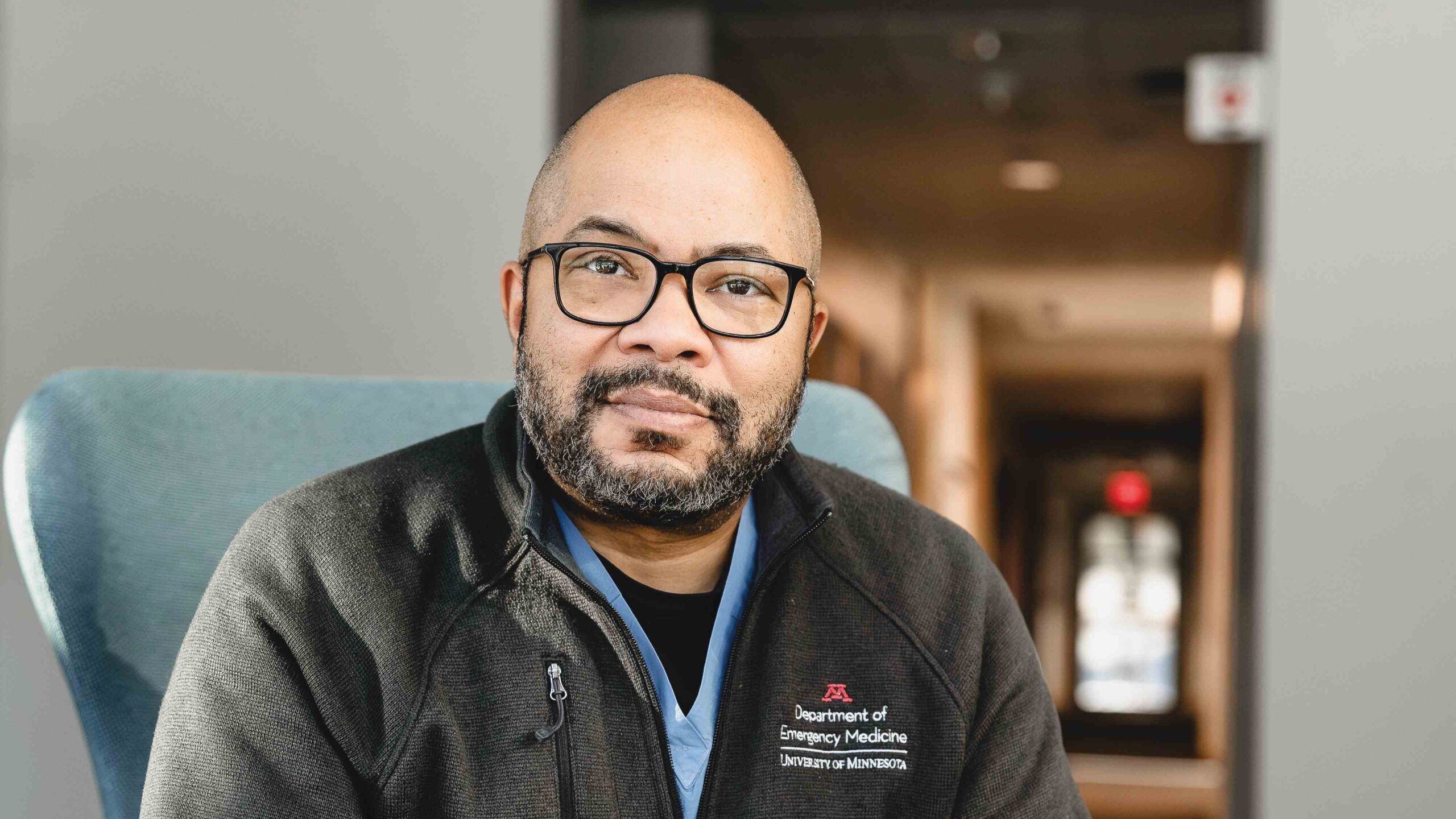
Photo credit: Sara Rubinstein
Dziwe Ntaba ’95 had been working in emergency rooms for fifteen years when he sat down to visit with a woman named Farah. Like a growing number of Minnesotans, she had struggled with opioid use disorder, but now she was in recovery. After Farah (a pseudonym) filed a complaint about her previous experience in the ER while seeking treatment for addiction, Ntaba had invited her to provide feedback. “Most doctors practicing today were not taught much, if anything, about the neuroscience of addiction in medical school,” Ntaba says. “In fact, many still think of addiction as a moral failing rather than a biological disease.”
Farah was blunt. It was difficult and humiliating to navigate the healthcare system, she said. When she had sought help from the emergency room at her most vulnerable moment, clinicians had treated her rudely and refused to admit her to the hospital. Ntaba swallowed his excuses and asked Farah to keep going. How could the ER improve its work with people with substance use disorder if he didn’t have the humility to listen and learn from her criticism?
Farah’s story “completely changed my perspective on my own work environment, my own patients, my own colleagues and how we practice medicine,” Ntaba says. “It’s a very different opportunity to sit down and force yourself to listen, with the assumption that we are the problem.”
Throughout his career in medicine, Ntaba has tried to listen more than he talks. Whether he’s working in remote parts of Africa or in a teaching hospital a few miles from Macalester, he engages the community where he practices as a vital partner in delivering care.
Ntaba was born in New York but spent his early years in Malawi, his father’s home country. When he was eight years old, he and his mother moved to Minnesota, where Ntaba graduated from high school. He came to Mac to play soccer and majored in biology, developing an affinity for science in courses taught by Jan Serie and Lin Aanonsen. Beloved psychology professor Walter D. Mink’s Brain, Mind, and Behavior class laid the foundation for work Ntaba would undertake years later when he shifted his focus to addiction.
He earned a medical degree from Oregon Health and Science University and a master’s in public health from Harvard University. There, he became close friends with fellow student Deogratias Niyizonkiza, a survivor of genocide in Rwanda and Burundi and the subject of Tracy Kidder’s book Strength in What Remains. Together, the two launched Village Health Works in 2007 in a remote, rural area of southwestern Burundi.
The project, which began as a three-room clinic, today encompasses a 150-bed teaching hospital, food security initiatives, and a premier boarding school. Its success is due partly to community health workers, trusted local leaders who reach out to residents who may be distrustful of the medical system and connect them with resources for prenatal care or treatment for stigmatized conditions like tuberculosis. Once those patients engage with the clinic and have positive results, they become trusted messengers themselves. It’s a virtuous cycle, Ntaba says: “You’re not just helping one patient with that investment. You’re helping their social network.”
Back in Minneapolis, Ntaba saw a steady increase in opioid overdoses at M Health Fairview University of Minnesota Medical Center, where he is a teaching professor in emergency medicine. His team was helping patients with opioid use disorder start taking the medication buprenorphine, which stabilizes brain chemistry and prevents craving and withdrawal. But many people who could benefit from the medication were not coming to the hospital because, as Ntaba later learned from Farah, they associated the healthcare system with trauma, shame, and judgment.
Then Ntaba met Nicole, an activist and outreach worker in the local Native community—in which, Minneapolis Department of Health data show, people are twenty-four times more likely to die of an overdose than white people. Ntaba observed how Nicole could talk with people who were suspicious of the healthcare system, share her own recovery journey, persuade her listeners to come to the hospital, and accompany them until their treatment plan was set. Nicole was trusted in a way that doctors were not. “They won’t even start listening to me unless I get endorsement from her,” Ntaba says.
Building on what he’s learned, Ntaba is working with partners across the Twin Cities metro area to develop a more robust opioid response strategy. Community clinics that have adopted the low-barrier buprenorphine model now offer rapid, free, same-day access to medication. An outreach program will hire people from the Twin Cities’ most vulnerable communities who have personal experience of addiction and recovery and who will be able to testify to the success of medication for addiction treatment with their peers. And middle school students are beginning to experience an expanded substance use prevention curriculum through BrainWaves, a program of the University of Minnesota’s Masonic Institute for the Developing Brain.
All of the work applies lessons from Ntaba’s overseas experiences and his respectful conversations with people like Farah. And, he says, it’s built on what he learned in Mink’s class at Macalester: “Understanding linkages between the brain, mind, and behavior really goes a long way.”
Robyn Ross is a writer in Austin, Texas.