





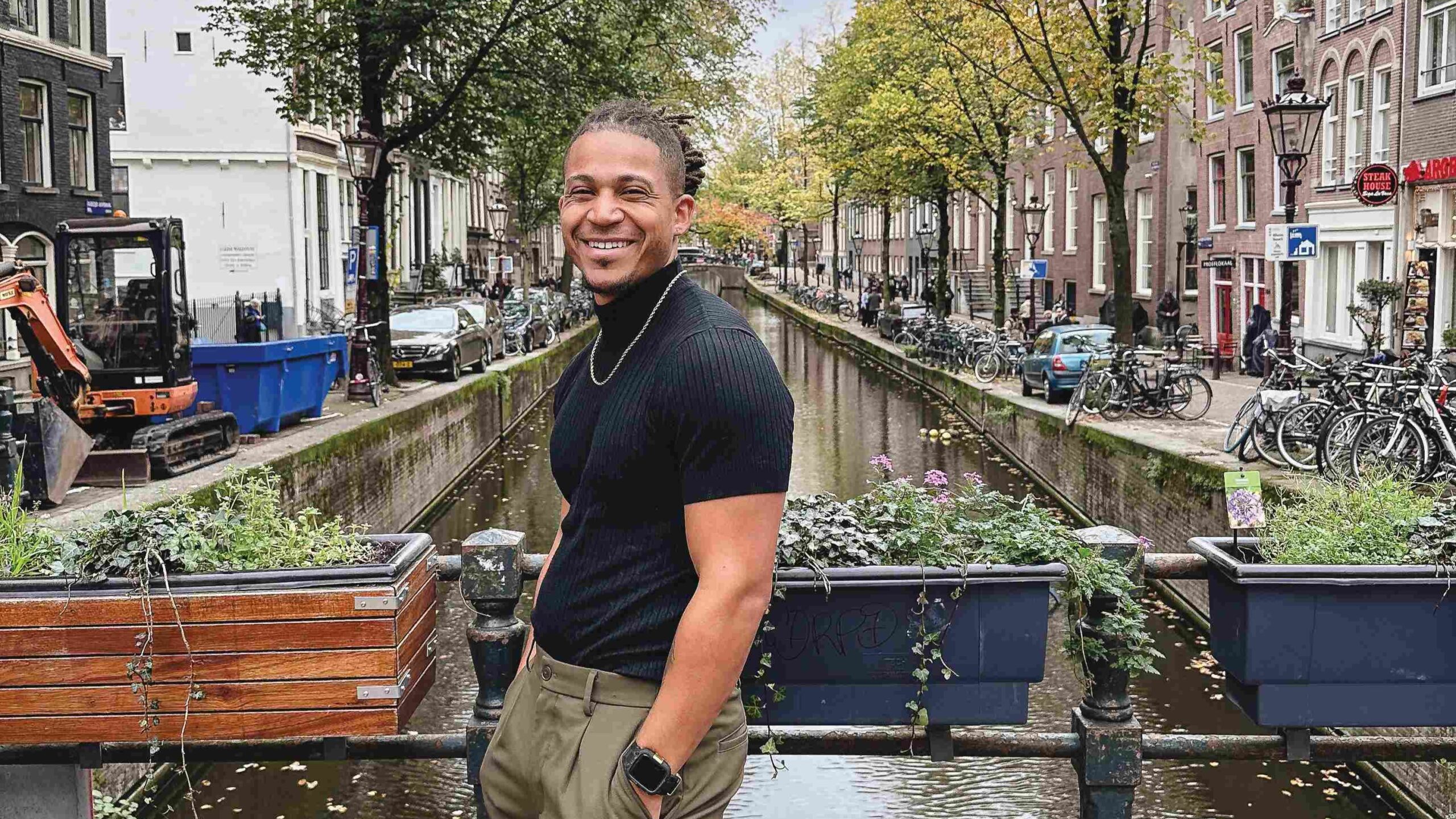
Kiante Miles ’20 started performing poetry in high school. At Macalester, he took it to the next level: performing works at campus events, writing a book, and, with support from the Live It Fund, built a poetry program for high school students in Minnesota and his home state of Oklahoma. He did it all while playing football for the Scots and working towards a computer science degree.
After graduating in the middle of the COVID-19 pandemic, Miles landed his first job as a data engineer. At the time, financial security seemed paramount, and pursuing poetry professionally took a back seat. For several years, he would focus his energy on building data pipelines and writing code. But in 2024, a connection from his time at Macalester called him up out of the blue and asked: “Are you still doing poetry?”
That phone call reignited a passion. Today, Miles continues his work as a data engineer at Hagerty. But when he clocks out of his nine-to-five, his work as a poet is just beginning. Companies now hire Miles to perform custom motivational pieces for corporate conferences and events. The dual career track has taught him crucial lessons about following what truly matters. “Anytime you feel your heart and soul tugging and pulling in a direction, you probably should follow it. You’re more than likely going to regret not following it sooner.”
Here, he shares what he’s learned about balancing interests and why your liberal arts degree is worth more than you might think. Plus, a poem in his own words.
Your degree is more than your major
A liberal arts degree is so much more than skills in one facet of life. It’s about communicating with people from different backgrounds and languages, fostering collaboration, and developing critical thinking. All those different aspects of a liberal arts education show up in any workforce. I wish I’d understood that better when I first graduated—I would have felt more satisfied with where I was at.
Don’t be afraid to take the plunge
When you’re considering a career pivot, ask yourself two questions: What happens if you do, and what happens if you don’t? A lot of times we play these games of “What if I quit and it fails?” We overcomplicate things and make life the obstacle. Go in with a plan that considers failure, yes, but still pursue the thing, because that’s what’s going to fulfill your heart and soul.
The person you are matters more than credentials
The biggest thing I’ve learned on the job is that the type of person you are is going to have way more effect on what jobs you’re able to get than certifications and qualifications. Your real qualification is how you take up space in a room. If you take up positive space in a room, companies are going to want you. Go ahead and take a career risk, because more often than not, companies can teach technical skills, but they can’t teach that energy.
Tap the MacConnect network
One of the biggest resources I’ve used is MacConnect. Anytime I need anything—a financial advisor, connections in my field, information about a company—I look for Mac alumni. And what I’ve found is Mac alums who are always willing to connect over coffee. Macalester alumni truly want to help people in the Macalester family. Don’t be afraid to reach out.
Value real confidence
The mentors I’ve valued most are people who are okay with saying “I don’t know, but let’s go find the answer.” It shows you’re willing to not just make something up, but that you are confident in your own abilities. It’s a subtle way to show real confidence.
Zipper
By Kiante Miles
There’s a difference between
independence and standing alone
Between being in the crowd and
playing your part in it
Regardless of where you’re standing in line,
There will always be a pull, a tug.
It might not always be from the front.
You might be going back…
To your dreams.
To your gift.
You may need to go back
In order to clear the path ahead.