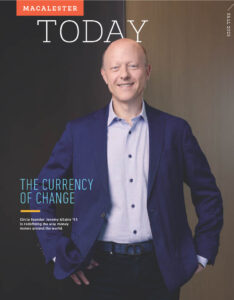








By Daniel Oberhaus, Photos by Andres Hernandez
When Jeremy Allaire ’93 testified before the Senate Committee on Homeland Security in November 2013, the fledgling cryptocurrency industry was in crisis.
A month earlier, the FBI had arrested Ross Ulbricht, the operator of a notorious dark web marketplace called the Silk Road that had become synonymous with cryptocurrency in the public mind. The site allowed people to buy drugs and other contraband, paying with cryptocurrency to evade detection. A few days after Ulbricht’s arrest, Allaire launched Circle, a company designed to bring cryptocurrency into the mainstream by making it easier to move money between dollars and the dominant cryptocurrency, Bitcoin.
Circle’s launch might have seemed like bad timing. But for Allaire, the fear and uncertainty swirling around the cryptocurrency ecosystem had created an opportunity for companies that were willing to work with regulators. He had come to Washington to sell lawmakers on Circle’s vision for the regulated future of digital currency.
“I believe that global digital currency represents one of the most important technical and economic innovations of our time,” he told the committee. “As this technology moves from early adopters into mainstream acceptance, it is critical in my view that federal and state governments establish policies surrounding digital currency.”
Cryptocurrency got its start in 2008 with the launch of Bitcoin, a peer-to-peer digital currency that allowed anyone with an internet connection to transact without going through a regulated central intermediary like a bank or payment process. Allaire was one of the few early crypto entrepreneurs who actively sought regulation—a maverick approach in crypto’s Wild West culture.
But, twelve years later, Allaire’s strategy of working with regulators has proven prescient. Circle has become critical infrastructure for the nearly $4 trillion crypto industry and a key player in its mainstream adoption. It processes trillions of dollars in transactions annually and has been adopted and used by major legacy payment platforms like Visa and Mastercard and global financial powerhouses like BlackRock, Robinhood, Stripe, and others.
The key to Circle’s success is an innovation in digital money called a stablecoin, a particular type of cryptocurrency that is typically backed by real dollars and is designed to maintain a stable price. The first stablecoin, BitUSD, was released by a pair of programmers in 2014 and promised to make even cross-border transactions as simple as sending an email. For years, internet users have been able to digitize and share music, images, and text. But money could move only via proprietary systems such as wire transfer services and Venmo. Stablecoins change that by allowing people to send money between different payment platforms because they share a common protocol. It’s the same concept that allows emails to be sent and read despite users having different email providers.
At Circle, the company’s stablecoin, USDC, is able to maintain a stable dollar value because it is backed one-to-one with actual cash and Treasury bills held in highly regulated custody. “A stablecoin is essentially a very safe version of a dollar,” says Allaire. “But it has all these superpowers that we love about internet communication and information access.”
Besides making it easier to send money between payment platforms, stablecoins enable billions of people without traditional banking access to participate in the global economy for the first time. “This is important for the democratization of the financial system and ultimately the ways in which credit becomes available to people and businesses around the world,” says Allaire, who traces the inspiration for Circle to his time at Macalester. “If it wasn’t for my liberal arts education and my ability to think from an interdisciplinary perspective about society, political systems, and the economy, I couldn’t do what I’m doing today,” he says.
Macalester was where Allaire first explored the internet when his first-year roommate connected their dorm room to an early research network that preceded the commercial web.
“I was communicating with people behind the Iron Curtain as they were witnessing tanks rolling by during the collapse of the Soviet Union,” he says. “It blew my mind.”
Allaire decided to spend his career working on the technology. In 1995 he and his brother, J.J. ’91, developed ColdFusion, a web development platform that made it easy for anyone to build dynamic websites and was adopted by companies including Boeing and Target. A few years later, Allaire launched his second company, Brightcove, which gave individuals, content creators, and brands the power to distribute content at the same scale as legacy television networks.
Both companies expanded access to tools that had previously been unavailable to most people. With Circle, Allaire applied the same logic to money itself.
The company has faced fierce competition from Tether, an offshore rival operating in regulatory gray areas. In 2022, the collapse of crypto projects such as FTX sent shockwaves through the industry, and Circle faced its own crisis when Silicon Valley Bank failed with over $3 billion of the company’s reserves trapped inside, causing USDC’s price to briefly dip below its dollar peg.
But those challenges have only validated Allaire’s long-term strategy to advocate for and comply with federal regulation. This summer, President Trump signed the GENIUS Act into law, creating the first federal regulatory framework for stablecoins and establishing guardrails such as maintaining 100 percent reserve assets kept in US dollars or similar safe assets. Circle used this regulatory clarity to overtake its rivals and become the dominant compliant stablecoin issuer, growing over 100 percent year over year. Earlier this year, it went public with a $1.1 billion IPO in one of the most successful tech IPOs in recent decades. It was exactly the type of mainstream validation for stablecoins that Allaire had been pursuing for more than a decade. But he sees this as just the beginning.
“When I was at Mac in the early 1990s and having these visions of the internet, it took twenty years for a lot of those ideas to happen,” he says. “I think we’re in a similar place with cryptocurrency right now, and the transformations are going to be just as significant.”
Jeremy Allaire ’93 recently joined the Macalester community for an educational conversation about cryptocurrency and its role in today’s financial landscape.
Daniel Oberhaus is a science and technology writer in New York. He is the founder of the creative agency HAUS and the author of The Silicon Shrink: How Artificial Intelligence Made the World an Asylum (MIT Press, 2025).