






By Michael Householder
On a Monday morning this past February, seven members of a multi-institutional team huddled around piles of cardboard boxes and tubes in a workspace in Macalester’s Law Warschaw Gallery. Gently placing one of the boxes on a work table, college curator Heather Everhart slowly revealed its delicate contents, a lithograph produced by an Inuit artist working in an area of Nunavut, Canada, known as Cape Dorset. For a moment, the team paused in wonder and appreciation.
Over the course of the week, the scene would be repeated many times as more than 200 additional items, including more lithographs, stencils, stonecuts, and three-dimensional objects were unboxed, measured, evaluated for damage, and catalogued. It was a week of painstaking curation punctuated by breathtaking discovery.
Soon, this trove of objects will be available for the world to see and study on Macalester’s campus, thanks to the college’s nearly 100-year-old commitment to maintaining a large, diverse, and robust permanent art collection.

Nikotye Mills, Following the Route, 1996

From left: Mary Pudlat, The Whale Hunt, 1990; dozens of prints arrived tightly rolled in tubes; Qavavau Manumie ᑲᕙᕙᐅ ᒪᓄᒥ, Migration of the Whales, 2002
Art as anchor
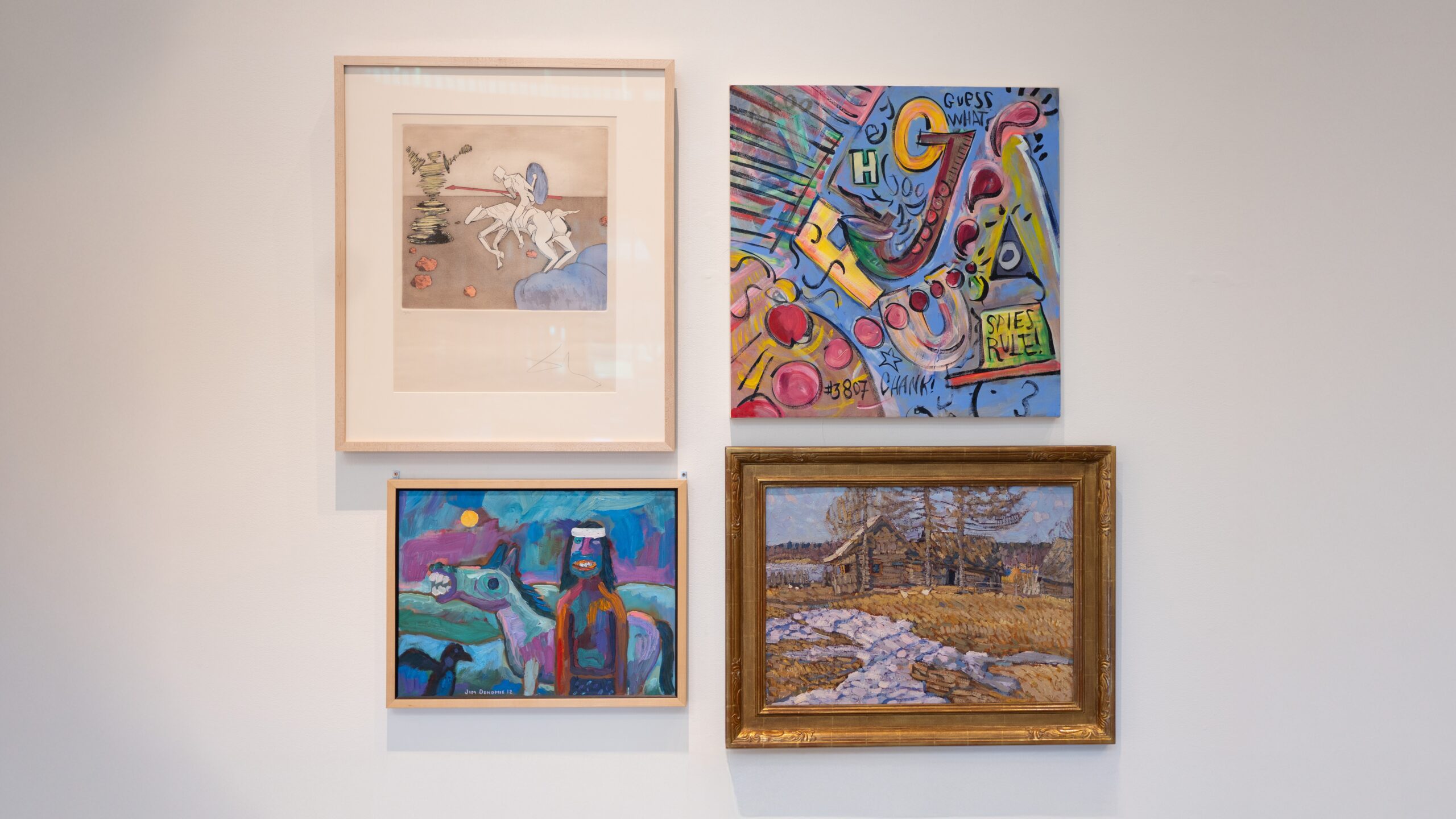
The college began collecting art intentionally and systematically in the 1930s. Today, Macalester College’s Permanent Art Collection, which is a program of the Art and Art History Department and is stewarded by Law Warschaw Gallery leadership, holds a growing collection of more than 1,800 objects, including paintings, sculptures, textiles, photographs, and mixed media works. Many of the objects were made by past and current faculty and students, thus serving as an archive of the college’s teaching and activities. The collection is also home to works by art world luminaries like Ansel Adams, Judy Chicago, Salvador Dalí, Käthe Kollwitz, Joan Mitchell, George Morrison, and Isamu Noguchi, as well as artifacts and art historical objects like African carvings and Chinese ceramics.
Objects from the collection can occasionally be seen inside the Law Warschaw Gallery, but a wealth of pieces appear all over campus every day. A tapestry, Dragon Ship, by Laurie Jacobi hangs on a wall in the Kofi Annan Institute for Global Citizenship. A ceramic, Yellow Sweater, by Gail Kendall, rests on a pedestal in the library. A ceramics installation, Sunbathers, by Marta Sorenson ’25, is tucked below the stairs in the Janet Wallace Fine Arts Center Commons. They are the concrete manifestation of the college’s commitment to preserving, sustaining, and growing the arts. As both decorative objects and teaching tools, they prompt and sustain reflection, inspiration, dialogue, and community.
It’s a collection that is almost always changing. Through the thoughtful acquisition and display of artwork from a range of cultures and perspectives, Everhart believes the collection continues to evolve as a more “reflective, inclusive, and accessible resource that supports both academic inquiry and personal connection.”
Where learning meets legacy
Promoting students’ direct engagement with the collection is one of Everhart’s primary goals as director and curator of both the Law Warschaw Gallery and the permanent art collection. She intends to launch a formal study collection in the coming years that will expand access to objects for instruction and research. Recently, instructors in the Art and Art History Department have used objects to teach methods of visual analysis and critical thinking. Students have also used objects as models and sources of inspiration for their own creative projects.
For student artists themselves, the collection can provide more than inspiration. Over the years, the college has acquired works from student exhibitions, as well as works produced later in graduates’ careers. For early-career artists, acquisition provides validation and public recognition. It is also a means through which they can support future generations of Macalester students, cultivating a virtuous cycle of giving back to the campus community.
“Collections and their holdings represent what an institution finds valuable and worth protecting,” says Nora de Rege ’24, an alum who spent years working with the collection. “The artwork that I was responsible for researching, organizing, maintaining, all represents and contributes to the identity of the college.”
For de Rege and other students who participate in the gallery’s work-study program, the collection provides a range of hands-on experiences in the form of curation, research, conservation, and museum education. These opportunities represent experiences where practice and theory meet. De Rege describes their experience as “invaluable” as they begin their career in the museum industry. “Because my work with the collection often coincided with my studies,” they observe, “I understood the value of an art collection through a theoretical framework.”
In addition to being an invaluable academic resource, the college’s collection nurtures the intellectual life of the campus community, and connects it to the vibrant Twin Cities cultural scene. This past spring, Everhart and de Rege assembled a highlights show (appropriately titled The Hits), bringing together works from Mitchell and Dalí alongside gifts of work by alums Siah Armanjani ’63 and Cynthia Brewster ’64, as well as by the celebrated Minneapolis artist Judith Roode. Underscoring the importance of such shows, de Rege notes, “I was always amazed to discover that some of my favorite artworks in the collection were by former students or staff members—I was even more amazed to realize it meant that the people of Macalester are core to the identity of the college.”


Creating space for complexity
Understanding which objects make sense for the college to acquire and preserve is one of the many challenges Everhart faces. In accepting and selecting works consistent with the institution’s mission and the role of the collection, Everhart strives to balance a range of aims. Within that broader vision, she applies her own vision of art “as a vital tool for cultivating empathy, connection, and collective responsibility,” a view shaped by her perspective as a Dene First Nations lineal descendant and multi-disabled person.
“I think a lot about invisibility—whose experiences are centered and whose are overlooked,” Everhart says. “Building this collection is about creating space for complexity: work that doesn’t tokenize marginalized communities but instead invites understanding, sparks conversation, and deepens care across difference.”
The college’s location on the Dakota land of Mni Sóta Makoce places it in a unique position within a vibrant network of contemporary Native artists from across Nations and geographies—an area of Everhart’s expertise, scholarship, and enthusiasm. The collection will begin to see greater representation of Dakota artists, along with work by Anishinaabe and Ho-Chunk artists who also call this region home.
“It’s an ongoing process, anchored in creating new relationships and deepening existing ones,” Everhart says. “We’ll also stretch outward, because our students, faculty, and staff are from lands and Nations of the global home. In doing so, the collection can welcome, expand, and complicate how we understand one another in ways that are more borderless, rooted, and empathetic.”
Curating with care
Occasionally, a single donation or acquisition, such as the gift of Inuit contemporary prints, has the potential to transform the art collection, creating new opportunities for scholarship, teaching, and elevating the college’s profile. Such opportunities, however, are accompanied by additional responsibilities to care for and ethically share the collection’s holdings.
Even as new objects come in, work continues on a comprehensive inventory of pieces already in the collection. As part of that work, objects are registered and recorded digitally. Their condition is noted, and, if necessary, preventative conservation is planned to ensure their stability and accessibility over time. Exposure to light is one of the most common causes of damage to artworks—particularly works on paper, photographs, and textiles. Many objects around campus have been removed in order to place them on light rest.
An invitation to look closer
While the permanent art collection makes a vital contribution to Macalester’s overall ambience as a place that offers stimulation and contemplation, shared history and individual innovation, the life of the mind and the enlivening pleasure of aesthetic experience, campus leaders believe the collection can also be taken for granted.
It’s a concern that associate professor and chair of art and art history Megan Vossler acknowledges, but which also leads her to double down on the collection’s vital importance. “In times of cultural and political pressure, art becomes even more essential—not less.” More than an assemblage of objects, Vossler adds, the collection feeds Macalester’s lifeblood: “It’s about upholding and sustaining our capacity to ask difficult questions, to imagine alternatives, and to connect across difference.”
For those willing to notice, the campus surrounds them with invitations to make those connections.
Dr. Michael Householder is a scholar of American literature.