






In the summer of 2020, international studies professor David Moore found himself preparing for a semester unlike any he had taught before. In response, he sketched out an entirely new class, Global Contagions, Past and Present, one that would help students make sense of both the historical forces and the lived realities of disease.
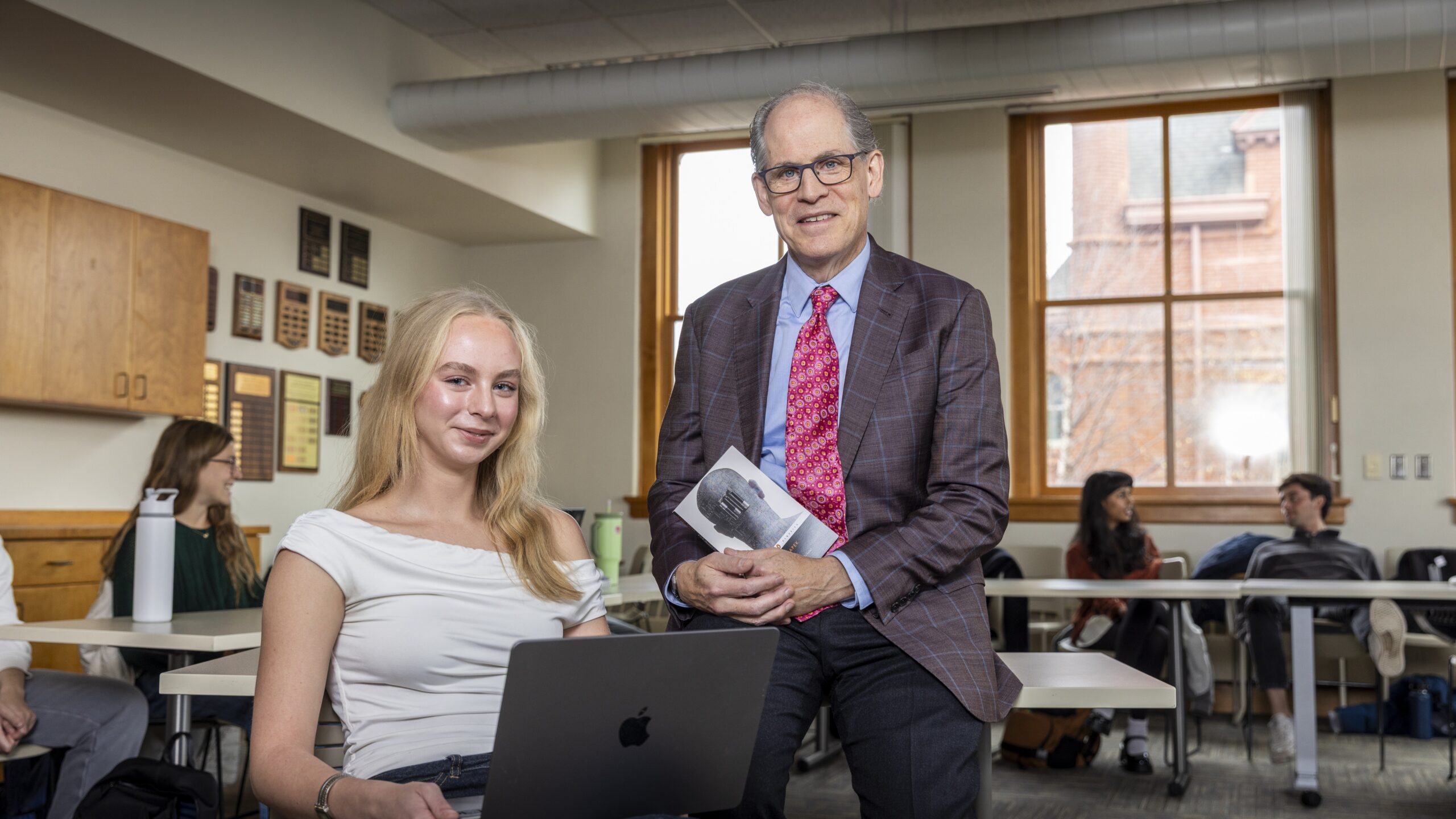
Recently, Moore has been feeling a similar unease about the spread of a new global phenomenon, artificial intelligence. Once again, he endeavored to hash out these ideas in a class he is teaching this semester, Thinking Internationally About (and With) AI and ChatGPT. To assist in the creation of the class, he tapped Ellie Spangler ’26 to co-write the syllabus and precept.
The syllabus explores AI and labor, modern media, academia, and the environmental impacts of data centers. The course grounds contemporary debates in a long history of technological imagination. Students watch Terminator 2 and read the 1920 Czech play Rossum’s Universal Robots, which introduced the word “robot” to the world.
For Moore, one of the most compelling aspects of the course has been watching students collectively build their understanding of AI in real time. With no established canon of scholarship on the subject, and few authoritative academic voices to lean on, the traditional model of a seasoned professor imparting expertise simply doesn’t apply. Instead, the class learns alongside one another, exploring an emerging field as it takes shape.
They’ve even coined a term, “cognitive shirking,” to describe the ways AI can degrade a learning experience when it replaces, rather than supports, meaningful cognitive effort.
“If you use ChatGPT to write your entire essay or generate all of your code for a computer science assignment, you’ve skipped so many steps in the process that you’re not getting much benefit for your cognitive growth,” Spangler explains.
“Because we are all reacting to this as it unfolds, it has flattened the usual classroom dynamic of expert and pupil,” Moore says. “We are engaging with a new field of study as it’s being created.”
This has often led to moments of co-discovery and students being able to make particularly meaningful contributions in class.
Moore and Spangler both say that there is palpable concern in the room during their discussions: for what AI means for the future of labor, human creativity, and the environment. As for higher education, Spangler notes that AI chatbots are “completely engaged with information that is already known and has been fed into the model.” Academia, on the other hand, is “oriented toward what we don’t yet know—and toward creating new ways of understanding the world around us.”