



32nd Annual International Roundtable
Stories and Sanctuary across Disciplines and Other Divides: Belonging and Bridging in Times of Rupture
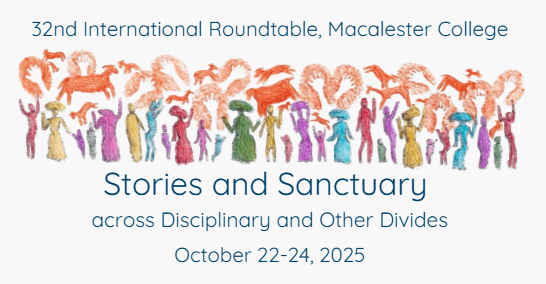
We are all storytellers. We tell stories in our meetings and classrooms, at children’s bedtimes and family gatherings, on mountain hikes and prairie walks. We tell stories to teach morality, to prove a point, to make connections, to pass down cultures, and for countless other reasons. We tell stories with words, images, music and dance; we share tales with codes, formulas, and theories, too.
Storytelling seems universal across cultures. We tend to take it for granted and rarely stop to ask about the what, who, why and how of storytelling. During the 32nd International Roundtable, we will slow down and do some root-seeking about storytelling, especially regarding its connection to sanctuary making.
Most likely, you have heard Chimamanda Ngozi Adichie’s Ted Talk “The Danger of a Single Story.” Perhaps you study literature and have encountered Ursula K. Le Guin’s “The Carrier Bag Theory of Fiction.” Are Le Guin’s feminist “carrier bag” stories inclusive of all that has been left out of the masculine hero stories of the bygone eras? Not necessarily. Just as stories can heal, hearten, and foster a sense of belonging; they can also harm, dishearten, and chillingly exclude, especially in divisive times such as ours. In the art and science of storytelling, contexts matter, audience matters, authorship matters, intention matters, theories of representation matter.
What are your stories? Where do you tell them? To/with whom do you tell them? Who do your stories represent or reflect, consciously or unconsciously? Do/should we tell stories of “us” or “them” in different ways? Are there necessary distinctions between stories meant to promote bonding in our own communities and those meant to bridge estranged communities? How can stories build worlds where “everyone belongs” (john a. powell) when ideological breaking seems inevitable in our societies?
When you hear “once upon a time,” you know what’s coming. If stories are anchored in time, do you tell stories of the past, the present, or the future? Or do you tell of the past that “is yet to come” (Karen Barad) or futures to be remembered? How will stories come to us when we suspend the linear time of modernity?
Storytelling is relevant to all – regardless of our disciplines and occupations. What revelations might surface if we consider research writing as a form of storytelling? Or if we consider storytelling as a form of research and theorizing? A methodology? A form of liberation?
This International Roundtable invites your stories and your musings about stories, whether you tell stories of human relations or of reptilian anatomy, of lions or of dinosaurs, of mitochondria or of galaxies, of ancient cultures or of speculated futures. Can we assemble our multi-species, multi-registered stories to expand and complicate our sanctuary and how we belong?
International Roundtable 2025 Organizing Committee
Hui Wilcox, Dean, Kofi Annan Institute for Global Citizenship
Joëlle Vitiello, Professor & Chair French and Francophone Studies
Lisa McCarthy, Administrative Coordinator, Kofi Annan Institute for Global Citizenship
Sedric McClure, Associate Dean, Kofi Annan Institute for Global Citizenship
Elizabeth Bolsoni, Program Coordinator, Student Research and Creativity
Suzanne Burr, Program Coordinator, Community Engagement Center
Sarah Tolman, Assistant Director of Programming and Assessment, Center for Study Away
Khaldoun Samman, Professor of Sociology and Faculty Associate Dean of the Kofi Annan Institute for Global Citizenship
Alexander Matthews ’28, Geography
Nadia Linoo, Program Coordinator, Kofi Annan Institute for Global Citizenship
Plenary Schedule
Wednesday, October 22nd, 2025 (Alexander G. Hill Ballroom, Kagin Hall)
- 4:45 p.m. – 6:15 p.m. Opening Keynote: Kao Kalia Yang, – Stories in a Time of Disbelieving
Thursday, October 23rd, 2025 (Alexander G. Hill Ballroom, Kagin Hall)
- 11:45 a.m. – 1:15 p.m.
- International Roundtable Panel: Kao Kalia Yang, Morgan Adamson, and Bayo Akomolafe, facilitated by Joelle Vitiello
- 4:45 p.m. – 6:15 p.m. Community Storytelling Event: Human Library
Friday, October 24, 2025 (Markim Hall, Davis Court)
- 2:00 p.m. – 3:00 p.m. Story Circle Reflection + Closing by Dipankar Mukherjee and Meena Natarajan
Student-led Sessions
Wednesday, October 22nd, 2025 (Davis Court, Markim Hall)
- 9:45 a.m. -11:00 a.m. Sow What? Shifting narratives and the power of agricultural education initiatives across continents
- 11:15 a.m. -12:30 p.m. “Active memory:” How survivors of the Pinochet dictatorship honor a history of resistance
- 1:00 p.m.-2:15 p.m. What I Saw is What They Silence: Understanding Zionist Myth Making and Stories from the West Bank
- 2:30 p.m.-3:45 p.m. Being Good Story Listeners: Lessons from Northern Ireland
Thursday, October 23rd, 2025 (Davis Court, Markim Hall)
- 10:30 a.m. -11:45 a.m. Sharing the Impact of Macalester Davis Peace Project: Stories of Peace Building and Reconciliation
- 1:30 p.m. -2:45 p.m. Outliving Apartheid: The Southern African Story
- 3:00 p.m.-4:15 p.m. Siva Samoa: Storytelling Through Dance”
Friday, October 24, 2025 (Davis Court, Markim Hall)
- 9:00 a.m. -10:15 a.m. Guayusa upina: Storytelling as Ritual in the Ecuadorian Amazon.(Guayusa upina: Cuentacuentos como un ritual en la Amazonía ecuatoriana)
- 10:30 a.m. -11:45 a.m. Weaving Stories, Tejiendo Canastas: Co-Creating Art and Myths as Unlearning with the Escuela del Bosque
- 12:00 p.m.-1:15 p.m. Tales Between Species: Sanctuary and Coexistence in Shared Landscape
Pre and Post Event Schedule
Wednesday, October 8th, 2025 (Davis Court, Markim Hall)
- 4:45 p.m. – 6:15 p.m. Embodied Storytelling Workshop for Dialogue across Differences facilitated by Pachaysana
Tuesday, October 21st, 2025 (Davis Court, Markim Hall)
- 11:30 a.m. – 1:00 p.m. Bonded Inheritance: Retelling the Story of Forever Chemical Contamination in the East Metro by Morgan Adamson, Professor of Media and Cultural Studies, KAIGC Faculty Fellow