







For Kirsty Herrera Garcia ’28, the classroom became reality inside the United Nations Security Council Chamber. The political science and Latin American studies major found herself closely watching diplomats debate whether the UN should renew a multinational stabilization force inside Bosnia and Herzegovina.
From her spot in the gallery, Herrera Garcia considered how the actions of these diplomats—how they addressed one another, the relationships formed behind the scenes, and the delivery of public speeches—would impact people around the globe.
“I realized these are people, real-life people that do these important jobs,” she said. “The way they react and act impacts whether these resolutions pass or not, and whether change will follow.”

From the classroom to the Secretariat Building
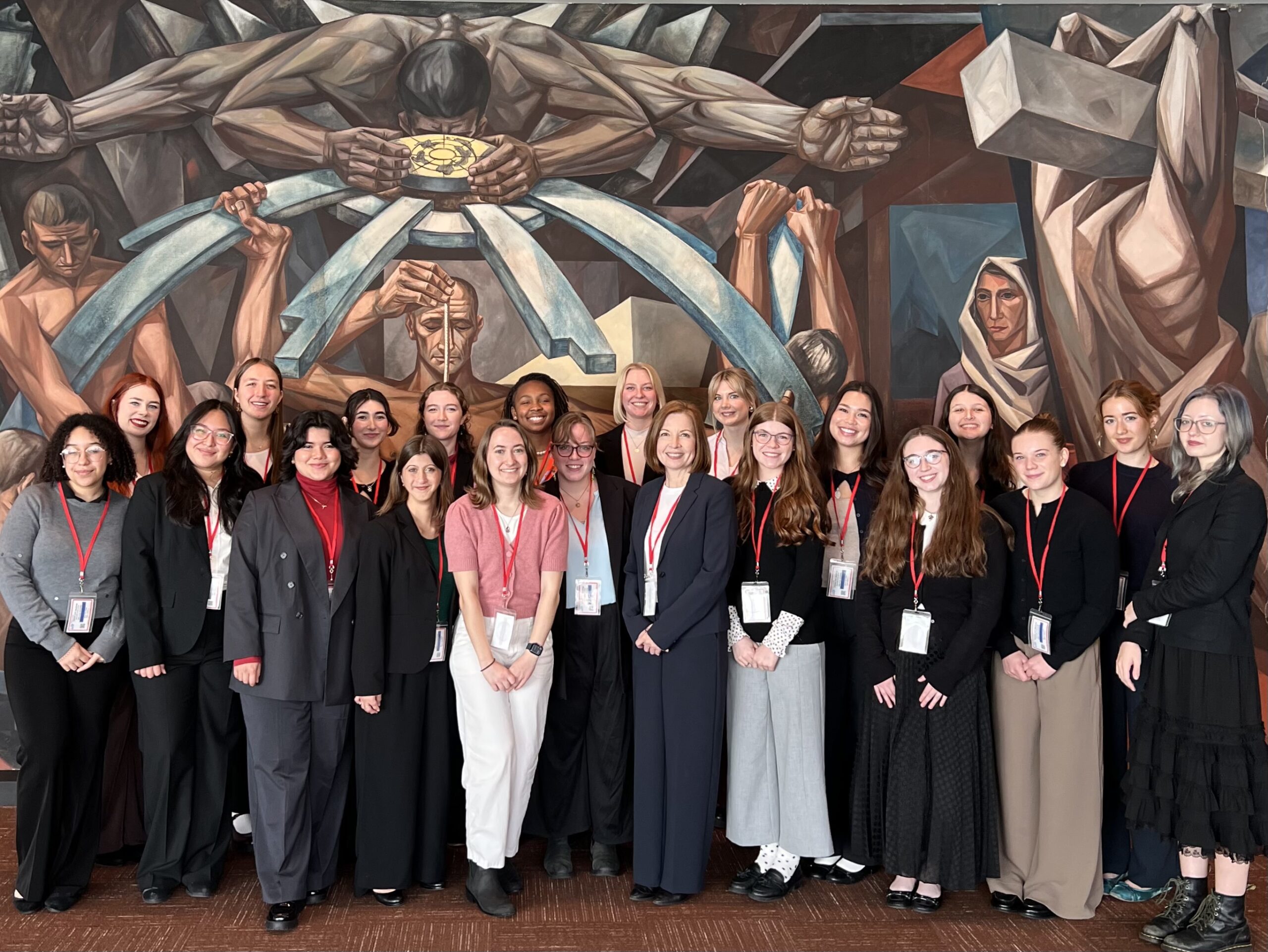
Herrera Garcia was one of twenty students from Macalester College who traveled to New York City in late October for three intensive days at the United Nations. The trip was organized as part of political science professor Wendy Weber’s course titled Women, Peace and Security, which is centered on the United Nation’s Women, Peace and Security Agenda.
The Women, Peace and Security Agenda was launched in 2000 when the UN Security Council first addressed the situation of women and girls in armed conflict and adopted Resolution 1325. The resolution focuses on protecting women and girls from conflict-related violence and ensuring women’s equal participation in conflict prevention, resolution, and peacebuilding. It was followed by nine more resolutions which together make up the Women, Peace and Security Agenda.
Macalester students, who had been studying the complexities of the Women, Peace and Security Agenda for weeks, spent their time in New York behind the scenes in the Secretariat Building meeting with UN experts who work to bring the agenda to life. Representatives from across departments, including peacekeeping, sanctions, genocide prevention, and disarmament, all spent time with Macalester students.
“In the classroom, it’s so easy to say, ‘Let’s do this,’ or let’s fix things ‘this way’,” said Camille Dizon ’28, a biology major. “But it’s just not that simple. This trip really opened my eyes to the things that actually go into the decision-making process.”
Highlights of the trip included meeting with the Senior Women Protection Adviser for Somalia and learning about traditional justice mechanisms. In the evenings, students also attended special events organized as part of the 25th anniversary of Resolution 1325, including a film screening at the Permanent Mission of Germany to the United Nations featuring Ukrainian women survivors of conflict-related sexual violence.
“Our time in New York had such a big impact on students,” Weber said. “Having the opportunity to meet with people who do the work and deal with the issues that we’ve been discussing in the classroom was incredibly meaningful. And spending three days hanging out at the United Nations was just really cool.”
The trip was made possible through the generosity of Macalester alum, Tonderai Chikuhwa ’96, senior policy adviser in the Office of the Special Representative of the Secretary-General on Sexual Violence in Conflict. Chikuhwa was a fellow at Macalester last year and invited Weber to bring Mac students to New York for the 25th anniversary of Resolution 1325. A gift from a donor subsidized and supported the students’ travel.
The challenges of diplomacy
Being onsite at the UN allowed students to turn abstract concepts into deeply human work. After weeks examining the progress, and also the limitations, of the WPS agenda, students got a chance to speak with the officials navigating those limitations.
“It’s so easy to make criticisms when you are out of the field and kind of out of touch with the limitations of the structure of the UN,” Herrera Garcia said. “It really made us think about how to circumvent those limitations, and how these people are trying to make the most out of the least.”
At the UN, the Macalester delegation met with officials navigating budget constraints, limited personnel, and competing political interests and priorities.
“Having the opportunity to see that the people who work on these issues recognize the limitations, but still do the best they can within them—I think that was really important,” Weber said.
Poised to take the reigns
Herrera Garcia found herself particularly moved by a sanctions expert who described her journey from being a UN tour guide to her current senior position. The official emphasized preparation, diplomacy and the importance of being “better than everyone around you.”
“Her speech was really inspiring,” Herrera Garcia said. “It felt like it’s achievable. They trust in students like us to take over, and they see our potential.”
Back in Minnesota, the students continue to process what they learned in New York. At the top of the list: they soon will be charged with making a difference.
“Almost every person we sat down with said, ‘You are going to be making these decisions in the world,'” Dizon said. “It felt good to know that we are believed in by the people that have the power right now.”
