







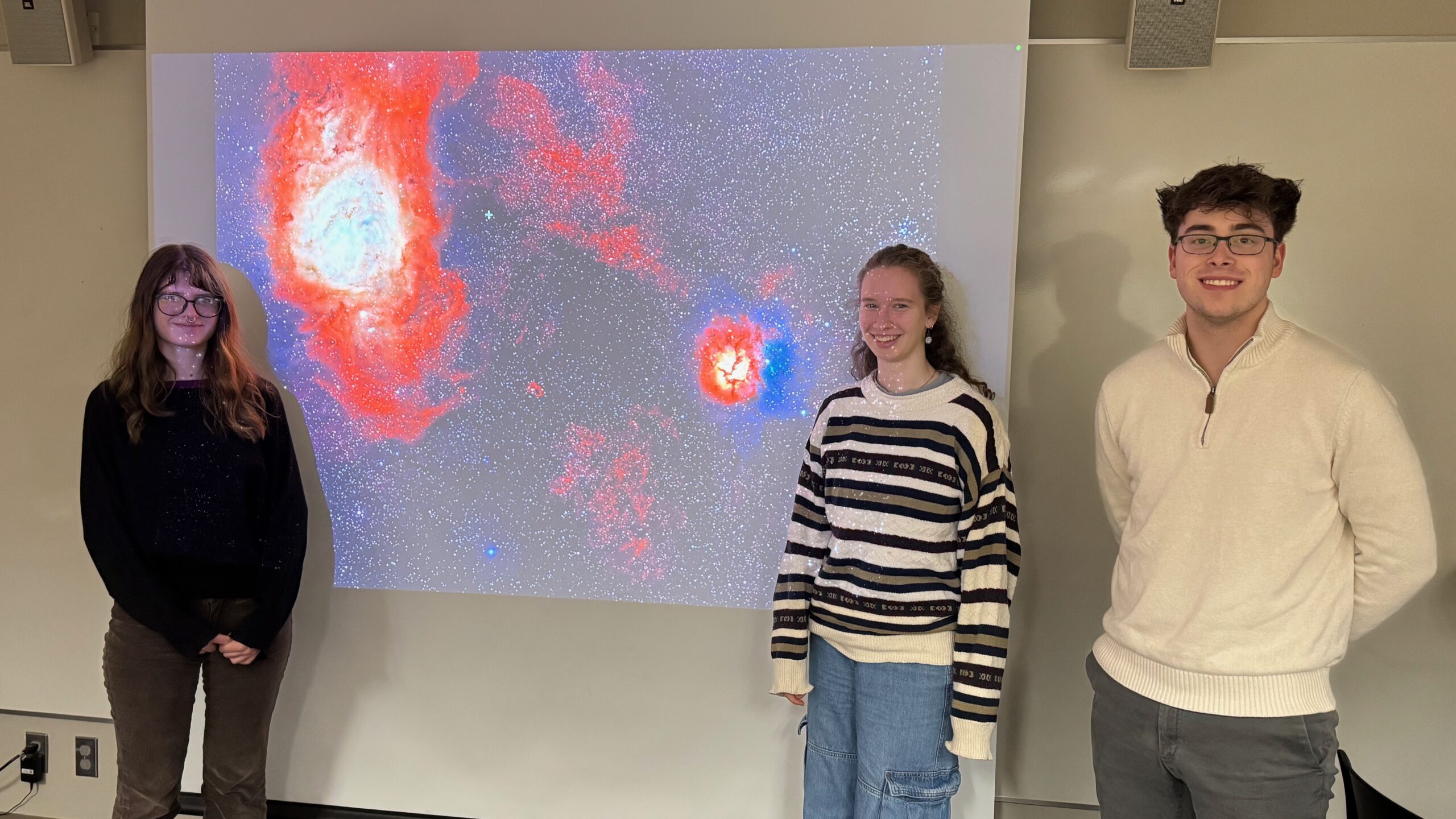
Every Tuesday afternoon this semester, sophomores and juniors from across the Midwest are gathering in an unconventional class that equips them with the skills to become expert users of an advanced robotic telescope. Representing Coe College, Augustana College, Knox College, and Macalester, they’re part of a new inter-institutional course called Macro Preceptor Training.
Professor John Cannon leads the course alongside Dr. David Fowler ’75, an expert astrophotographer. Fowler brings a unique dimension to the class as a dedicated volunteer, generously giving his time to support and mentor students.
We asked Professor Cannon to tell us more about the course—called MPT25 for short—and its impact.
Could you describe the format of this course and explain how it works?
MPT25 is an immersive exposure in astronomical data, instrumentation and techniques. This is an intentionally small class. MPT25 targets current sophomores and junior majors who, once trained as MACRO preceptors, will be able to play leadership roles in the consortium. This will include the unique opportunity to lead long-term research programs that span multiple semesters.
How does this format reshape traditional classroom norms and routines?
This class does not use a textbook. Instead, it instills the necessary skills for students to become expert users of a very complicated robotic observatory. The inter-institutional nature of the class brings individuals together from multiple different campuses. Each of the participants uses an identical computer workstation located in our research lab to ensure a uniform experience.

How have students responded to this learning style?
I’ve received very positive feedback from participants. They have enjoyed learning about the technical aspects. The opportunity to then go to the telescope in Arizona and to connect those concepts to the telescope—and to the sky—is unique. The Arizona night sky is unlike anything most of the participants have ever seen before.
What unique perspectives or skills do students gain from this initiative?
In typical coursework, learning about the telescope’s operation is limited to the most critical and digestible details. In MPT25, the participants are truly getting dirt under their fingernails—it’s a unique opportunity to be able to master astronomical observing techniques using this technology.
What is David Fowler’s role in the course?
Dr. David Fowler ’75 is an expert user of the PixInsight software, a frequent user of the RLMT, and a close collaborator with everyone in MACRO. He is leading the segment of the course in which the PixInsight software is used to create physically meaningful (and beautiful) images of astrophysical systems. The techniques that David is teaching are nearly magical. To see individual images transformed into majestic color mosaics of the night sky is transformational learning.
How does this course advance diversity and accessibility within the field of astronomy education?
This class allows individuals to access major science programs that are simply not possible with on-campus facilities. Further, by training participants from all of the MACRO campuses, we build a foundation of knowledge that will intersect with many other students in the future. Regardless of what capabilities exist on any given MACRO campus, interested and motivated students can benefit from the training that the MPT25 participants receive.