







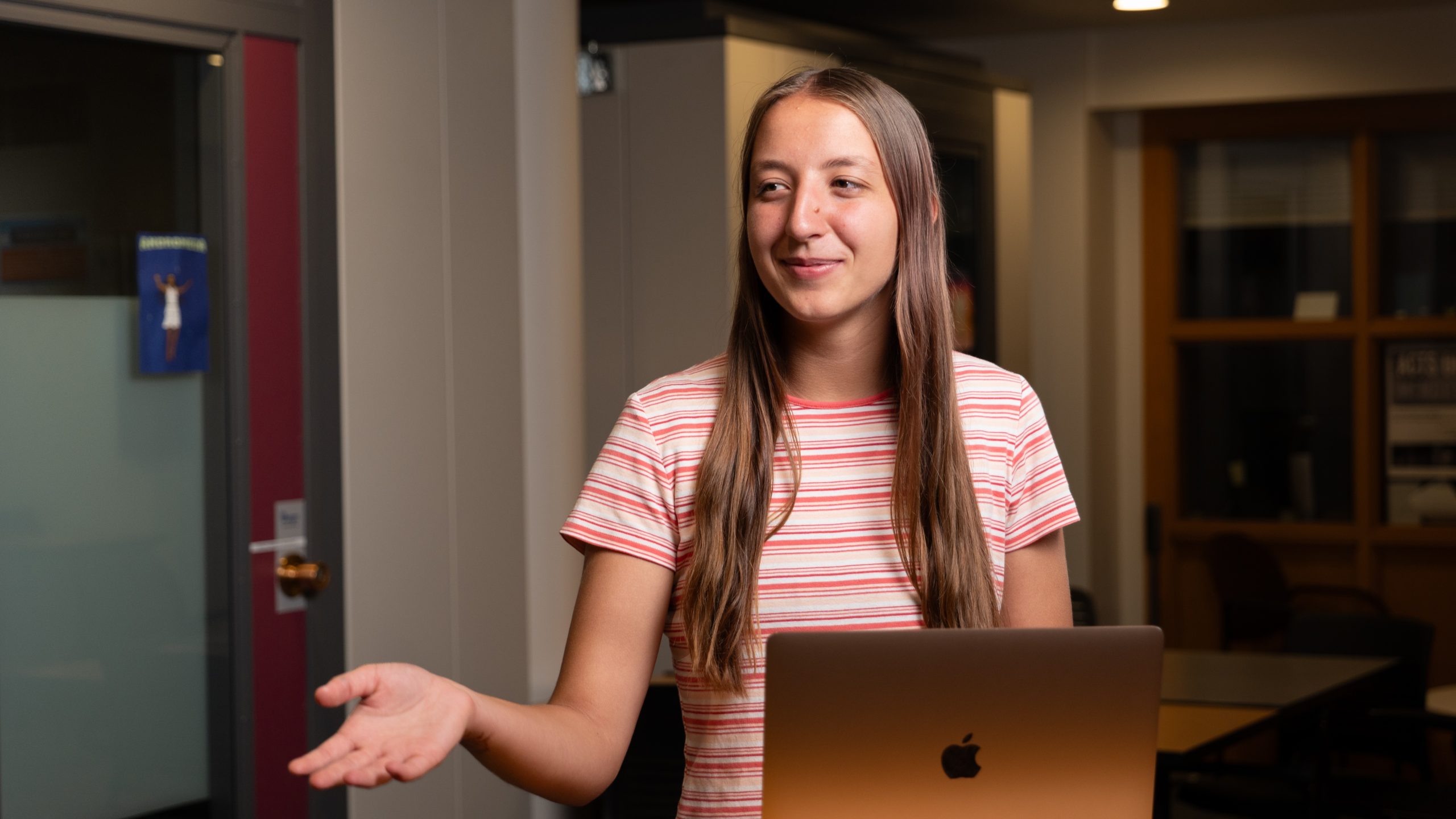
At a St. Paul library this fall, adults will gather to learn how to build websites from scratch. Macalester student Alara Yener ’28 spent the summer thinking through what those learners will need to succeed.
She helped prepare for the third year of a free, eight-week website development workshop for adults. The program introduces participants to HTML, CSS, and JavaScript as they learn to build their own website, often for a new or existing business.
Led by Joslenne Peña, assistant professor of mathematics, statistics, and computer science, the workshop is designed for adults who are not pursuing careers in computer science. It also aims to reach people who have not always felt represented or welcomed in computer science spaces.
“We specifically target populations such as queer and BIPOC people because a lot of the time, classrooms for computer science aren’t necessarily super inclusive,” Yener said. “We intentionally tried to create an inclusive environment.”
A political science and data science major, Yener spent much of the summer laying the groundwork for the workshop. She conducted community outreach, reviewed research on adult computer science education, and visited libraries to find an accessible location. This year’s workshop will be held at George Latimer Central Library in downtown St. Paul.
The library visits became one of her favorite parts of the project. Librarians offered ideas for navigating logistical challenges, including finding spaces open late enough for adults to attend after work.
Yener’s previous experience teaching English learners also shaped how she approached another challenge: participants arrive with varying levels of technology experience.
“Sometimes in past workshops, some people were able to move a lot quicker through things, but then didn’t have anything to do because they were waiting for people who were brand new to technology,” she said.
Yener suggested creating additional curriculum options for participants ready to move ahead.
The project follows a design-based research model, with the workshop adjusted each year based on participant feedback and lessons from previous sessions. Researchers examine participants’ confidence in solving technology-related problems, motivations for enrolling, experiences with technology at work, and plans for using their new skills.
As the project’s only student researcher this summer, Yener worked closely with Peña to explore areas that interested her, including pedagogy and curriculum design.
“She’s very accommodating and says, if there’s something specific in the project that you really want to work on, we can do a deep dive into that,” Yener said. “It was nice to be listened to on a project I care about.”
Generative AI has added another question for the research team: What does it mean to learn coding when AI can produce code from a simple prompt? Yener said the team is exploring how to incorporate AI responsibly while maintaining the workshop’s focus on problem-solving and confidence.
This fall, Yener will continue with the project as a teaching assistant. For her, the workshop’s value goes beyond mastering HTML or JavaScript.
“It doesn’t really matter if you know how to code,” she said. “It’s about how your brain works and how you approach solving problems in a new and different way.”