








Five Takeaways: Congress to Campus
By Catherine Kane ’26
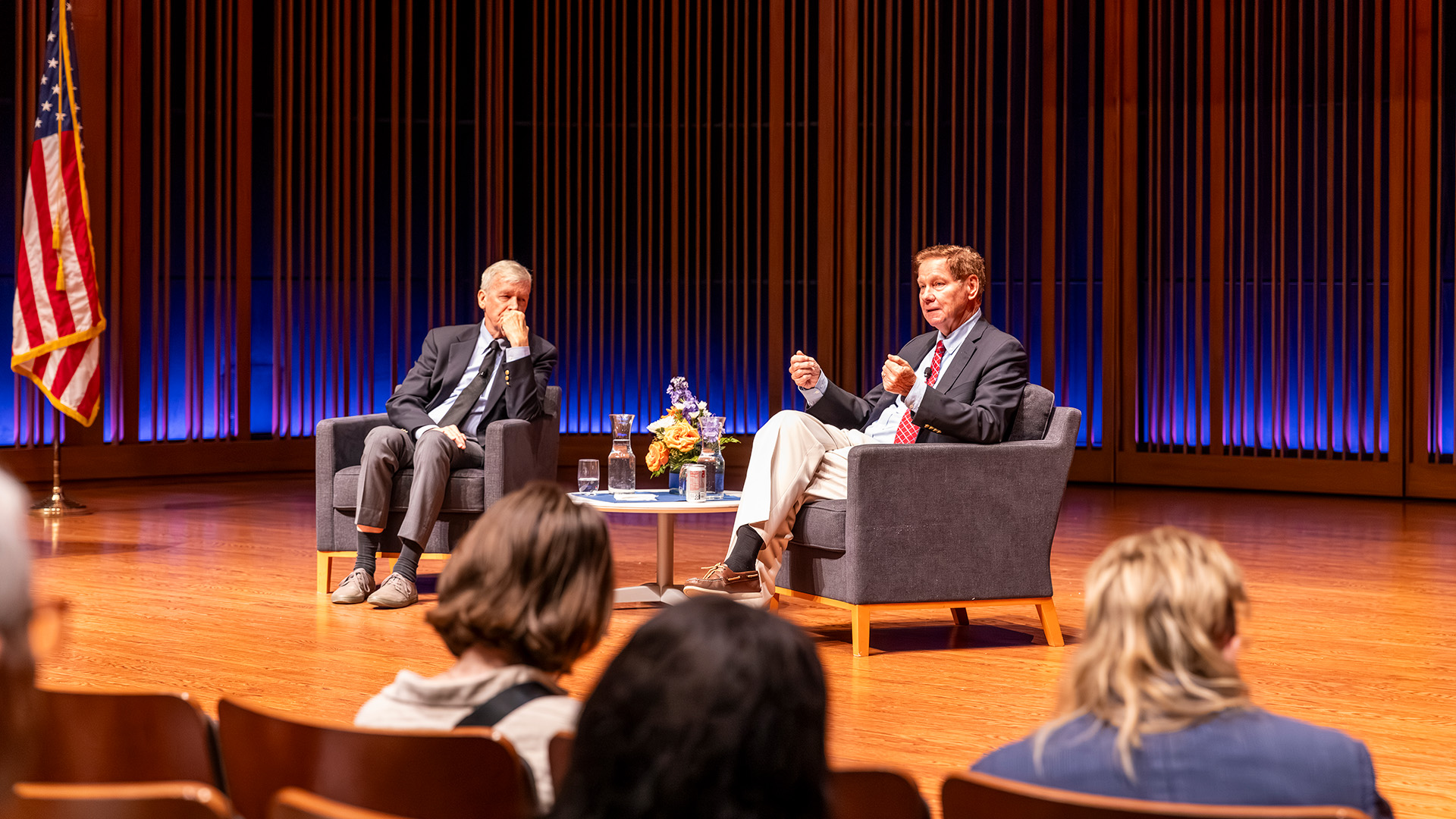
Late September, former US Representatives Tom Davis (R-Va.) and Peter Kostmayer (D-Pa.) visited Macalester for the fourth annual Congress to Campus event, arriving amid a Congressional funding showdown and unprecedented actions by the Trump administration.
Congress to Campus is the flagship program of the Association of Former Members of Congress. For more than forty years, the program has sent former elected leaders to more than 140 colleges and universities to model how to converse across differences and help foster the skills necessary for a thriving democracy.
Representatives Davis and Kostmayer spoke to the Macalester community about the shifting balance of power between the federal government’s executive and legislative branches. Here are five takeaways from their conversation:
Gerrymandering facilitates political polarization
Kostmayer put it bluntly: “You can’t have the politicians doing reapportionment, they just can’t help themselves.” Davis agreed, arguing that it takes “a lot of hubris to look at gerrymandering with a straight face and say it works with democracy.” He suggested that the courts may ultimately need to step in as a more impartial force in drawing congressional districts, but that so far, they have been reluctant. Davis also pointed to gerrymandering as the root of much of the political polarization in Congress today. With few competitive districts, politicians no longer need to appeal to moderate voters, and instead cater to the more extreme elements of their parties.
Restrictions on international students are short sighted
Davis and Kostmayer both criticized the current administration’s efforts to make it more difficult for international students to study at American universities. Davis argued that it is in the United States’ “best interest to try to be a welcoming country” for foreign scholars and innovators. Kostmayer went further, calling the policies “cruel and unproductive,” warning that they jeopardize the global reputation of American higher education as the “envy of the world.”
The current administration’s exercise of executive power is unprecedented
Both Representative Davis and Representative Kostmayer agreed that the Trump administration’s firing of independent members of the Federal Reserve Board of Governors and Federal Trade Commission is unprecedented. Davis noted, however, that many presidents, when faced with resistance from regulators, bureaucrats, and a gridlocked Congress, often become frustrated and push the boundaries of executive power. He gave the examples of President Biden’s attempt to cancel federal student loan debt and President Obama’s DACA executive order. Kostmayer disagreed with Davis’ comparison, calling President Trump’s actions “not comparable to the behavior of his predecessors,” and adding the actions are “very, very dangerous.”
Government shutdowns are risky, political stunts
Davis represented Fairfax County, Virginia, a congressional district with 70,000 federal employees. For him, shutdowns were always off the table. “It doesn’t make any sense to me on a rational basis,” Davis said of congressional Democrats’ plan to block the Republican spending package, “but on a political basis, it doesn’t make any sense not to do it.” Kostmayer characterized shutdowns as a maneuver for the parties to “make their points, make their arguments and stare each other down,” but ultimately comes at a “very high price.”
Change happens at the ballot box
“The way to fix things is at the ballot box,” Kostmayer said. “Those are the facts, ladies and gentlemen: we aren’t going to have a change in this country until we have new people in charge of making policy.”