








Macathon 2025 once again transformed campus into a hub of rapid innovation on November 7–8. For twenty-four hours, students worked through the night—whiteboards filling, laptops glowing, and teams huddling around last-minute prototypes—as they raced to identify real-world problems and build solutions that matter. Teams are paired with alumni judges to fine-tune their ideas. After the twenty-four hours are up, they have seven minutes to present their concept to the judging panel. The three highest scoring teams are rewarded with cash prizes.
Judge Peter Pascale ’94 kicked off the event with a challenge that set the tone: “Fall in love with the problem, not the solution.” With that, teams dove into their work, supported by alumni mentors before stepping onto the stage for their seven-minute pitch (introduced by a drumroll, of course).
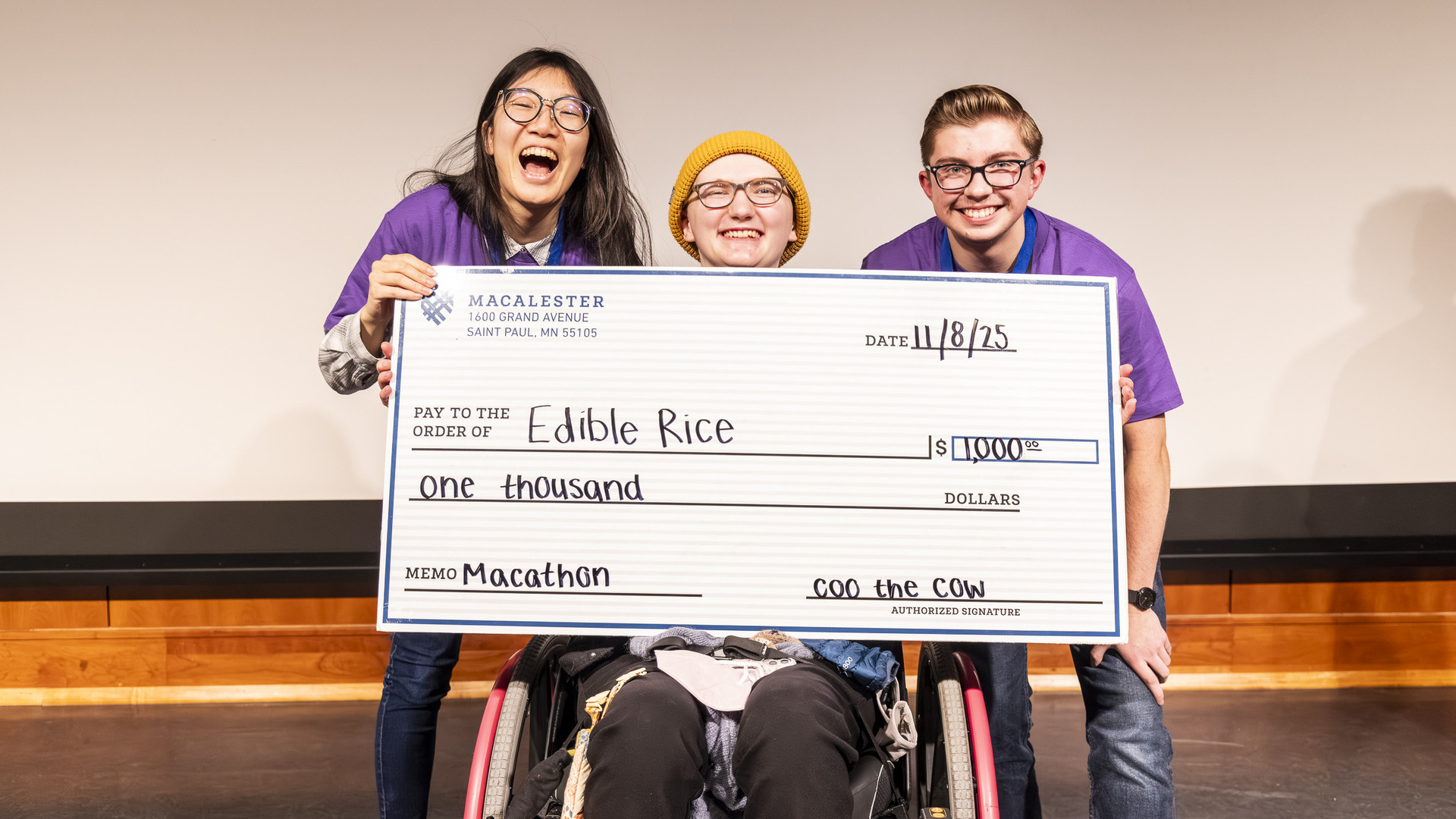
In first place, winning $1,000: Edible Rice (Evvie Bond ’26, Shelly Bai ’26, Toby Hibbard ’27)
Edible Rice took first place with “Toasty Tubes,” an insulated medical tube designed to prevent feeding tubes from freezing—an everyday issue for the three million people who rely on them. Their design uses insulated wiring wrapped around tubing, offering a practical fix that can be adapted for multiple medical devices.
In second place, winning $750: Jeet’s Jesters (Bruno Guiduli ’26, Eric Wentz ’26, Martin Bernsten ’26, Theo Darci-Maher ’27, Sanjeet Devidayal ’26, Ethen Kantu ’26)
Jeet’s Jesters placed second with a project focused on improving the way waste facilities sort materials. They built an AI tool that uses a YOLOv8 computer vision model—trained on a little over 600 images—to spot valuable items moving along a conveyor belt and point them out to human sorters. Their goal wasn’t to replace people, but to make their jobs easier. The team also designed the system so it could be added to existing facilities without major costs or long installation times.
In third place winning $500: Salchipapa (William Acosta Lora ’27, Berni Perez de Nucci ’28, Karla Martinez ’27, Patrica Escobar ’28, Nayla Trigueros ’28)
Salchipapa took third place for addressing bias in pulse oximeters. These devices often overestimate blood oxygen levels in people with high melanin, which can hide signs of hypoxemia. The team created a recalibration model that makes readings more accurate, resulting in a bias improvement of 51 percent for people with darker skin tones. Their work pushes toward making common medical tools more reliable for everyone.
Also included in the award lineup is the Dave Mao Keeping It Real Award for representing the spirit of the event—playfulness, joy, and possibility. Team Musasabi (Jill Chung ’28, Yaoki Kitahara ’28, Hazel Huang ’29, Tenzin Bhutia ’28, Eddie Piao ’28) took home this prize. A special thank you to Dave’s family for setting up this fund to continue his dedication to Macathon students.

As the event wrapped up, judges encouraged students to keep going. “Please don’t stop with your ideas—they’re exactly what our world needs right now,” said Vice President of Student Affairs Kathryn Kay Coquemont.
