







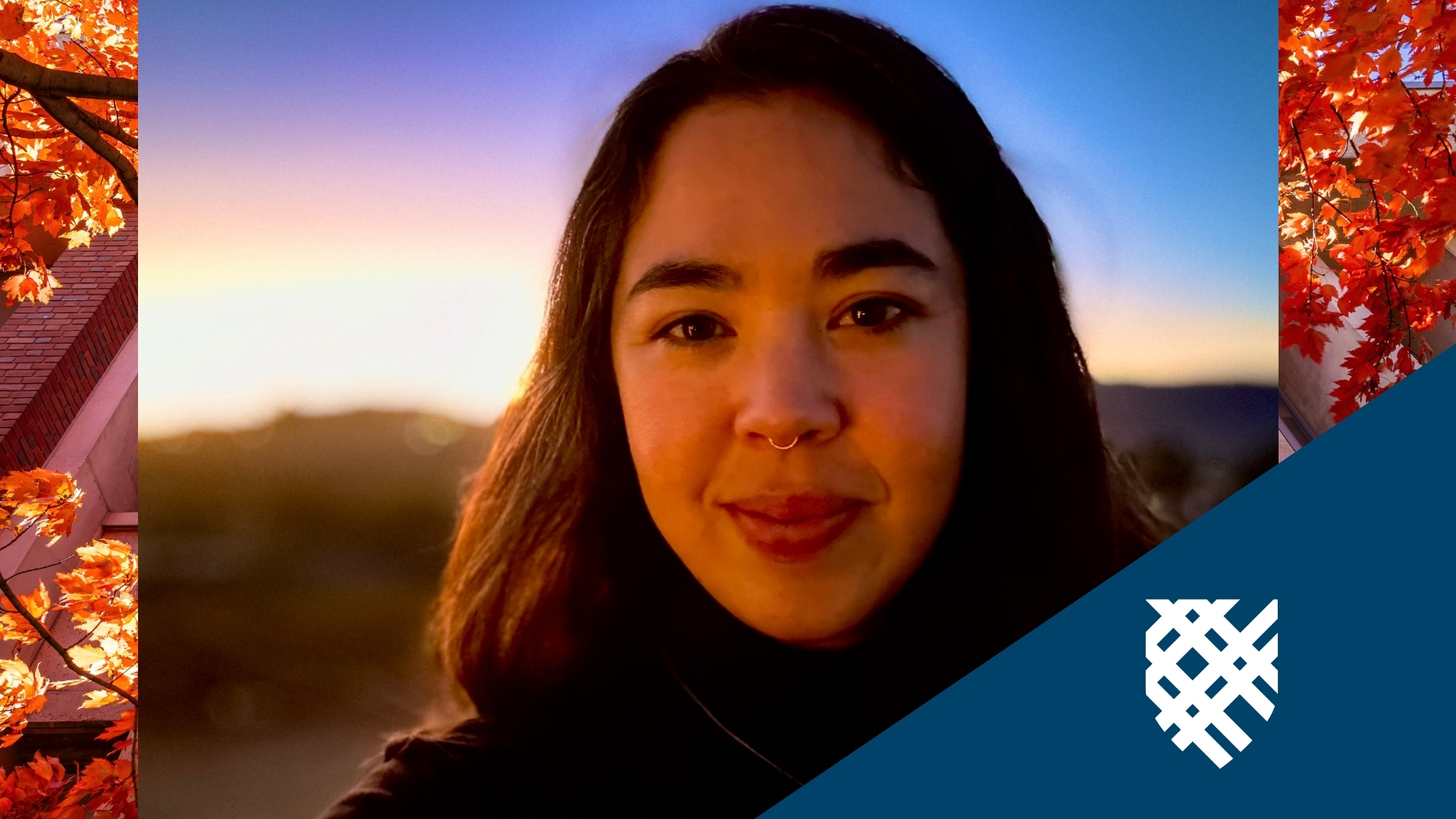
This year’s celebration includes the annual Lavender Community Luncheon featuring Eiko Mizushima ’10 (she/they), a trauma-informed occupational therapist, somatic experiencing practitioner, and interdisciplinary artist based in Minneapolis. Ahead of their visit to campus, we sat down with Mizushima to talk about how their student experiences and identities helped shape their path toward a career centering therapy and somatic practices for queer, trans, gender-nonconforming, and other marginalized communities.
You work across many disciplines—therapy, art, and social justice. Why approach healing in this interdisciplinary way?
The world has many different faces to it. And so, for me, it’s important to be able to look at the world through different angles: sometimes that means helping people with doing things, sometimes that means helping people feel things, and sometimes that means leaning into our social circles and figuring out how to repair conflict when it happens. At the root of all these different modalities, I’m always keeping my eye on liberation and what is possible when we don’t feel trapped by despair—how to help people feel that in an embodied way, not just in an intellectual way. I often tell folks, when you are feeling oppressed or trapped in your own body, you’re not the only one feeling that way, and that is what connects us to other people. So a lot of my work is taking what feels very personal, and helping to expand it in this liberatory way to oppression that we’re all facing.
Your therapy practice also puts value on healing through art and play, while connecting to nature. What inspired those connections?
I started as a biology major at Macalester, and I really enjoyed being outside. For me, being outside was one of the most healing things—a place where I got to feel the most myself. I also had been considering pre-med at the time, so I liked the idea of helping people heal through nature. As I went along that journey, I found that different disciplines, some were more or less supportive of being able to be more creative and be more playful. I do think that play is the best way to learn and to heal. I also found that certain environments were more supportive of me as an Asian person and as a queer person, which led me to more social justice movements. For me, healing requires that we be in right relationship with land, and that also means being in solidarity with the people of this land, or understanding the lands you come from if you’re not from here.
How do your own communities inform how you approach this work?
I see the body as a fine-tuned instrument that is sensing into the world. We are living in soil that is rich and full of different bacteria or water or fungus, and as different people in our communities, we’re all experiencing different things. I get to use my body to sense into what’s happening for others, and there are moments when all of a sudden you realize we’re all experiencing similar things. Being able to listen deeply to the echoes of what’s going on in different communities and then being able to follow those threads, bring them back in—I use that as a guide for the medicine that is most needed in the moment.
How do you sustain your own self as you work to heal others?
I have to keep remembering to love myself, that I deserve love, just like I want for everyone else. There’s also a certain amount of care and gentleness: taking myself outside on walks, and giving myself time to look and be with the world. This allows me to continue expanding into myself as a human that is changing and growing, just as much as I was in college. I continue to have these benchmark moments in my life where I need to expand and learn something new, or give myself different nutrients that I didn’t need before.
Was there a mentor, class, or moment at Macalester that particularly shaped your journey into this space?
BIPOC and queer mentors at Mac, be them staff or professors, were really, really helpful to have in my life, both in introducing me to queer theory, and introducing me to systemic racism as an intentional thing and not an accidental thing. I took a workshop with Alina Wong and Seungmi Laura Cho, who were both working in Student Life at the time. I took a class on transnational adoption, which really helped to connect for me, classism and Orientalism, with white supremacy in the US. A Queer Theories class was really validating when I was trying to discern who I was and words to use for myself. It’s exactly what I needed at the time, because I was really feeling like I didn’t belong or fit in. Those books, those people, those professors made me be like, ‘nope,’ this is exactly how you belong in this space and in these histories.
For current Mac students who identify as queer or LGBTQIA2S+, what advice would you offer them?
Being queer and gender nonconforming is the best thing that’s ever happened to me. But at the time, when I realized I was queer, ‘oh no’ was how I was feeling, because I was so afraid of being queer and the consequences. I didn’t really have examples of people in my life who I knew of who were queer and who were living life in a way that looked wonderful, or who looked like me. And so I just want to say that, being queer, being gender nonconforming has been just the best thing that’s ever happened. And I would say that whatever you’re afraid of oftentimes is the medicine that you most need. And so, just try to build a little safer relationship with fear, and treat fear as a flag to look at with curiosity and with lovingness.
Continue the Conversation
LGBTQIA2S+ History Month continues throughout October, with events and programming hosted by Institutional Equity and partners across campus. Check out the calendar.