



Paths Back to Poetry: Literary Salon with Ashley Wynter
By Peyton Williamson ’27

For its first Literary Salon of the semester, the English and Creative Writing department warmly welcomed poet and editor Ashley Wynter for an afternoon of conversation, reading, and writing, hosted by Professor Michael Prior. The event offered students the chance to get an insight into Wynter’s creative work and process, as well as her career as a poetry editor at Copper Canyon Press, one of the nation’s oldest independent literary presses.
Wynter described writing as her “first love,” though her path back to it was anything but direct. After being discouraged from poetry in high school, she set it aside and pursued conservation biology in college, only to realize she hated it. Her passion for writing resurfaced when she worked on a campus newspaper and at a few internships in journalism and communications, although she noted that while she enjoyed the writing aspect, she realized that that type of work wasn’t for her. Eventually, she enrolled in a Master of Fine Arts (MFA) program in fiction at Minnesota State University, Mankato. Because Mankato’s program required writing across multiple genres, she was able to rediscover her love for poetry on her own terms, even within a fiction program.
As an editor now, Wynter approaches manuscripts with care and curiosity. Her goal is not to “change the book” but to understand “the fabric of the language” and suggest revisions that remain true to the poet’s voice.
One of the first questions students asked her was how their coursework at Macalester could prepare them for roles like hers. Wynter pointed out the importance of close reading and analyzing language. Understanding syntax, structure, and tone—skills which are all developed in literature and creative writing courses—translates directly into editorial work. For those interested in publishing, she encouraged persistence: apply widely, apply again, and ask for feedback when possible.
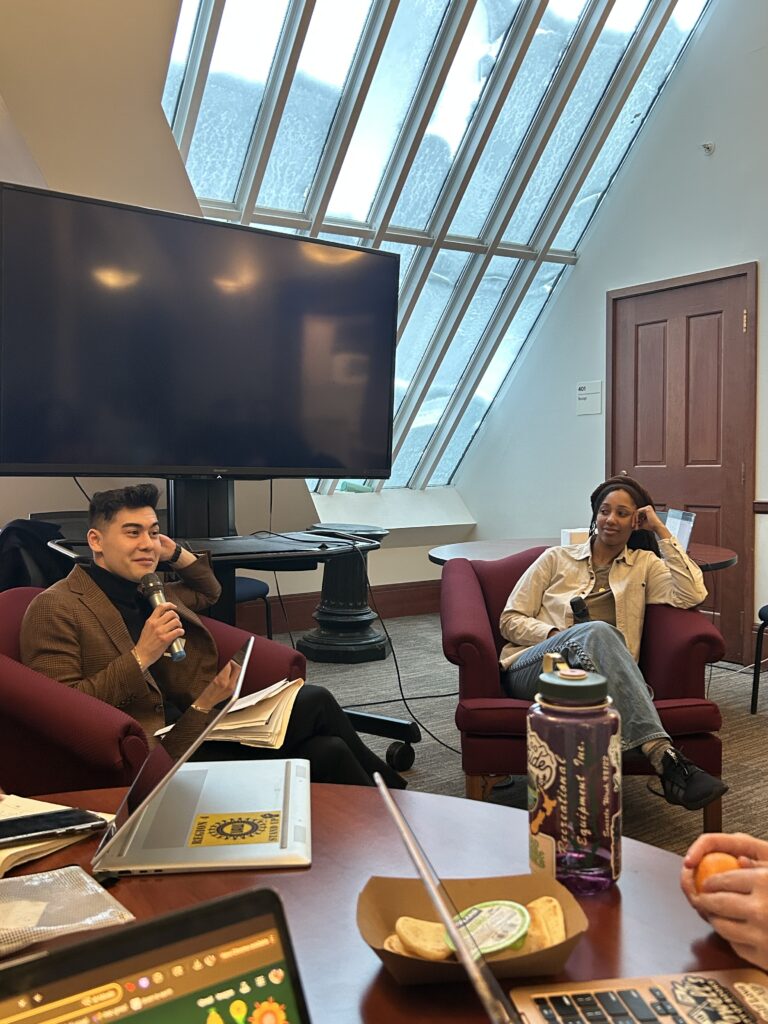
“It’s never personal, so take advantage of all opportunities,” she said. She also emphasized that many places don’t necessarily look for students who are “right in line” with the job’s description; she got her fellowship because her experience in arts programming, running the creative nonfiction section of her undergraduate newsletter, and working at the literary magazine in her MFA program all combined to make her well-rounded.
After the Q&A portion, Wynter graciously shared some of her new work as part of her in-progress manuscript, tentatively titled “The Architect of Forgetting.” The collection explores the body as a site of trauma and resilience and the unstable relationship between truth and memory. Many of the poems are sonnets, including several arranged in crowns—a sequence of interconnected sonnets often revolving around a single theme—a form she found unexpectedly generative. “If I gave myself so many limitations, I’d actually write faster,” she said.
The evening concluded with a brief writing activity inspired by Terry Tempest Williams’ “Why I Write,” which Wynter says she returns to often to stay grounded in her work. She says she likes to view the essay as a reminder that in a world driven by profit, creative work can still be an act of devotion.
The English and Creative Writing department would like to thank Ashley Wynter for taking the time to chat with us. It was a great night for everyone involved!