



“Macbeth” at the Guthrie with Prof. Matt Burgess and Co
By Daniel Graham ’26
As spring’s early arrival brought sunlight to the Twin Cities, Professor Matt Burgess decided to cast some darkness on his International Storytelling class. On Saturday, March 7th, Prof. Burgess’s class took a trip to downtown Minneapolis to see a matinee showing of William Shakespeare’s Macbeth at the Guthrie Theater.
Prof. Burgess devised the International Storytelling class years ago in response to student requests to read more international literature. He wanted to offer those students a new lens for their writing.
“I think sometimes when we take creative writing classes, it seems that there’s like rules to do things,” Prof. Burgess said. “And this class offers an opportunity to interrogate some of those rules [and] power structures behind some of those assumptions we make about storytelling in an attempt to be more aware of what we’re doing. [We can] broaden our understanding of the ways in which literature can talk to people across space and time.”
Macbeth allowed Prof. Burgess to explore these ideas while taking advantage of the Twin Cities community. The Guthrie has an extensive history of excellent Shakespearean productions, and this one was no exception.
“A lot of times I’m watching Shakespeare, and I don’t really know what’s going on — and I’m a college professor,” Prof. Burgess said. “But some actors are able to say the lines [in a way that] you can completely follow. It’s like a magic trick. And the folks in this production were really good at that … and because [its plot has so much causality], for me, it’s a play that’s easier to keep in my brain while I’m watching. So, it was a lot of fun.”
The class paired the Scottish Play with a screening of Akira Kurosawa’s 1957 film Throne of Blood, a samurai adaptation of the production.
“[Kurosawa] uses some of the principles of cinema and Noh Theater to talk about this Shakespearean drama in ways that are sort of perfectly aligned with what we’re trying to do as a class,” Prof. Burgess said. “[The movie helped] broaden our ideas of storytelling and the ways in which times and culture affect all that.”
Prof. Burgess most enjoyed the play’s brief runtime — it’s the shortest of Shakespeare’s tragedies.
“I loved that there was no intermission and that it was like two hours,” Prof. Burgess said, “because I have to go to the bathroom a lot. So that was great.”
He specified that he still had to go to the bathroom during the play: “That’s why I was glad when it was over.”
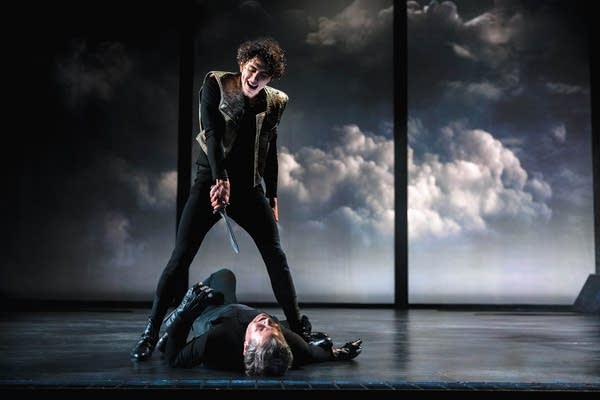
In the Guthrie’s production, Daniel José Molina has a delightful descent into madness in the titular role and a spectacular delivery of Macbeth’s “Tomorrow, and tomorrow, and tomorrow” soliloquy.
“It was weird watching a Macbeth who was younger than I am,” Prof. Burgess said. “I felt strange about that, but it made sense [for a play about] peak ambition. And for this guy, I like that he looked like Timothée Chalamet.”
The production had a lot of other things to like, too: Meghan Kreidler plays a masterful Lady Macbeth alongside him. Scenic designer Riccardo Hernández’s stripped-down set allows those tragic performances to pop. Costume designer Judith Dolan’s outfits mix futuristic and vintage silhouettes. Joe Dowling (who served as the Guthrie’s artistic director for 20 years) brings the whole production together with his expertise.
The International Storytelling class is one of many ways that students can learn about other modes of storytelling through the English and Creative Writing department. Every semester, the department offers classes across genres, eras, and disciplines that invite students to think in new ways.
“If students are interested in learning more about Shakespeare, I encourage them to take Professor Penelope Geng’s courses,” Prof. Burgess said. “And if students are interested in the ways in which stories talk to each other across time, I encourage students to embrace the historical periods we [teach] here to enrich their understanding of literature and their own writing.”