



MacSlams preps for Midwest Poetry Mash-Up at Coffee House
By Callisto Martinez ’26
For members of Macalester’s competitive slam poetry team, MacSlams, the transition from April to May brings much more than the lead-up to summer break, finals stressors, and last-minute study sessions. From April 30th – May 2nd, the five-poet team will perform the work they’ve been polishing since January at the annual Midwest Poetry Mash-Up, which brings poets from across the globe together in Minneapolis for three days of competition.
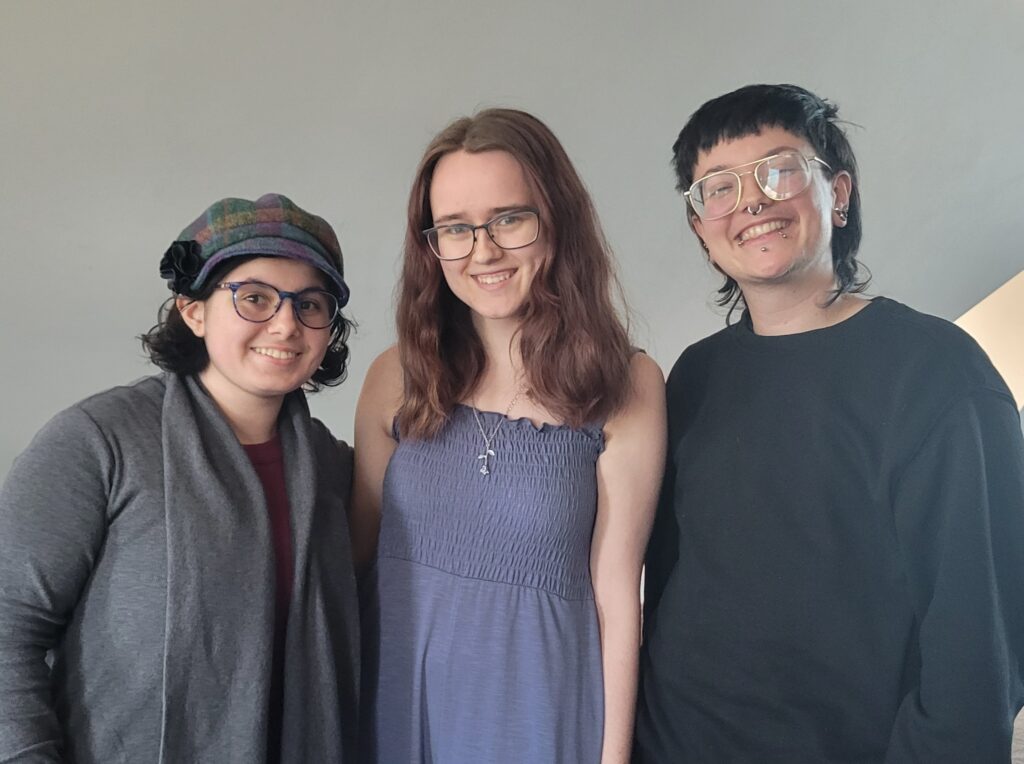
This year’s teams will go head to head at the Phoenix Theater in Minneapolis; tickets are still available for purchase online. Coached by alumni Ollie Schminkey ’16 and Natalie Kaplan ’16, this year’s team features returning member Zari Baker ’27 and new members Avery Sinclair ’26, Riley Gaikowski ’29, Andrew Fleming ’29, and Shoshana Castro-Root ’29. At the competition, Schminkey will wear two hats: MacSlams coach and Midwest Poetry Mash-Up founder.
With MacSlams’ three-year winning streak at the Midwest Poetry Mash-Up, practice opportunities are of the essence. On April 15th, the English and Creative Writing Department’s weekly Coffee House served as another opportunity for the team to perform in front of an audience. Before the Open Mic kicked off, MacSlams invigorated the crowd with a sneak peek of what they’ll perform at the mash-up.
The Words sat down with Avery to find out more about the team’s other methods for preparation, and how the slam poetry community here at Macalester fits into the greater picture.
The road to competition is long, and complete with plenty of stops around other Twin Cities-based slam groups along the way, according to Avery. In addition to performing at monthly slams at Macalester, the team also performs at the BuckSlam poetry slam, which is open to anyone who wants to perform and will hold its next slam on Wednesday, May 13th, at Yellowbird Coffee Bar in Minneapolis. One of MacSlams’ alums and an English major, Anna Šverclová ’23, is also a co-founder of BuckSlam!
“The BuckSlam community, and the MacSlams community are very connected,” Avery said. “… We usually have MacSlams people there, either performing or just being in the crowd and having a little cheering section. And a lot of times we’ll invite BuckSlam people to come to the slams [at Mac], to be in the audience or be sacrificial poets [who start the night with a score, but do not compete]. It’s been a really great way for people to be making that poetry community in the broader Twin Cities.”
For Avery, performing at BuckSlam brings a different sense of community than performing at MacSlams events — and it’s certainly not caused by the whopping $1 cash prize for winning BuckSlam.
“Sometimes it’s easier to share vulnerable pieces, which a lot of slam poetry is, with a crowd of mostly strangers,” Avery said. “Here, it’s a crowd of all students. It can be really great to have that community and [know] each other, and [to have] a lot of shared experiences, but it can also be really nerve-wracking to share the sensitive content in our poems with an audience that we’re then going to see in class the next week.”
With monthly performances through both MacSlams and BuckSlam, it’s hard to believe the team finds time for biweekly practices. Still, the team meets with Schminkey and Kaplan for content edits at the beginning of the semester and performance-based edits, as the mash-up draws nearer. The team’s collaborative editing process fosters experimentation while also emphasizing the fragile line between the emotion and tension that keeps audience members engaged and the poetic tools that get audience members asking questions.
“I don’t always agree with the feedback that I get from my poems, but there is a lot of emphasis on trying it anyway,” Avery said. “You can always go back to your previous draft, if that’s what’s working.”
Both MacSlams and the greater slam poetry community carry a vested interest in the political and interpersonal nature of poetry. This is what makes slams offer more than the two minutes a poet spends on stage, for poets and audience members alike. For Avery, and many other slam poets, that space is irreplaceable.
“I think there’s so many horrible things happening in the world, and also in the Twin Cities, and also in a lot of our personal lives,” Avery said. “Poetry gives us new ways to talk about that. I think it’s a good space for catharsis and holding a lot of different emotions that aren’t usually that aren’t always given space, whether it’s because they’re so uncomfortable or because they usually get shut down.”