



New Books from our Professors Daylanne English and Peter Bognanni
by Jizelle Villegas
On the first day of April at our Literary Salon, Professors Daylanne English and Peter Bognanni shared with us the upcoming book projects that they’ve been working on for the past couple of years.
Prof. English shared her new book, Soul Sounds: The Afterlife in African American Literature and Music. It examines 19th century spiritual novels, speculative fiction, and contemporary hip hop artists. An art piece by her favorite artist, Jack Whitten, is on the cover of the book. Throughout the book process, connections became a recurring theme, one surprising connection being that the artist behind her book cover and her advisor for the book are from the same place: Bessemer, Alabama.
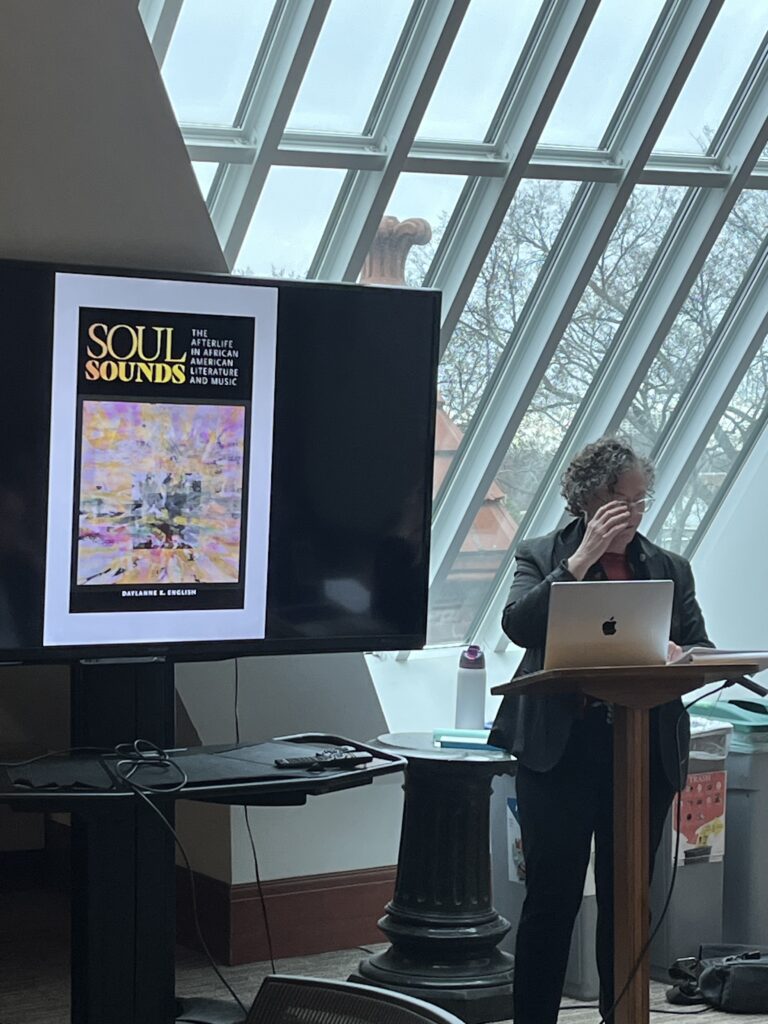
This project has origins from 10 years ago, when Prof. English was on a sabbatical. She had been working on a project on Afrouturism, but it didn’t work out as she wanted it to because the server she worked on had crashed, and along with it went her work.
Despite that, she came back to her work with Afrofuturism and thinking about the afterlife, and how they’re connected. “The afterlife is a future,” she began, but added that “Well it’s actually not just in the future, it’s eternal. So it’s in the past, it’s in the future, but it’s also right next to us all the time.”
Prof. English’s research in this book pushes back on Afro-Pessimist thought, especially how Afropessimist scholar Saidiya Hartman uses the term afterlife to refer to a legacy of pain. She said she has “beef” with the concept. “I should stop listening to Kendrick Lamar,” she joked with us about using the term beef.
Other pertinent connections she made with the work in Soul Sounds feel similar to the ICE occupation we witnessed (and its lasting effects) in the Twin Cities.
She said, “I want to suggest that the ICE occupation itself functions as a kind of pandemic, like Covid, but an unnatural one that’s spread through communities, violently targeting people of color and poorer, otherwise marginalized people.”
She finds power in speculative fiction texts, and her research allows for solidarity to be imagined through the genre, even while it can represent real life and inspire real activism.
To end her book talk, Prof. English asked us, “How about Black joy? How about Black resistance?” This is what her new book is all about: how joy can be within the afterlife even despite all the hardship of life, which pushes back on Afro-pessimism.
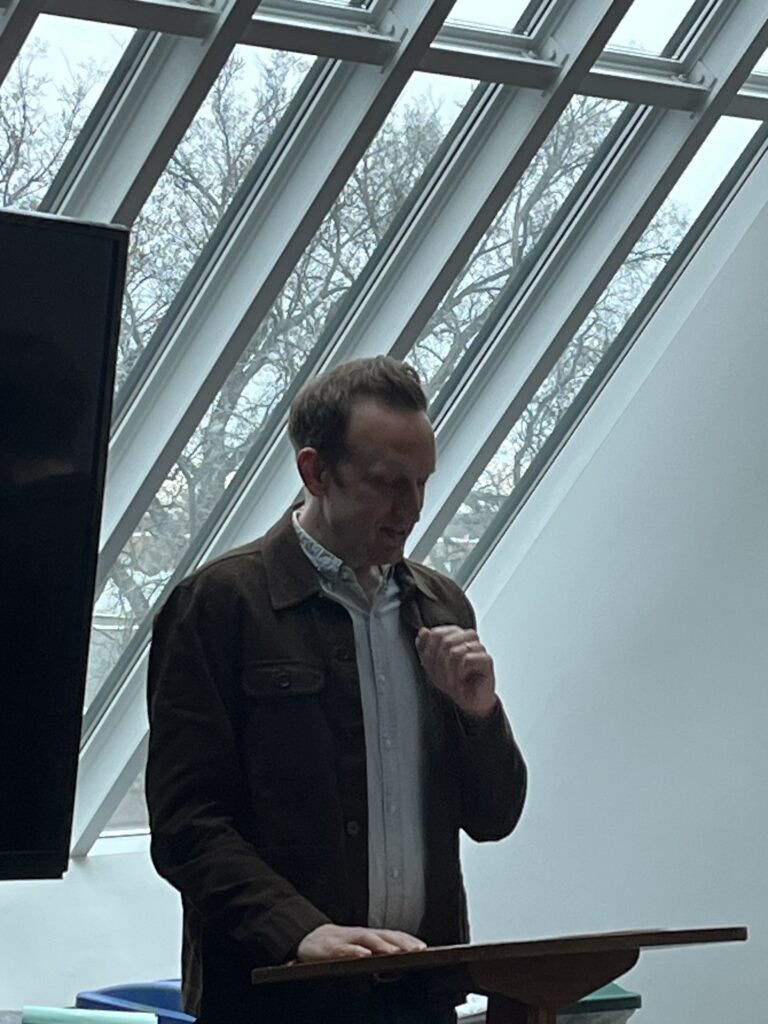
Prof. Bognanni’s new book, How to Lose Yourself Completely, is coming out in June. There will be a launch party at Red Balloon on June 3rd, so if you’re in the area and want to celebrate the release, you should go! We will also be hosting a book launch next semester, so if you’re on campus, you should also come to that.
He told us about the power of young adult fiction, which is the genre he writes in the most now. “What was the book I really wished I had?” he posed to us as he explained the novel’s background.
His book is about a young adult, Case, who struggles with mental health after his brother passes away and decides to go to an adventure therapy program with other young adults with mental health struggles. Something bad happens to their program leader, and the kids have to figure out how to care for themselves alone.
His inspiration for the novel was deeply personal to him: he was also a young teen who struggled with anxiety. His trajectory into young adult novels started about seven or eight years ago, and “by accident.” He and the audience laughed at that.
“There is something about falling in love with a book and seeing yourself in a book that can be particularly life changing,” Prof. Bognanni said.
For research, he called up a former classmate and Mac grad who works as a wilderness therapist to get intel on how it all works. “Tell me all about this, and I’ll name a character after you in the book. And so the love interest is named Diana,” he told us.
The theme is interesting, but that’s not the only interesting aspect about the book. Because of Prof. Bognanni’s love for “Choose-Your-Own-Adventure” books as a young boy, the novel has an inverted first person perspective through the second person narrative. The “You” acts as an “I.” His choice in writing like this, along with being a big perspective writer, is that anxiety causes people to sometimes feel dissociated, as though they’re watching life from a distance.
After he provided us with background, he read the opening chapter aloud to us. A lot of laughs were shared among the audience.
We would like to thank professors Daylanne and Peter for taking the time to share their new projects. We look forward to displaying them in our Nook and for y’all to read them whenever they become available.