



Ollie Schminkey ’16 talks poetry and community in “Land of 10,000 Lakes”
By Callisto Martinez ’26
For Mac alum and slam poet Ollie Schminkey ’16, a poem’s purpose stretches beyond the page. Author of two poetry collections, Dead Dad Jokes (2021) and Where I Dry The Flowers (2024), Schminkey’s poetry intricately draws out political and social issues within personal relationships. During their time at Macalester, Schminkey was a member of the MacSlams competitive slam poetry team. Some of their poems from tournaments have accrued over 100,000 views on YouTube.
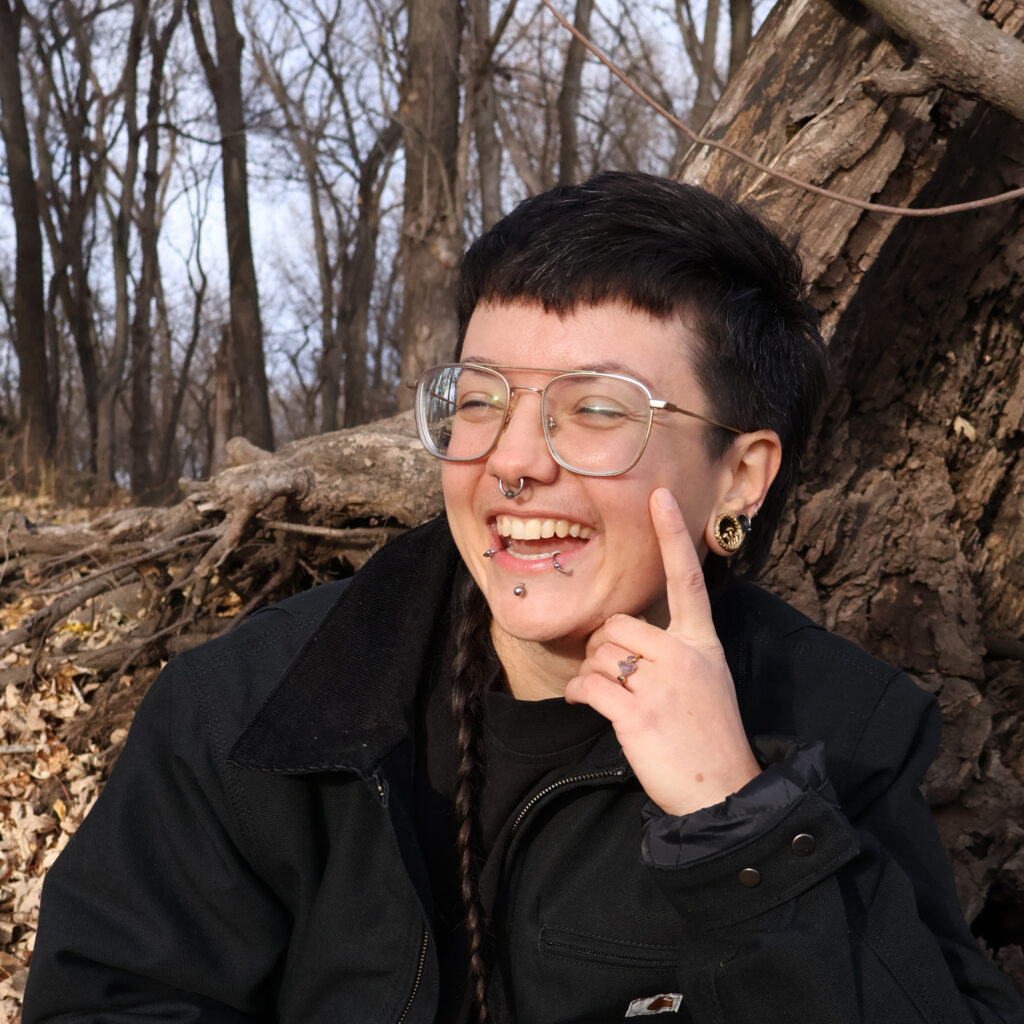
Now, Schminkey coaches the current MacSlams team in preparation for its upcoming competition, the Midwest Poetry Mash-Up, which Schminkey also directs. Beyond planning events that bring together poets from across the globe, Schminkey has also used poetry and the community it fosters to support Minnesotans who are most impacted by Operation Metro Surge, which deployed 3,000 federal agents to Minnesota in December. At PEN America’s “Bread, Borders & Belonging” event, fundraising for Stand with Minnesota—an organization fighting housing insecurity, which has worsened due to ICE’s presence in the Twin Cities—Schminkey performed their poem “Land of 10,000 Lakes.”
Photo Credit: May Whitsitt
The Words chatted with Schminkey about that poem and how poetry, much like the Land of 10,000 Lakes itself, serves as a site for movement-building and mutual aid. Read on to find out more about Schminkey’s insights and updates!
Was there a particular moment or moments in your life that inspired “Land of 10,000 Lakes”?
Everything going on in the Twin Cities, in particular. It’s not like bad things haven’t happened before in the United States, and it’s not that those things haven’t impacted me, but I do feel like the months of January and February, everything felt so close, and so dangerous and violent in a way that I have not witnessed in the same way in my lifetime. So, I spent a lot of time in the last few months trying to make emotional and poetic sense of what’s been going on in the Twin Cities.
That poem was probably, like my sixth or seventh poem that I’d written about it, and a lot of the other ones were just not right for the internet. I needed to write them, but not every poem that you write is a poem that should go on the internet. I feel very grateful … that I waited and put forth something that I feel like could speak to the moment and speak to more people than some of the other things that I wrote.
How do you decide whether a poem is something that feels right for you to share?
Classically, I think a lot about what the audience would get out of this. I also think about my own emotional needs—if I share this poem and I don’t get the reaction that I want or that I’m hoping for, can I handle that? You can’t control how other people are going to react to your work. Once it’s out there, it’s out there.
I feel like for this particular poem, a lot more considerations came into it, because I’m thinking a lot lately about, like, my actual safety, in terms of, like, what I can say on the internet. So I was thinking about that a lot, also thinking about this particular moment and my positionality. Normally, I’m a huge fan of just saying: let other people tell their own stories; let the people who are most affected by something speak on that. And we’re in a moment where people who are undocumented can’t publicly say certain things because it could be physically dangerous to their lives. This particular poem was a little bit of a different approach for me. I feel like I’m still in my lane, but on the edge of my lane in this poem for me and for my boundaries.
When you published your poem [online,] what did you hope people would take from it, and what’s the feedback you’ve received?
When I first posted it, my friend and fellow poet, Kyle Tran Myhre, [who has been] an activist, organizer, poet for a really long time, was holding all of these workshops about what artists can do to support the movement. … [One] of the things that he said was: one of the most important things that you can do as an artist is use whatever art you [create] to get real money and real resources for people.
So, the reason that I ended up posting this poem was actually because I just wanted an excuse for people to see something and have something to link to. Because just linking to Stand With Minnesota, that’s not going to get as many views as if you have some piece of art attached to it. I really just wanted more people to donate to help Minnesota, so that people can stay in their houses and have food. Right now, I am the most wary I have ever been about posting on social media and sharing work because I don’t trust that free speech will always be protected, and I feel very cautious about my place as a transgender semi-public figure … All of that being said, I wanted this poem to reach the people who needed it.
What are some of the moments that have taught you [about how] poetry [can do] something important for other people in our community?
I just taught a little workshop on queer and trans history and resistance. One of the things that we talked a lot about was how throughout queer and trans resistance, handmade zines have been really important as a way to connect with people. In those zines, it’s mostly poetry, little essays, but also community resources and very practical [information].
I think about this relationship between art and practical resources, and poetry in particular. I feel like there’s a pretty strong connection of that throughout history. Kyle [Tran Myhre] talks about this all the time too. I think about poems too, especially rallies, and protests, and gatherings that start off with a poem. I think about the poet’s job as an emotional caretaker of the people in that space, an emotional translator to provide that witness, provide that action. … Art is powerful, and can create a feeling in people, and then those people also go do something.
I read online that you have a new book coming out this spring.
I have a new prompt book coming out. I went through and read the entirety of the Button Poetry catalog (so if you ever need a recommendation, I know what Button [Poetry] has published), and I chose a poem from each collection, and then wrote a prompt to go alongside it. It’s a huge book that you can go through and read a poem from all your favorite Button [Poetry] authors and then write a poem inspired by it.
What was the process of compiling that and thinking of prompts like?
I wrote a novel and I wrote another poetry book that’s all about getting top surgery and being trans, and I am choosing not to publish them right now. … I’m on the precipice of queering agents for my novel, and I was going to propose that my, you know, like, newest collection of trans poetry, get published. It’s tough, because if nobody speaks out, then nobody says anything. Right now, I do personally feel like I’m toeing a line of how much I want to say and how much I feel comfortable speaking out.
… You get to read a poem, and you get to write a poem, and so it also helps people build the conversation that they have access to about what poets are saying. It’s not super accessible for everyone to buy 15 poetry books, so this is like a little sample. And one thing that’s cool about Button [Poetry] and their authors is that they represent a really wide range of experience. I always think one of the most powerful things about poetry is getting to hear other people’s experiences. And poetry is so good at building empathy. I think it actually helps people build bridges, and helps humanize different people. And so I feel like this book also does a great job at that, because you get to hear so many different people’s experiences, and then honor them by being inspired by that poem in some respectful way.
The Words thanks Ollie for their time, insights, and care for our community.