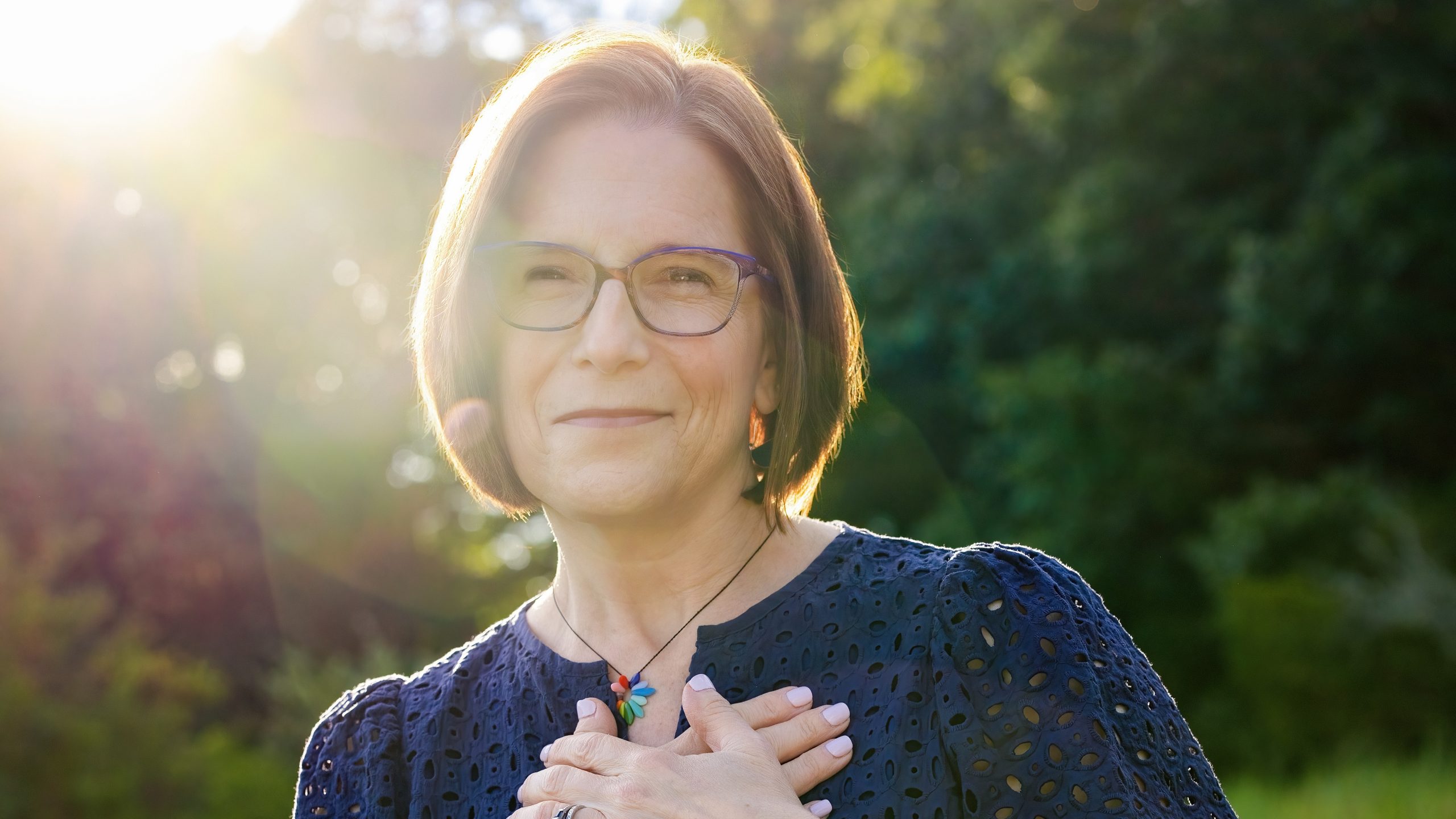




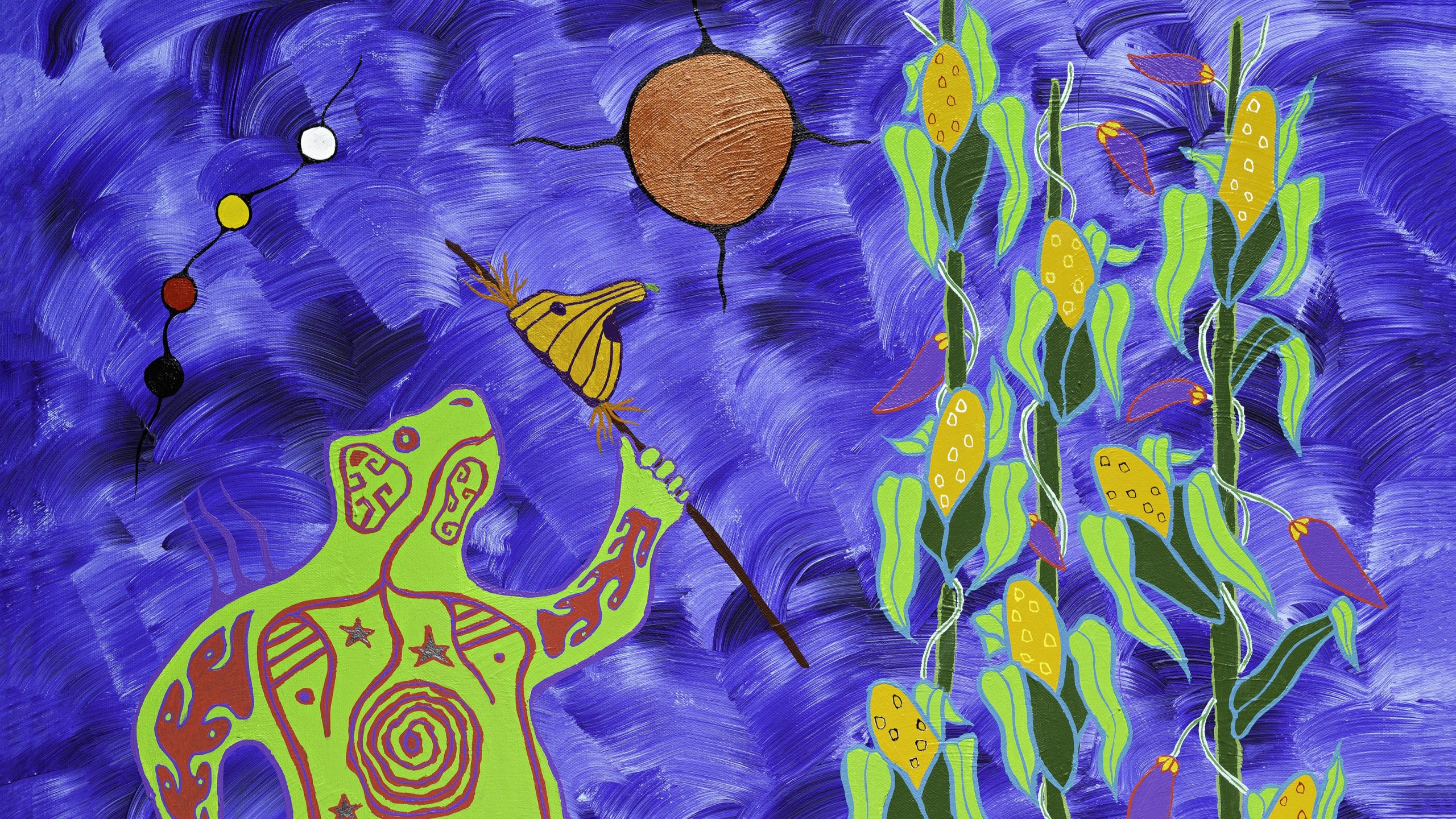
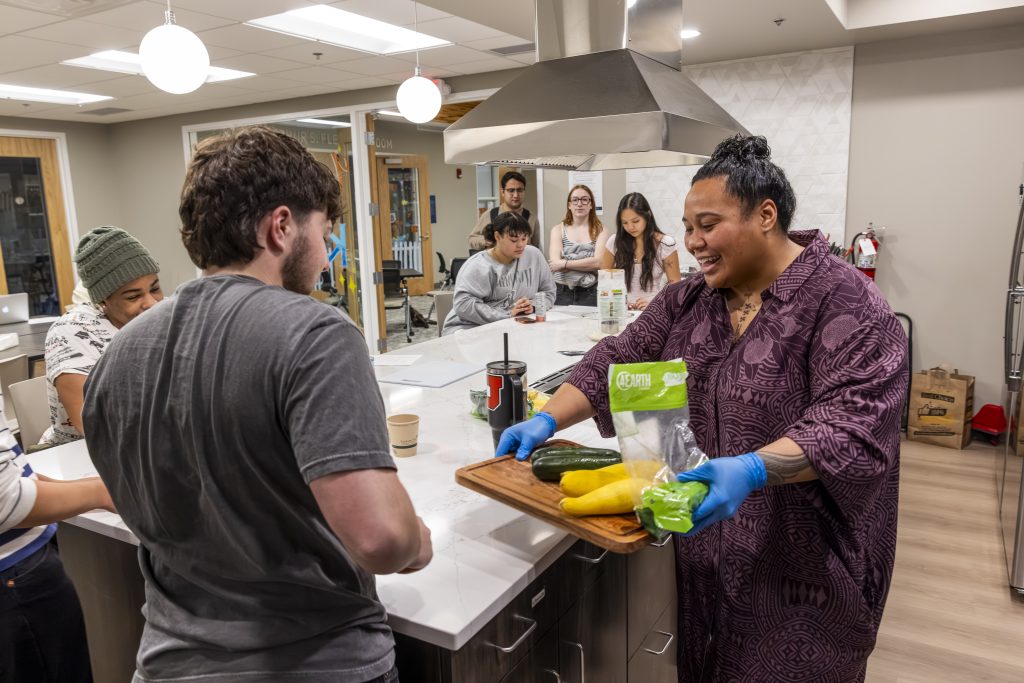
On a brisk April morning, the smell of masa and simmering beans wafts from the teaching kitchen in the Lealtad-Suzuki Center for Social Justice. Inside, stationed among an assortment of pots and pans, educational studies professor Dr. Kehaulani Fagatele-Folau shares a chapter from Robin Wall Kimmerer’s Braiding Sweetgrass centered on the Three Sisters.
Corn, she tells students in her Race, Culture, and Ethnicity in Education course, is the eldest sister—tall and quick to grow, supporting her siblings like a trellis. Beans—the middle sister—nourish the soil beneath and climb up the corn stalk, tying the new family together. Squash—the youngest sister—is short and stout, and her broad leaves shade and protect. “Together, they are sisters who thrive as one.”
The telling of the creation story complete, students split into teams, cooking up their own Three Sisters-inspired meals. The hands-on activity offers an appetizing introduction to a traditional Indigenous story. But for Fagatele-Folau—one of five faculty fellows hired as part of the Macalester Native and Indigenous (MNI) Initiative—this lesson in creation serves as a deeper teaching moment.
“There were many struggles to get lunch provided in schools,” Fagatele-Folau says, referring to decades of activism that led to the government mandating lunch in public schools. “What could happen if we understand that history? And what might happen if my students, many of them future educators themselves, explore the idea of sharing the Three Sisters story with their own students? What could come from those possibilities?”
A new commitment
Fagetele-Folau’s class is one piece of a broader initiative designed to foster engagement that better examines those possibilities. The Macalester Native and Indigenous Initiative is the college’s most comprehensive effort to date to center Indigenous people, knowledge, and history. When faculty, staff, and students established MNI in 2022, they built on decades of work already underway at the college. Since then, MNI’s influence has rippled through the Macalester ecosystem, flowing into disciplines and departments as different as chemistry, music, and entrepreneurship.
A $1 million grant from the Mellon Foundation, the nation’s largest supporter of the arts and humanities, has largely funded the people at the initiative’s center: a cohort of faculty fellows who expand interdisciplinary Native and Indigenous studies on campus. Two additional funds established by generous alumni, the Heidepriem Endowed Fund for Indigenous Support and the Ikway Ogimaa Fund, animate the campus landscape with community programming, staff and faculty development, and paid student research and internships.
All five MNI postdoctoral fellows are teaching and conducting research. Native community members guest lecture as part of the Indigenous Voices: Classroom Guest Series. The Office of Sustainability and its student workers tend a Three Sisters garden. Native entrepreneurs frequent the library’s Idea Lab. The work surges on.
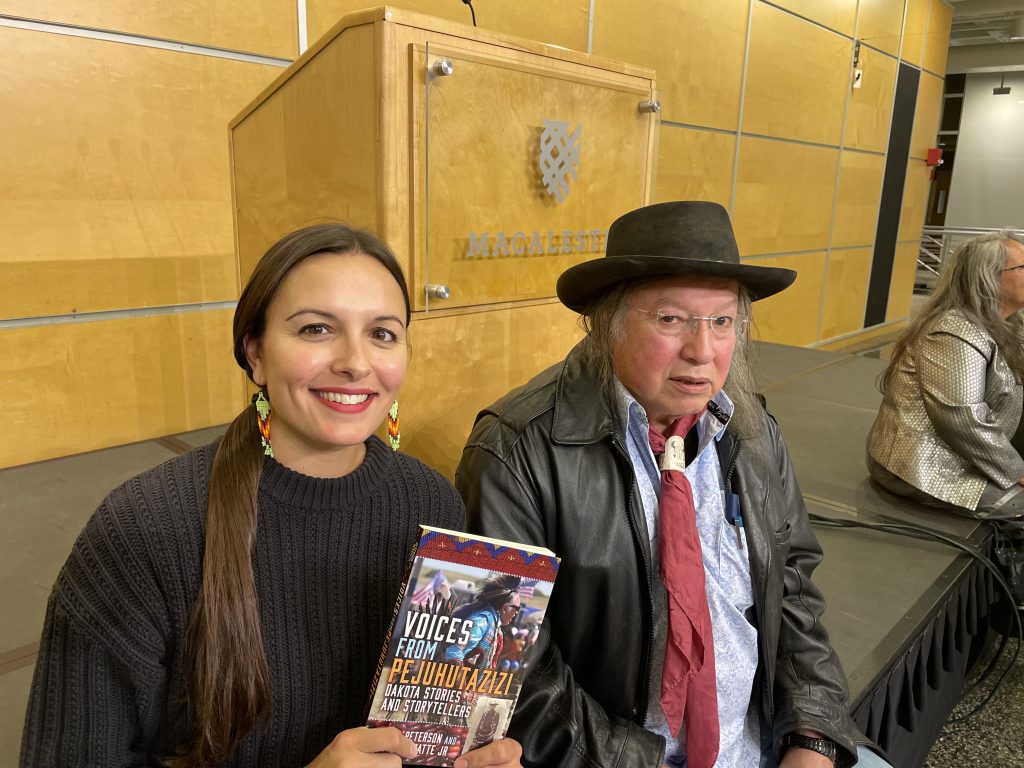
Walter “Super” LaBatte Jr. ’70, right, and history professor Dr. Katrina Phillips at LaBatte’s 2022 book talk for Voices from Pejuhutazizi. (Provided)
For history professor Dr. Katrina Phillips, who helped found MNI and chairs the initiative’s steering committee, the momentum has been striking. “Change in academia often happens at a glacial pace, but the intentional progress we’ve made across campus almost feels surreal,” Phillips says.
MNI’s charge five years ago builds on work by faculty, staff, and students who have worked for decades to make Indigenous people and their knowledge more visible at Mac. Phillips says the institutional commitment was both a necessary responsibility and a joyful opportunity, given Macalester’s location on Mni Sota Makoce, the traditional homelands of the Dakota people.
“To do this work in a place like Minnesota, just a few miles from Bdote—the sacred site of creation for the Dakota people—it means a lot,” says Phillips, a citizen of the Red Cliff Band of Lake Superior Ojibwe. “As a Native woman and as a Native scholar, it’s incredible to showcase what Native and Indigenous studies can look like at a small liberal arts college like Macalester.”
Creating a larger ripple
Mni is the Dakota word for water. It’s also a fitting three-letter acronym for the initiative—something fellow Fagatele-Folau noticed long before arriving on campus. “I love that play on words,” she says. “As someone from the ocean, water is life and central to my research and scholarship.”
The Madau-Moana (Pohnpeian-Tongan) scholar’s research centers on the knowledge of the Indigenous peoples of the Pacific, where she traces her ancestry and where the ocean is widely regarded as a living ancestor. Now in the Twin Cities, she learns from Dakota knowledge-keepers to better understand and protect local waterways. Of the chance to center Indigenous knowledge in her teaching, she says, “It means everything.”
With a doctorate in education, culture, and society, Fagatele-Folau was hired by Mac’s Department of Educational Studies, where she now extends Indigenous perspectives into curriculum and pedagogy. Her fellow MNI fellows have taken up posts in Anthropology; Philosophy; Spanish and Portuguese; and Women’s, Gender, and Sexuality Studies.
It’s a distinctly Macalester way of doing things. Instead of housing Indigenous studies experts within a single department, as many peer institutions do, Mac has moved to thread Indigenous knowledge and scholarship through its broader curriculum, classes, and departments, a process known as indigenizing. That interdisciplinary approach extends beyond MNI, with Indigenous scholars already embedded in American Studies, Biology, History, and Linguistics.
“Being an Indigenous scholar is not only about Indigenous histories—it’s about lifeways and culture and art and science and really every area of the liberal arts,” says Lisa Anderson-Levy, executive vice president and provost. “MNI is providing us with new ways to think about indigeneity or what indigenizing even means.”
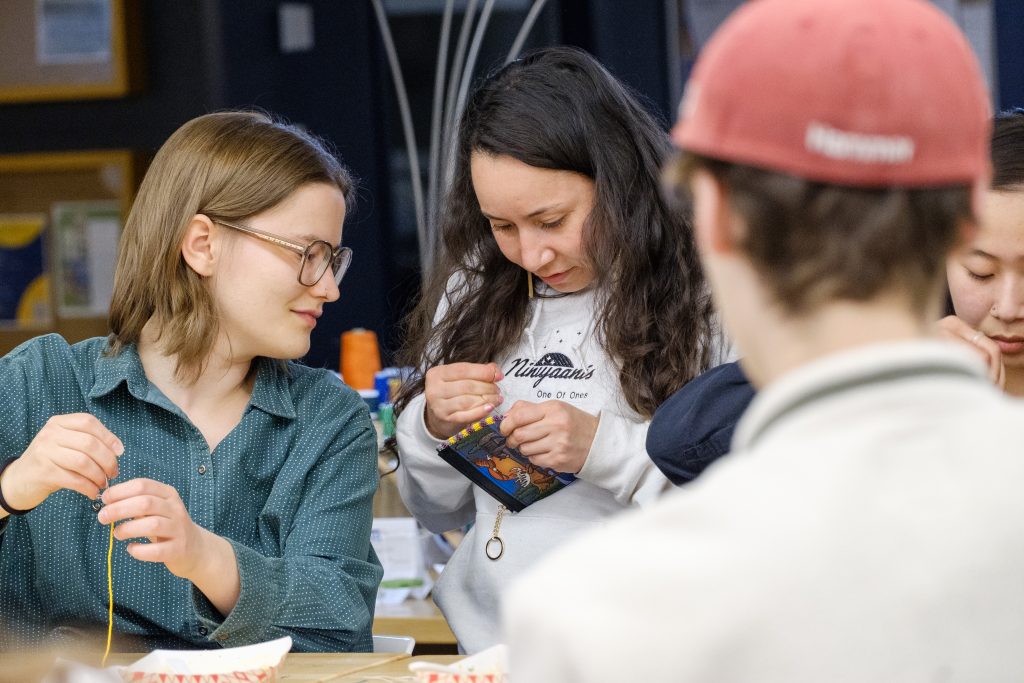
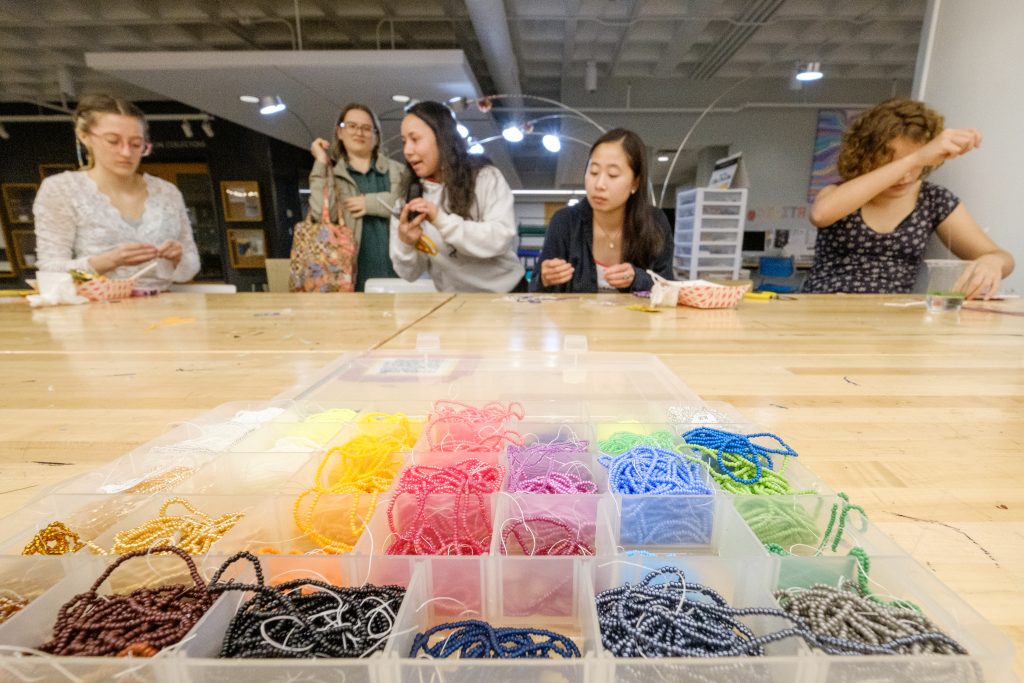
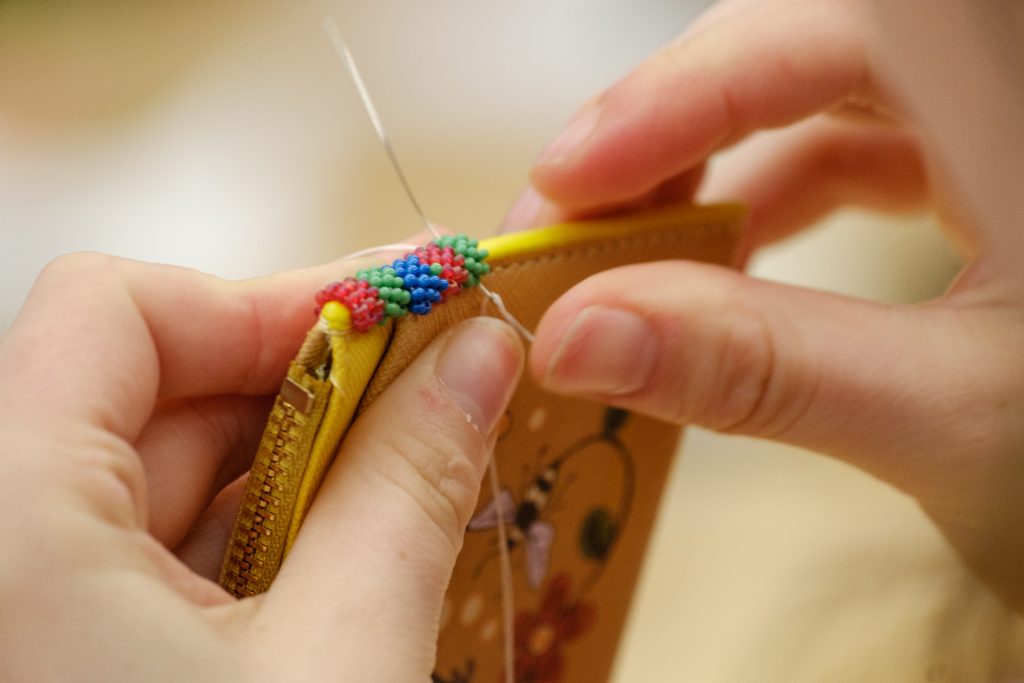
Brook LaFloe ’15 shares traditional beadwork with students in the library’s Idea Lab. (Photos by Kurt Stepnitz)
Finding themselves in the syllabus
Students are taking notice. Issa Teigita ’28, who is from Saipan in the Commonwealth of the Northern Mariana Islands, learned from friends that Fagatele-Folau had joined the faculty. A fellow Pacific Islander, she signed up for the professor’s first course, Moana Epistemologies and Pedagogies.
An early reading reshaped how Teigita saw her own home. The essay, by Tongan writer Epeli Hau‘ofa, reframes the Pacific not as a scattering of small, dependent islands but a vast sea of interconnected peoples. “Reading that, I realized that is exactly who we are: a highly supportive community,” Teigita says.
Teigita believes what she learned in the course was more than academic: “I saw Kehau and her teachings from the Pacific as an inspiration. And I saw that through our culture, which is something others often think of as small, I can be someone bigger.”
Then and now
One of the first people to sign up to support the MNI initiative was Walter “Super” LaBatte Jr. ’70. A Sisseton Wah’peton Dakota artist, historian, and storyteller raised on the Upper Sioux reservation, LaBatte has long been a Macalester super fan (on a Reunion panel this summer—in a moment of genuine excitement—he ripped open his jacket to reveal a Mac T-shirt, exclaiming, “I love Mac!”).
Helping to launch MNI programming, LaBatte visited campus in 2022 with his niece and co-author, Teresa Peterson, for a reading from their book, Voices from Pejuhutazizi: Dakota Stories and Storytellers. The book offers five generations of Dakota storytelling drawn from a manuscript by LaBatte’s grandfather. “Tickling his heart,” LaBatte says, roughly 150 people flowed into the Kagin Ballroom to hear his family’s stories come to life. “I was rather excited, maybe even surprised to see there were that many students interested in my experience,” he says. “It felt good to be able to share my stories with them.”
The moment stands in contrast to the late 1960s, when he was one of the college’s first Native students. The then-history major remembers being approached by a classmate with a survey about future course offerings at Mac. When he suggested Native American history as an option, the peer rebuffed his idea.
The conversation stuck with LaBatte for decades and it even caused him to rethink his future. Enjoying the similarities between the Dakota language and German, he switched his major to the latter. In the process, he found joy in sharing knowledge and traditions between two cultures.
“I just love experiencing other people’s culture and environment. And at Macalester, there’s quite a difference in how they approach that nowadays,” LaBatte says, pointing to the MNI Initiative and a lineup of current courses that center Native history. “We’ve made a tremendous amount of progress.”
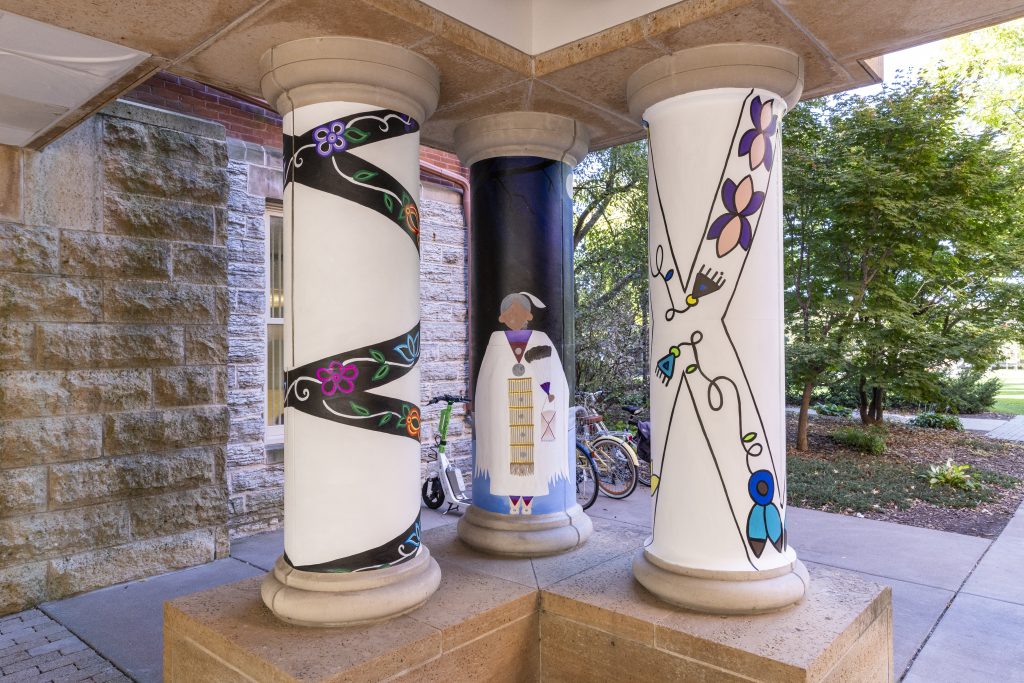
Programming with purpose
Each year, the MNI steering committee greenlights a longer list of partnerships and events. Most give Mac students, faculty, and staff opportunities to collaborate with local Indigenous communities. The Indigenizing Initiatives series has featured a festival of new Native plays and a screening of Star Wars: A New Hope in Ojibwe (Ajuawak Kapashesit ’13, who did the language dub, was present for a Q&A). A celebration of the Honor the Earth organization, which has promoted Indigenous environmental initiatives for the past thirty years, brought together Indigenous leaders to discuss environmental justice issues with students.
Artist-educator and entrepreneur Brook LaFloe ’15, from the Turtle Mountain Band of Chippewa, spent an evening in the library’s Idea Lab this spring. The cofounder of Niniijaanis One of Ones, a social enterprise for Native children, had received an inquiry from the Department of Entrepreneurship and Innovation—would she like to host a Native beading workshop and chat with students about launching her own community-driven business?
And so, in the middle of finals week, LaFloe dished out colorful beads across worktables. “To see college students crafting, enjoying themselves, taking a necessary break,” LaFloe says, “it was all so refreshing.”
The workshop gave LaFloe a chance to share an artistic tradition practiced today by many Indigenous peoples. “I take very seriously the chance to learn things about my own culture that were taken away and then to give that back and pass that on,” says LaFloe, whose business supports Native artists and culture bearers. “It’s an honor to share our culture with others.”
Sustaining the work
The future of MNI, leaders say, runs deep—and while the program has made real strides, the college is at the starting line of a much longer commitment. The Mellon Foundation grant has been extended through 2028. A global Indigenous studies concentration has launched. And a special community building seminar for staff and faculty is working to create lasting bonds with Indigenous communities in and outside of Macalester.
Mads Goodwin Clark, associate director of the Lealtad-Suzuki Center for Social Justice, coleads the community building seminar and serves as the staff advisor to the student group Proud Indigenous Peoples for Education (PIPE). Both roles are deeply personal for them, a member of the Mdewakanton Dakota. “Knowing that our story is integral to the mission of MNI and trying to be a good relative in that way has been challenging but also very rewarding,” Goodwin Clark says.
Some of their favorite memories include workshops with Native artists introducing faculty and staff to Native dance and beadwork. A visit to Wic̣aḣapi, a Native burial ground in St. Paul, was particularly moving.
Each moment, they say, is a part of something larger: MNI finding its way to every corner of campus. “All those small steps make a much larger drop in the pond so we can keep the momentum going.”
PIPE’s Lasting Legacy
Macalester’s newest initiative builds on decades of work by Indigenous students, faculty, and staff who made space for Native visibility on campus long before MNI arrived. Much of that momentum can be credited to Proud Indigenous Peoples for Education (PIPE)—the student group founded in 1969 as the Native American Coalition.
For years, PIPE has connected its campus community with its local Indigenous one. Most memorable, perhaps, are PIPE’s campus powwows held in the 1970s, the late 1980s and early ’90s, and the 2010s. It’s a tradition students hope to bring back in spring 2027.
“I hope we had a strong, positive influence on Macalester,” says Janice LaFloe ’92, who co-led the revival of the campus powwow in 1989. “What I got to see was an increase in Macalester knowing a little bit about who American Indians are today, not as a people to be viewed as history, but as contemporaries.”
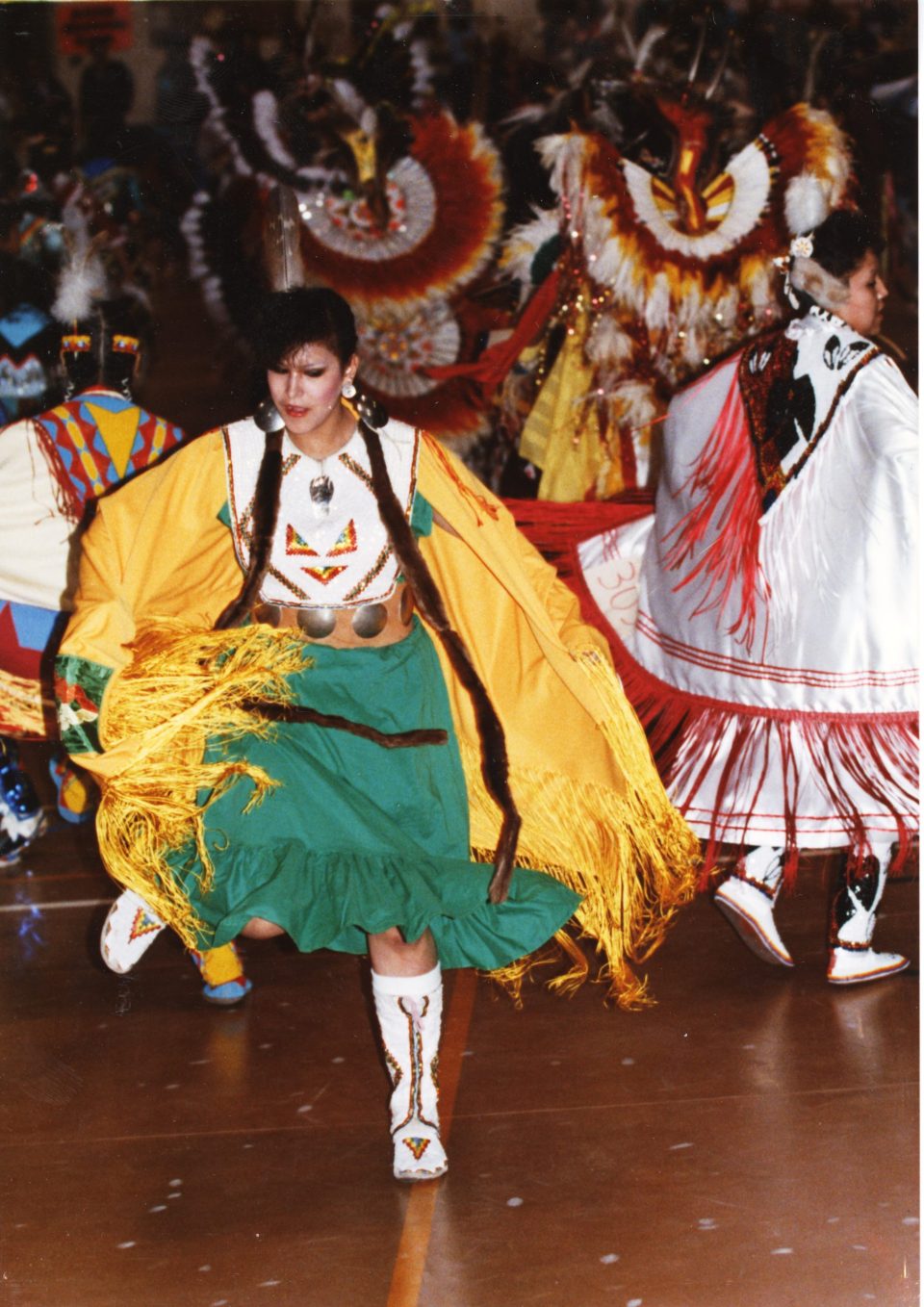
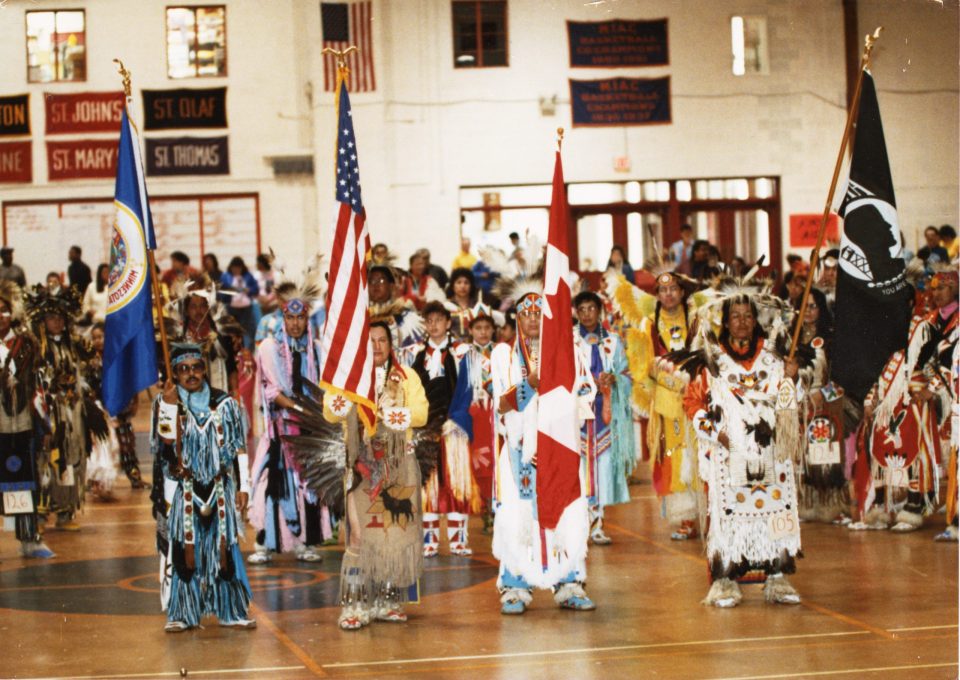
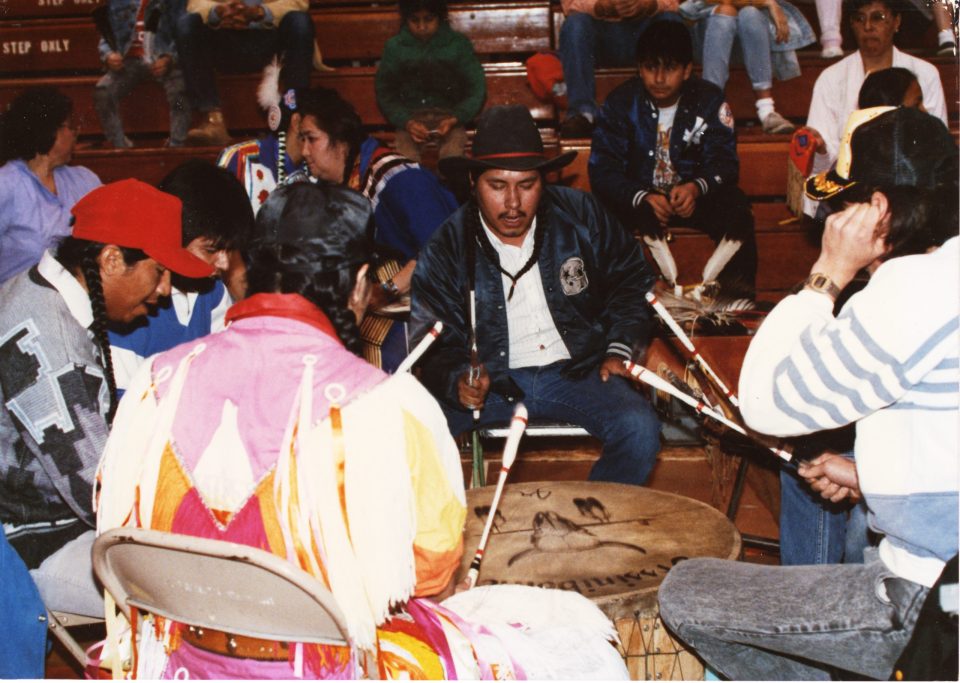
Dancers and drummers from local tribes compete at Macalester’s campus powwow, one of three hosted by student group PIPE between 1989 and 1991. (Photos Courtesy of Macalester College Archives)
Meet the MNI Fellows
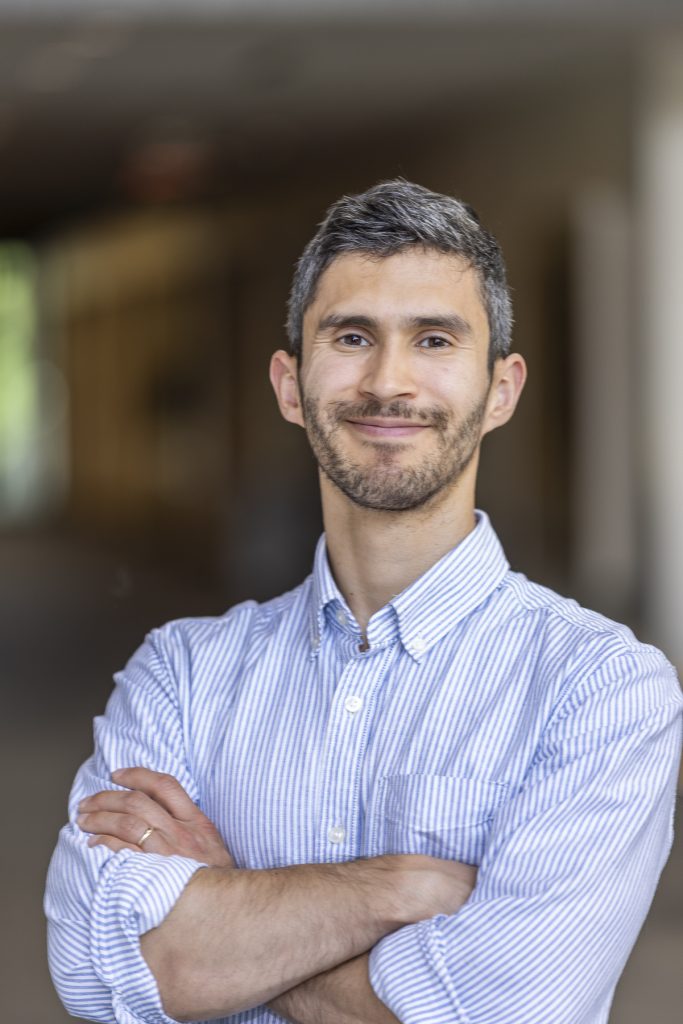
Dr. Daniel Coral Reyes
Spanish and Portuguese
Recent courses: Analysis of Hispanic Texts; Cinemas of Abya Yala: Representation, Collaboration, and Production
Research interests: Indigenous filmmaking in Latin America, particularly how contemporary filmmakers reclaim and reinterpret early 20th-century archival footage from the Amazonian rubber boom.
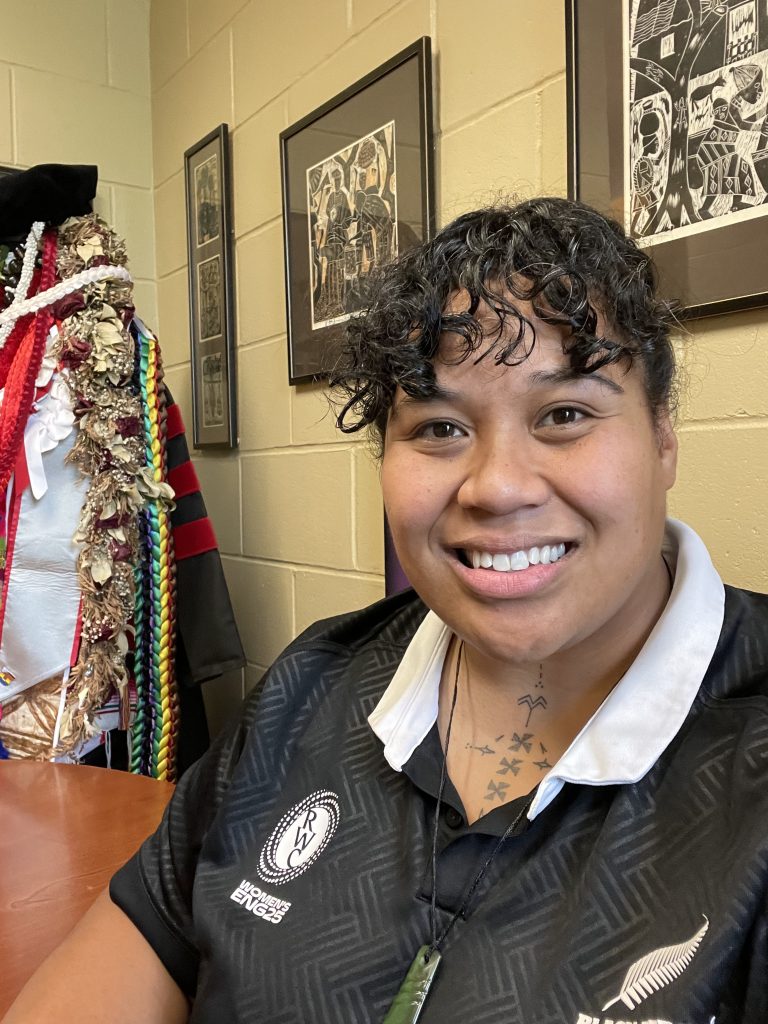
Dr. Kehaulani Fagatele-Folau
(Pohnpeian-Tongan)
Educational Studies
Recent courses: Moana: Theories of Water; Education and Society
Research interests: Indigenous feminisms and Pacific Islander epistemologies, with a current focus on the Tongan deity Hikule‘o and what their cosmology reveals about Tongan philosophies of gender, fertility, and the afterlife.
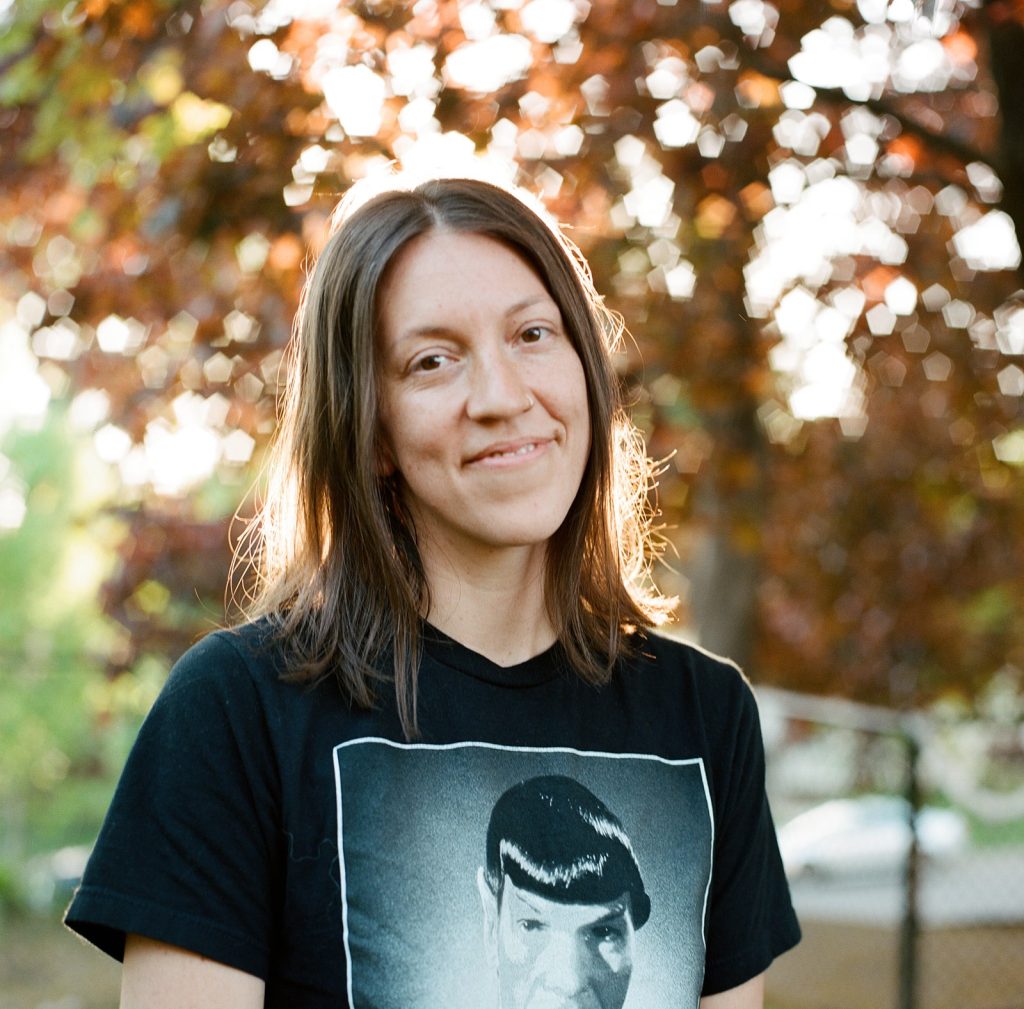
Dr. Aila O’Loughlin
(Sámi-American)
Philosophy
Recent courses: Indigenous Philosophy; Environmental Ethics
Research interests: Indigenous kinship ethics, a framework for right and wrong based on whether an action strengthens or damages kin relationships, including relationships humans have with animals, land, and the natural world, with a current focus on mining in Sápmi.
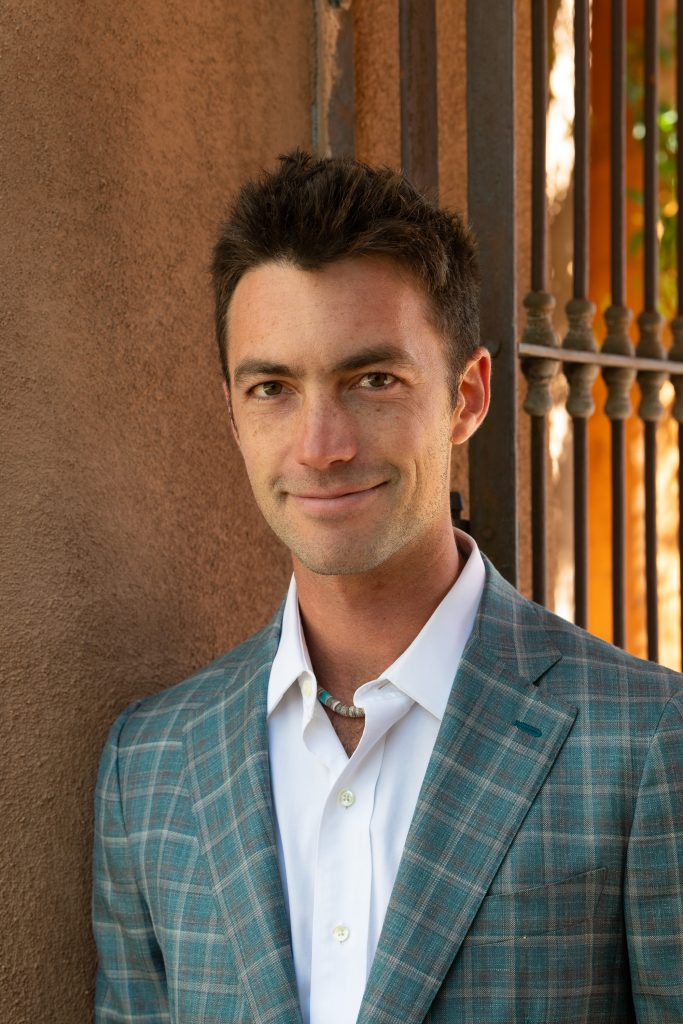
Dr. Robert Weiner
Anthropology
Recent course: Religion and Colonialism
Research interests: Collaborative archaeology in the Indigenous Southwest, particularly at Chaco Canyon, where his recent book project traces the history of the region’s monumental roads and their significance in Diné (Navajo) and Pueblo cultures today.
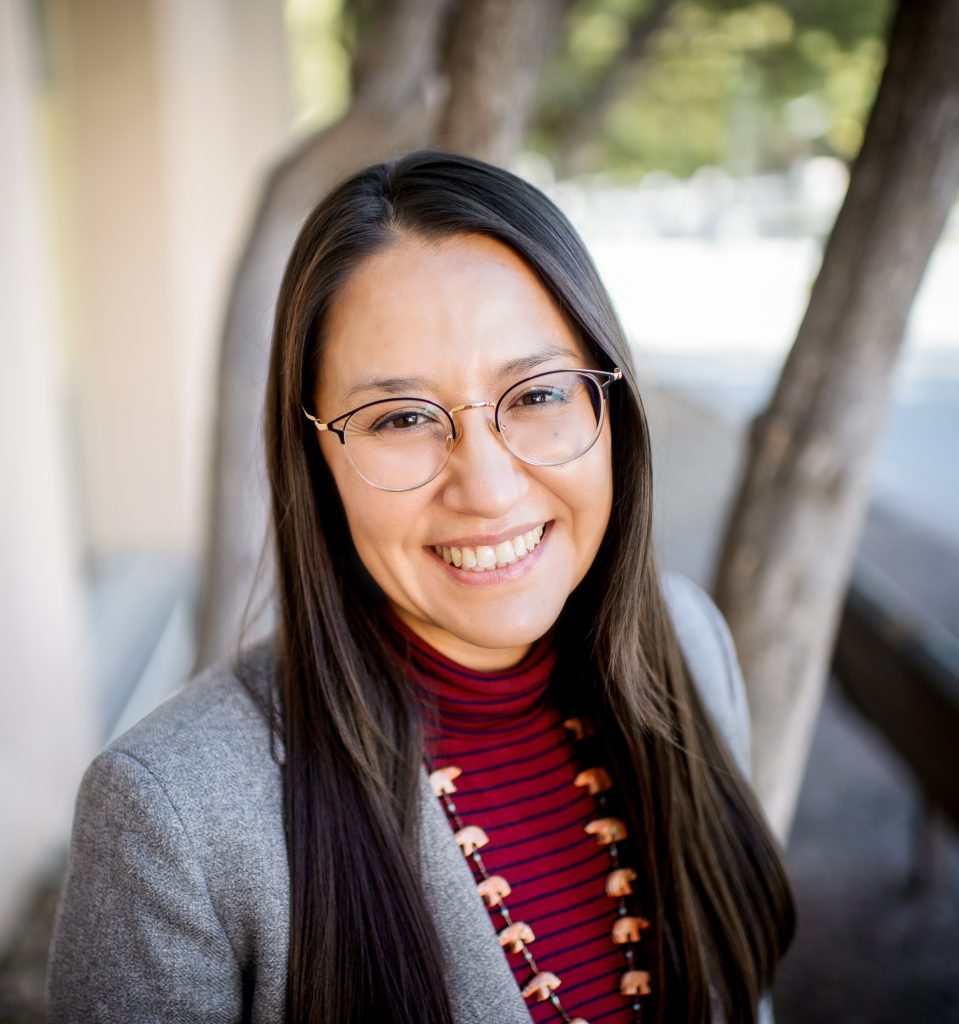
Dr. Melanie Yazzie (Diné)
Women’s, Gender, & Sexuality Studies
Recent courses: Indigenous Feminist and Queer Studies; Worlds Upside Down: Revolutions in Theories and Practices
Research interests: Centering an Indigenous feminist methodology, Diné (Navajo) history, water rights, and Indigenous environmental justice, including recent work on the Northeastern Arizona Indian Water Rights Settlement and its implications for Navajo claims to the Colorado River.