



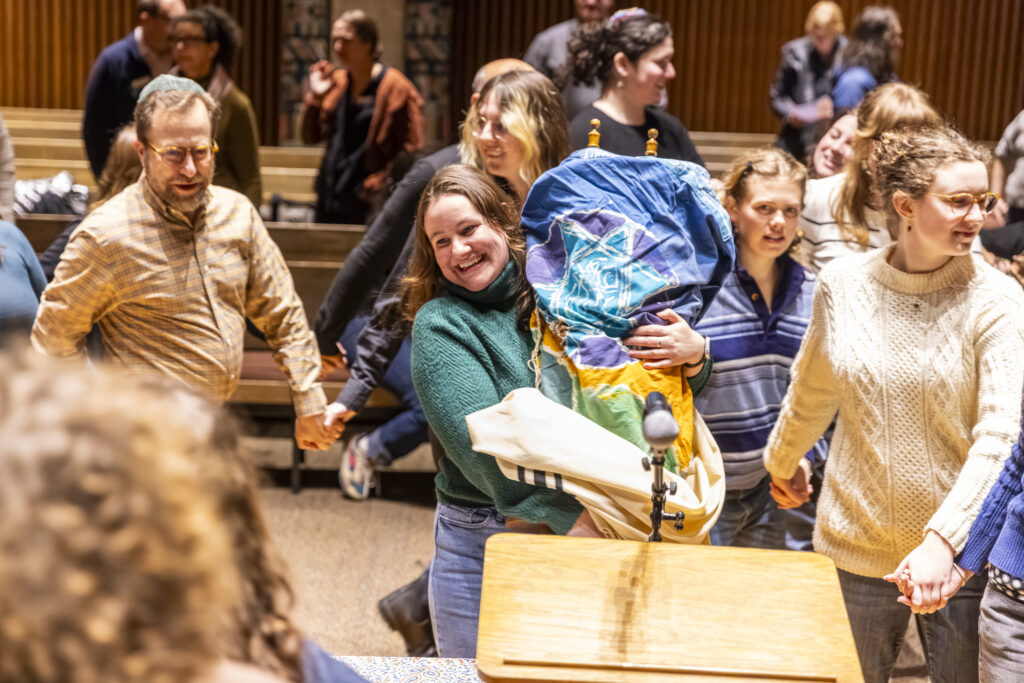
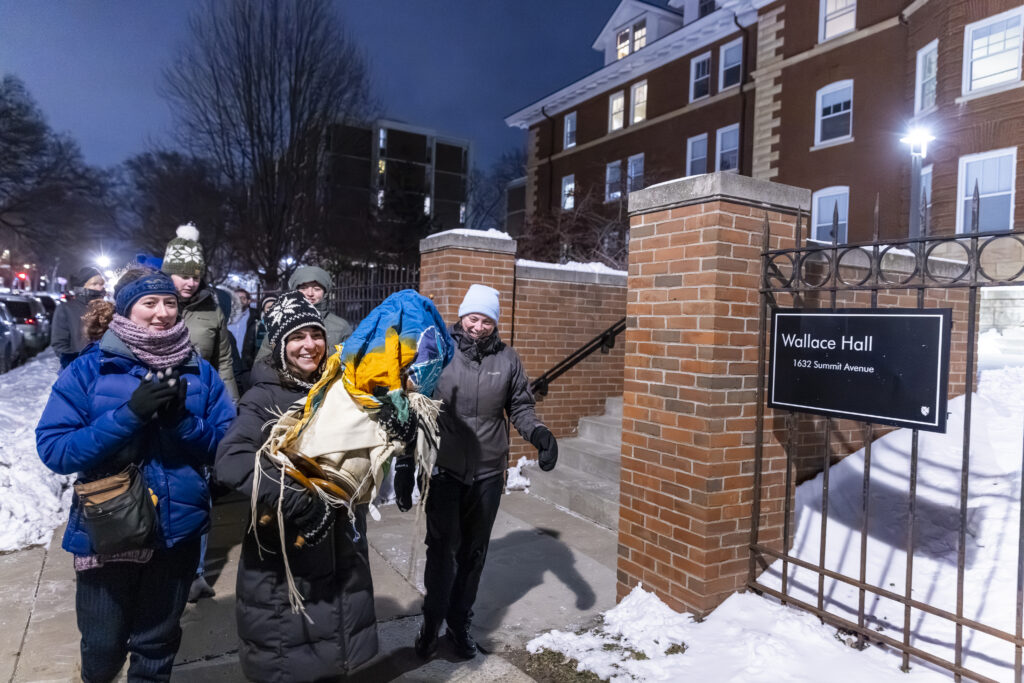
On a cold Sunday evening in February, a lively procession wound its way through the streets of St. Paul. Beginning at Portland and Pascal avenues, members of Macalester College’s Jewish community carried a Torah scroll toward campus, tracing a path through the neighborhood that it had lived in decades before.
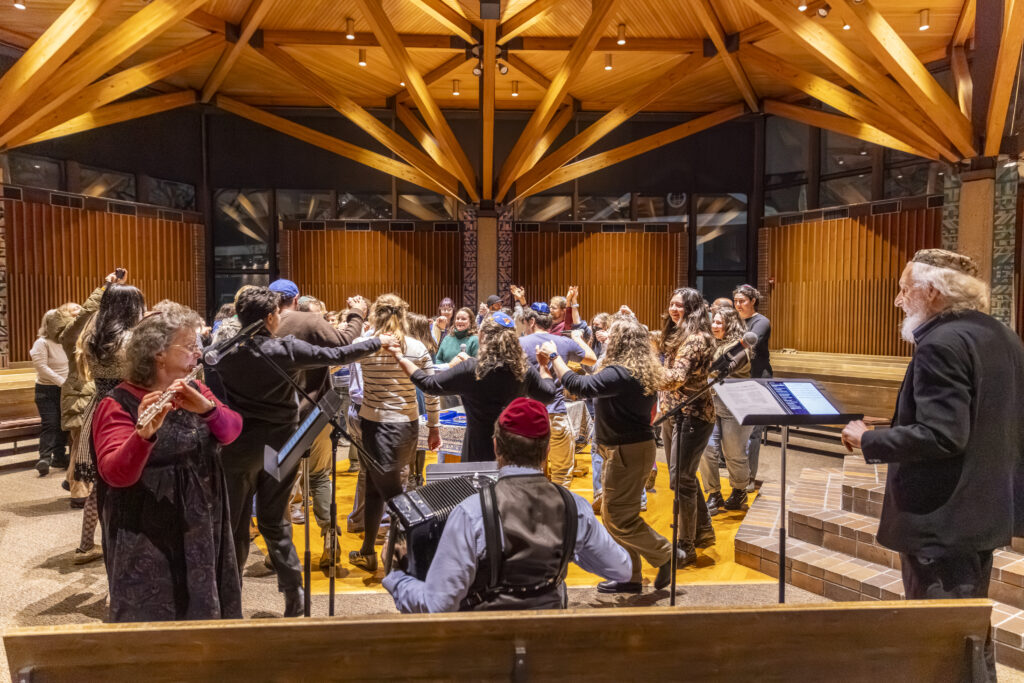
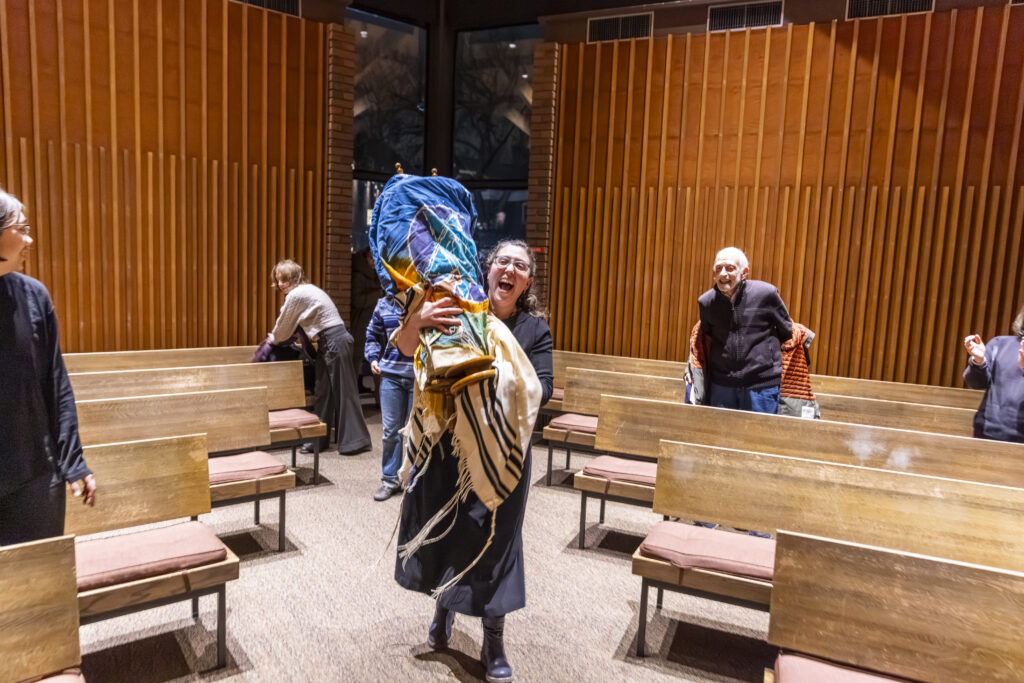
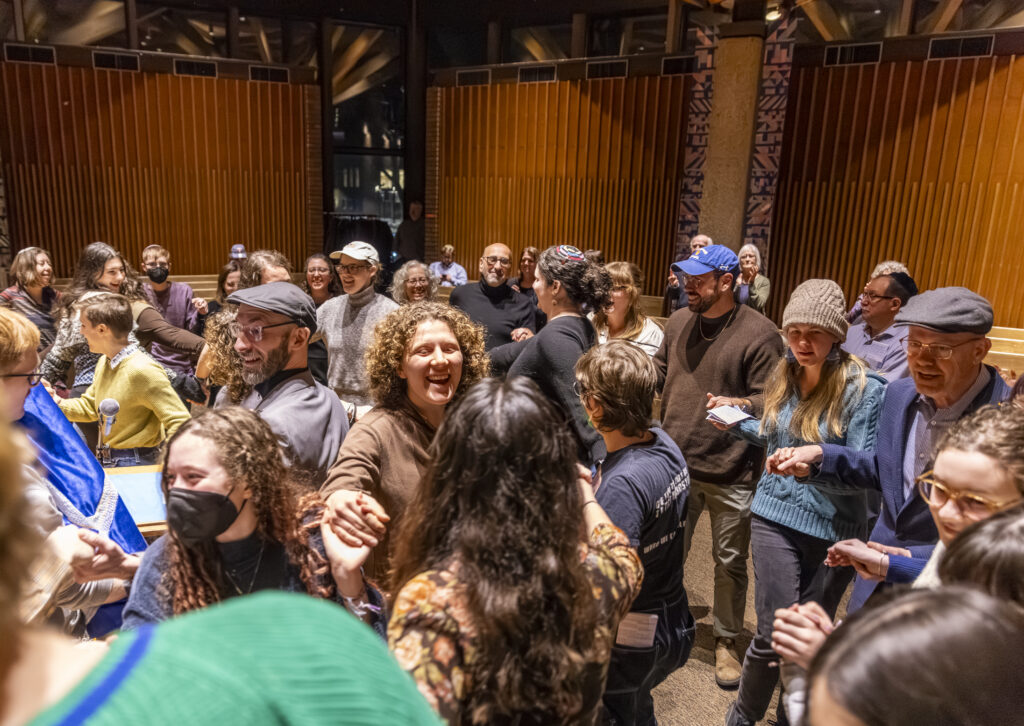
Dance and song broke out on campus as the procession reached its destination—Weyerhaeuser Memorial Chapel. For the participants, there was much to celebrate: for the first time, Macalester’s Jewish community would have a Torah of its own.
“I just love dancing with Torah,” said Macalester Rabbi Emma Kippley-Ogman, who has served as the college’s Jewish and interfaith chaplain for nearly a decade. “In that circle, with people of all ages, it’s not about how fast you can go, it’s not about how fancy your footsteps are, it’s about actually joining your heart with the person next to you to music, moving in space.”

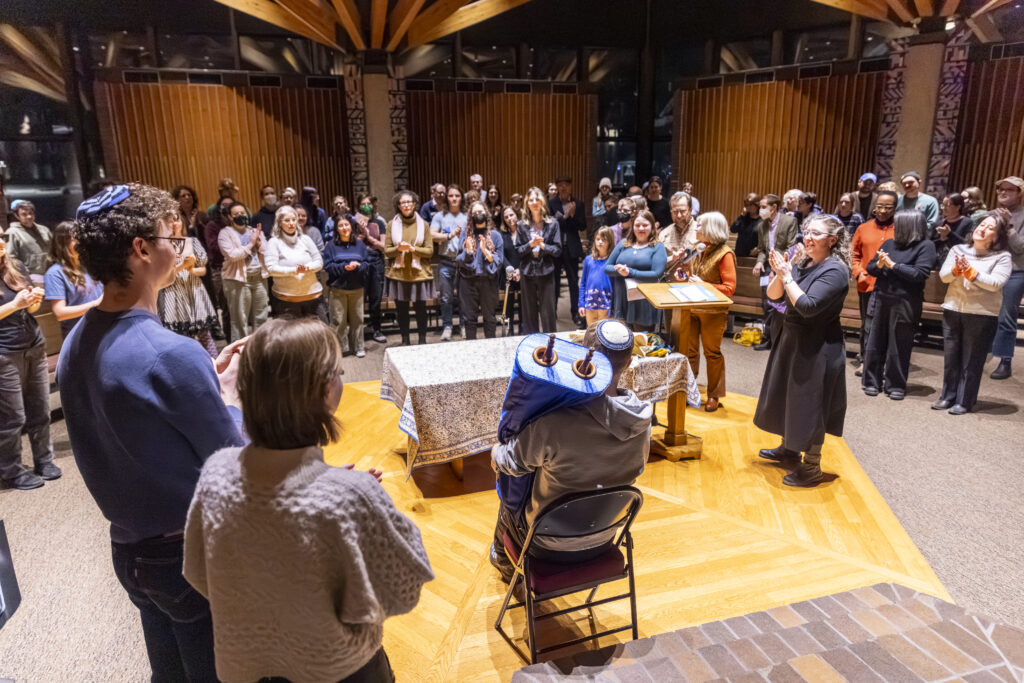
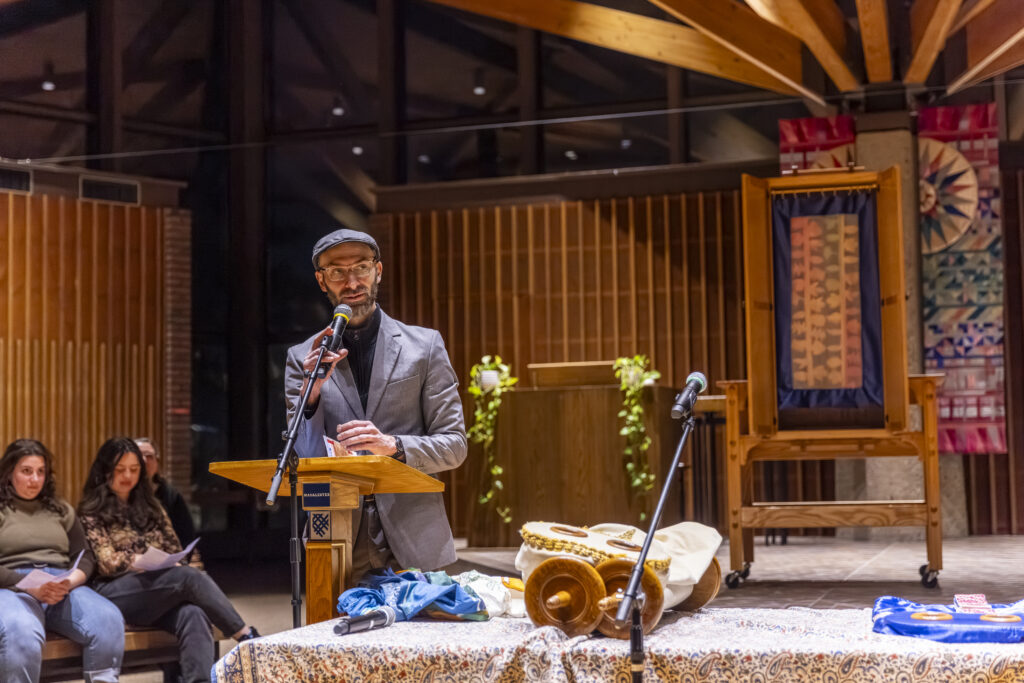
That distinct spirit of togetherness could be felt throughout the Hachnashat Sefer Torah—a scroll welcoming celebration—on February 22, 2026. And it was felt across the generations as Macalester alums and friends of all ages returned to campus to dance, chant, and celebrate alongside current students, staff, and faculty.
Peggy Davis ’72, who helped found the original Hebrew House on campus, shared her hope with attendees that the Torah will serve as a living symbol of the same sense of community and togetherness she and her peers worked to build more than fifty years ago.
“I hope that Jewish learning, wisdom, and community is as strong a support for today’s students as it was for me, given the difficult time in which we are living,” Davis said. “Bringing the Torah here today gives the students a physical, tactile reminder of history, survival, learning and community.”
Helping welcome the Torah to its new home was Macalester Executive Vice President and Provost Lisa Anderson-Levy, who believes the sacred text will serve as a source of connection for the entire Mac community.
“For Jewish students and employees, this Torah offers a sense of rootedness and continuity. For those who aren’t Jewish, it offers opportunities to learn, to listen, to ask questions, and to encounter a tradition different from your own,” Anderson-Levy said. “One of the joys of being here at Macalester is that no text belongs only to one group; everything becomes part of a shared conversation.”
Welcoming Torah—the Macalester way
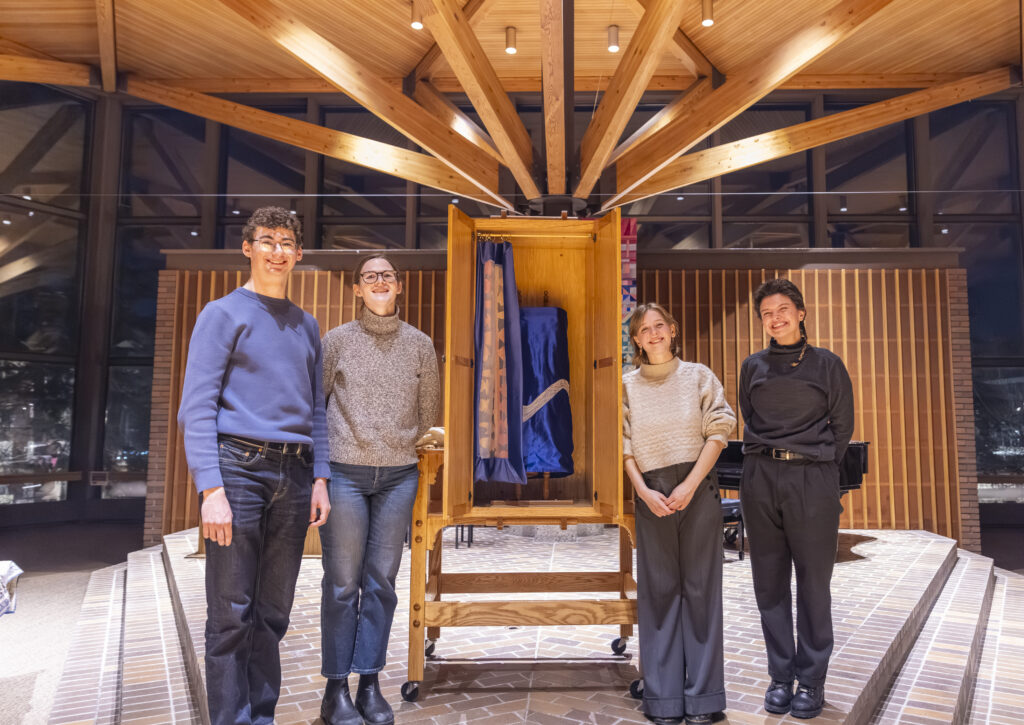
The welcoming celebration was the culmination of a years-long effort from across the college and beyond. Students, staff, donors, and neighboring congregations all worked together to welcome the Torah to campus. Jessica Williams ’26, a student leader with Macalester Jewish Organization (MJO), designed a portable ark to house it, while Wade Oesterich, a carpenter with Facilities Services, built the piece using wood from retired dormitory bedframes. Demetrios Marcos Vital, a local scribe, painstakingly restored the mid-19th century text to its original splendor. And the scroll’s ritual clothing—a mantle and belt—were designed and produced by students.
Miles Rakov ’27, a chemistry major and leader with MJO, took on the Torah’s mantle. Rakov has been sewing since attending a Jewish camp in fifth grade. “That we’re getting a Torah of our own, and that we can dress it ourselves, with things we’ve actually made, it feels really powerful,” Rakov said.
His design centers on Bdote, the Dakota word meaning “where two waters come together”, and the confluence of the Mississippi and Minnesota rivers just three miles south of campus. “Connection to the land is central to the Dakota people, and this is especially true for Bdote,” Rakov said. Embroidered in blue and purple, the rivers meet at the center of the mantle in a burst of color, with beadwork and stitch shapes inspired by Dakota beadwork.
“It represents how we grow and change at Mac and within MJO, and how, after we make this transformation together, we leave to find our place in a wider community that’s always changing as well,” Rakov said.
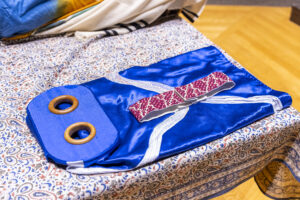
Lucy Anderson ’28, another MJO leader, worked on the Torah’s belt, cross-stitching a pattern inspired by the pomegranate, which is the organization’s symbol. The pomegranate in Jewish tradition represents all of the mitzvot—righteous actions that a person can take in their life.
“It’s really cool to create an item that people are going to touch and use, potentially for decades to come,” said Anderson, a geography and studio art double major. “With that comes a little bit of pressure, but it’s an amazing way to contribute to the community and the people around me.”
A scroll comes home
Macalester’s new Torah may be new to campus, but this specific scroll is hardly new to the neighborhood. Believed to have originated from Moravia in the mid-19th century, the Torah was once housed at the Sons of Jacob Congregation, just blocks from campus. When that congregation closed in the early 1980s, it merged into what is now Beth Jacob Congregation in Mendota Heights—and the scroll went with it. There, in need of repair, it has sat in the congregation’s ark unused for decades.
As demand for on-campus Jewish religious practice—including shabbat and holiday services, and b’nai mitzvah celebrations—has grown in recent years, MJO leaders have felt the need for a scroll that the college could call its own. Stepping in to help fill that need were Howard Berkenblit and Tina Schaper, parents of MJO alum Ellie Berkenblit ’24. The couple generously offered to provide the necessary gift to bring a Torah to Mac. When Beth Jacob graciously agreed to donate its damaged scroll, the family’s gift provided the necessary funds for repair.
“We are so grateful that our daughter Ellie was able to find a way not only to continue to nourish her Jewish identity at Mac but that she was able to find such a vibrant, impactful, supportive organization in MJO,” the Berkenblits said. “With MJO now having its own Torah, generations of Mac students will have increased opportunities to learn and to pass on Jewish values and traditions.”
Rabbi Kippley-Ogman echoes that sentiment: “Welcoming a scroll is a real embodiment of the ongoing learning, wrestling, challenging, and questioning that is the core practice of Jewish community.”
A Torah for the generations
Gabriela Helf ’23, now in her first year of rabbinical school at the Jewish Theological Seminary in New York, returned to Minnesota to lead a blessing at the welcoming ceremony with fellow alum Rabbi Heather Renetzky ’15. As a student, Helf was an MJO leader and said the experience helped light her path forward.
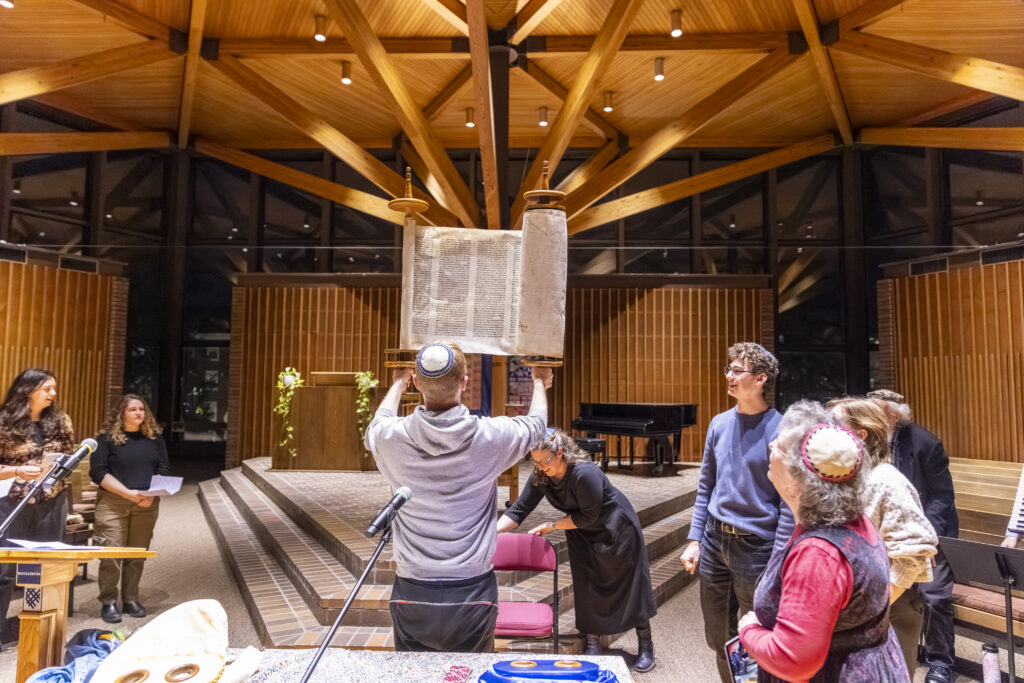
“It was the first place at Mac where I really found my community,” Helf said. “I also got a lot of practice in being a leader in a ritual setting, in a prayer setting, and in a kind of community organizing setting—that was a really wonderful experience.”
To return to community—bound together by a shared sense of joy and the knowledge that this Torah would carry their community’s story forward—was the highlight for so many in attendance.
“To be in the chapel surrounded by all my friends, it’s just so exciting,” Helf said. “And to be a part of a really big celebration across generations, I think we all needed that right now.”
“When reading the Torah, to get from one story to another, you have to actually pass through all the other stories, because you have to physically move the scroll past each one,” Rabbi Kippley-Ogman said. “In the impermanence of the student community, this is an invitation to a sense of continuity. This story is directly connected to one that came before, even though you weren’t here, even though those people are not here anymore, the thread is present.”
February 27 2026
Back to topMore College Newswire News

Macalester Welcomes a Torah Scroll of Its Own
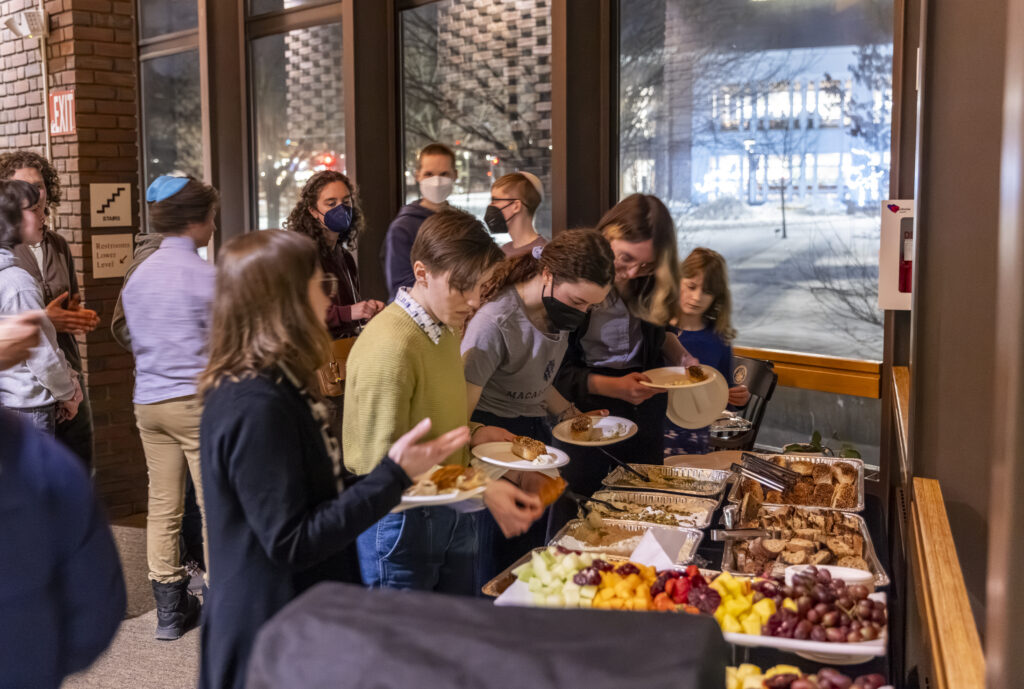
Macalester’s Jewish community welcomed its first Torah to campus in a ceremony filled with dance, song, and nosh.

Bobbie Pennington ’24 Named 2026 Mandela Rhodes Scholar
Pennington is the first Scot to receive the scholarship, which provides funding for up to two years of postgraduate study at a South African university.

Geological Excursions in Argentina
A longstanding geology class is part of a growing group of Mac courses that include short-term study away components.

Macalester Receives Full Re-Accreditation for Maximum 10-Year Term
The Higher Learning Commission's review team concluded that Macalester's clear mission permeates the college's operations and academic programs.

‘Voices of Lake Street’ Project
Caroline ‘Fitz’ Fitzpatrick ’26 created a digital story map that aims to garner support for Lake Street business owners who have weathered many challenges in recent years.

Macalester recognized as Fulbright Program top producer
This academic year marks the fourth consecutive year that Macalester has been recognized as a high-output school.