








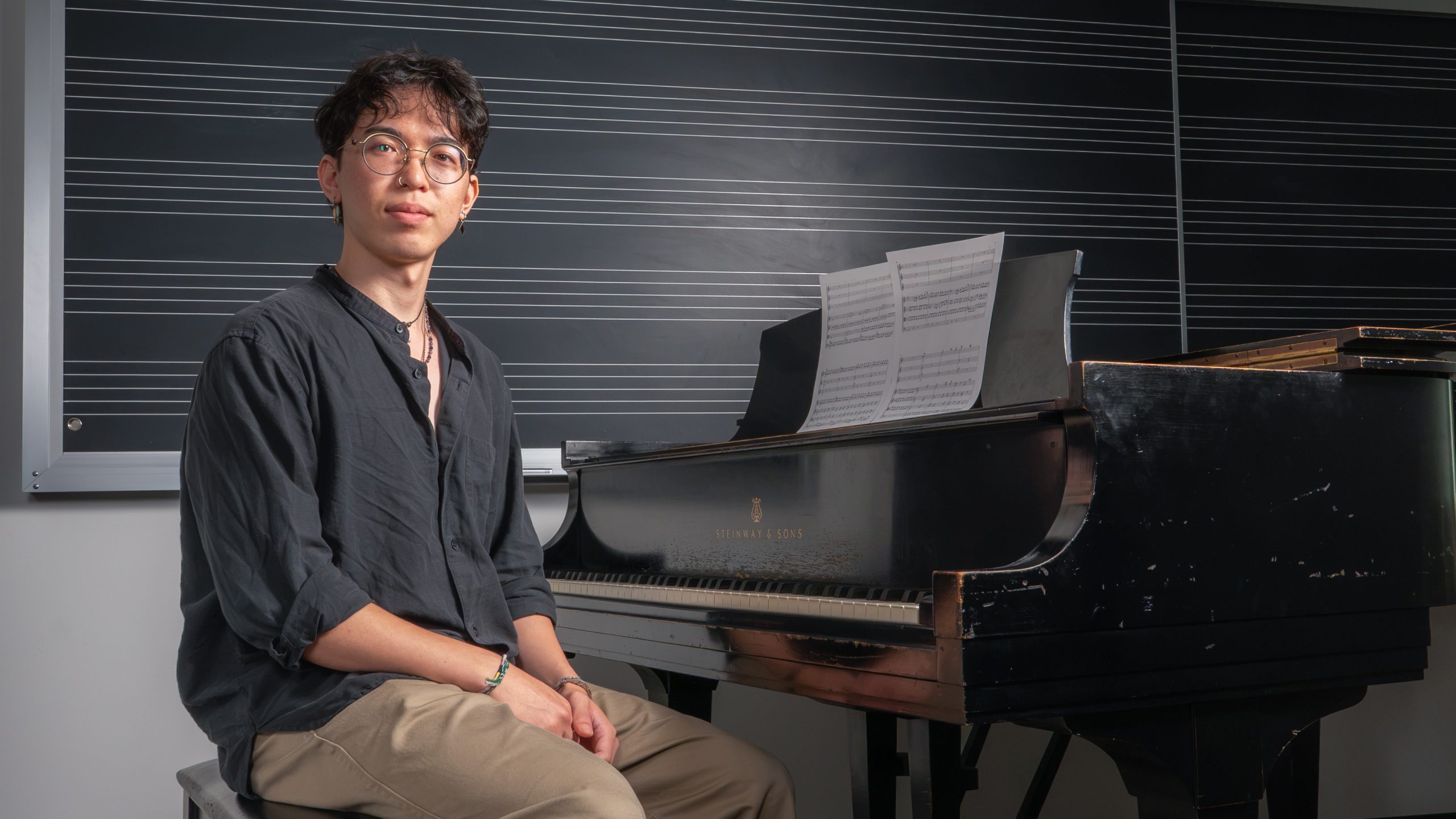
When Max Chang ’27 visited Minnesota with their family to tour colleges, Macalester wasn’t originally on the itinerary. But after a last-minute suggestion from their parents, the budding musician decided to make a detour to check out the St. Paul campus, and, more importantly, visit the Music Department.
Within hours, professors had invited the California native to attend a class session and even gave them a free, individual lesson. It was a memorable trip with access to experts that the then-high school senior didn’t forget quickly. “Mac was just very responsive,” Chang says. “I really liked the vibe of campus, and the music program here seemed very strong.”
Now a senior music major at Macalester, that early impression has played out in distinct ways as a full-time student. A violinist and passionate composer, Chang recently spent their summer working one-on-one with music professor and fellow composer Victoria Malawey transcribing handwritten scores into something musicians around the world could pick up and play.
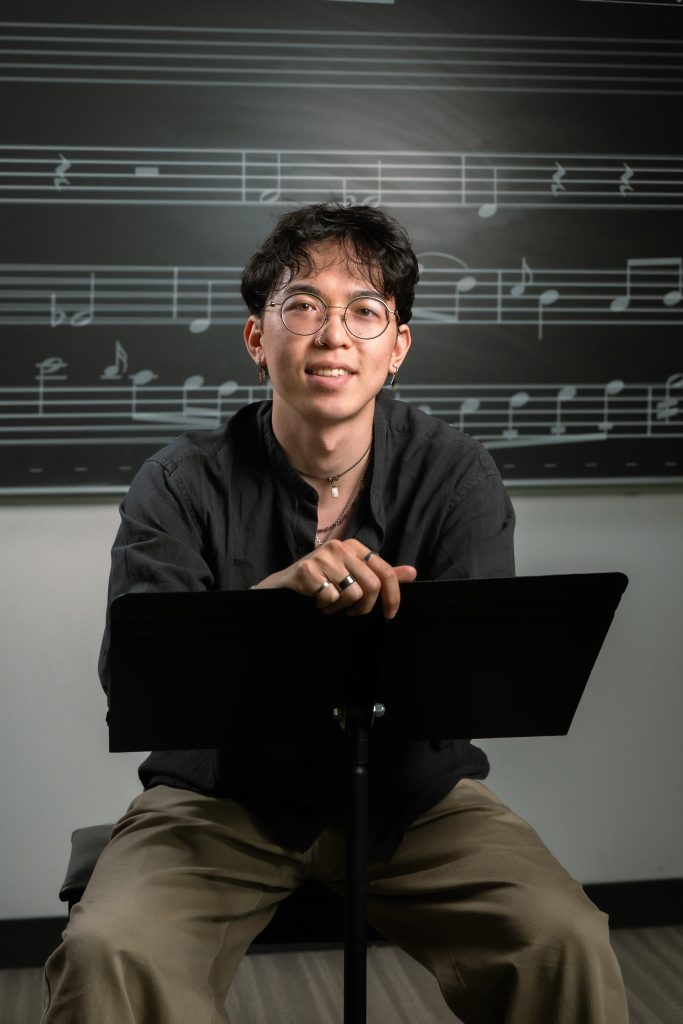
Chang has been working to transcribe a collection of Malawey’s canons, compositions the award-winning composer and singer-songwriter created during recent artistic residencies. It’s detailed, meticulous work, but, as both teacher and student know firsthand, invaluable preparation for graduate school and beyond.
“I’m both learning how to use Dorico, which is the industry standard for music notation software and can be more challenging than other programs, but I’m also getting to study Professor Malawey’s compositions at the same time,” Chang says.
Each individual score goes through multiple drafts as Chang works to format each piece so it’s clean and readable by professional musicians. “She’s very specific about what she wants, which is great, because then I know exactly what I need to be doing. But that also means there’s many, many drafts of each score as we work to get it right.”
Developing a strong working relationship has been key to their partnership, especially when transcribing something as personal as composed music. For Malawey, the work is rooted in a mission to show up for students who are willing to take a professional chance on music.
“It’s hard to find meaningful work in the arts,” Malawey says. “And so, when there’s a student who wants to take that risk and really wants to devote their life to doing this—that aligns directly with my values. It’s really important to me as someone who can mentor them. I want to be part of that, and I want to help them succeed.”
Chang first worked side by side with Malawey during an independent study. Over the four-month mentored experience, Chang composed an octet for woodwind and string instruments. That independent study then led organically to this past summer’s composition project. It’s the kind of sustained access to faculty Chang was looking for at Mac, and a critical component to the education Malawey hopes to provide.
“This kind of one-on-one work really lets him develop a specialized skill set,” she said. “And I’m so proud of how far he’s come. We’ve been working together now for a while, and I’ve just been delighted with his stick-to-itiveness, figuring things out on his own but also knowing when to bring me the things he can’t figure out.”
In their final year at Mac, Chang plans to carry that technical precision alongside a renewed interest in exploring various creative outlets. They’re already working on an honors capstone piece: a five-movement quintet for strings, piano, drums, and bass guitar. The composition will blend classical and funk influences inspired by recent trips to Italy and Hong Kong, as well as poems by Mary Oliver.
Eventually, Chang hopes to pursue a PhD in composition and perhaps even become a professor of music. First, though, Chang plans to savor their senior year, taking a composition course for video games. An avid gamer, it’s a tantalizing career path.
“There’s so many more possibilities of genres and sounds you can use,” Chang says. “You can do anything you want in there.”