



By Dawn Araujo-Hawkins (Photo credit: Dorothy Hong)
For more than thirty years, the Interfaith Alliance, a national coalition of progressive religious leaders, has sought to counter the theocratic tendencies of right-wing Christianity and to promote democracy in the United States. The group has worked for causes including the separation of church and state, combating antisemitism and Islamophobia, and delegitimizing the use of religion for anti-LGBTQ+ discrimination.
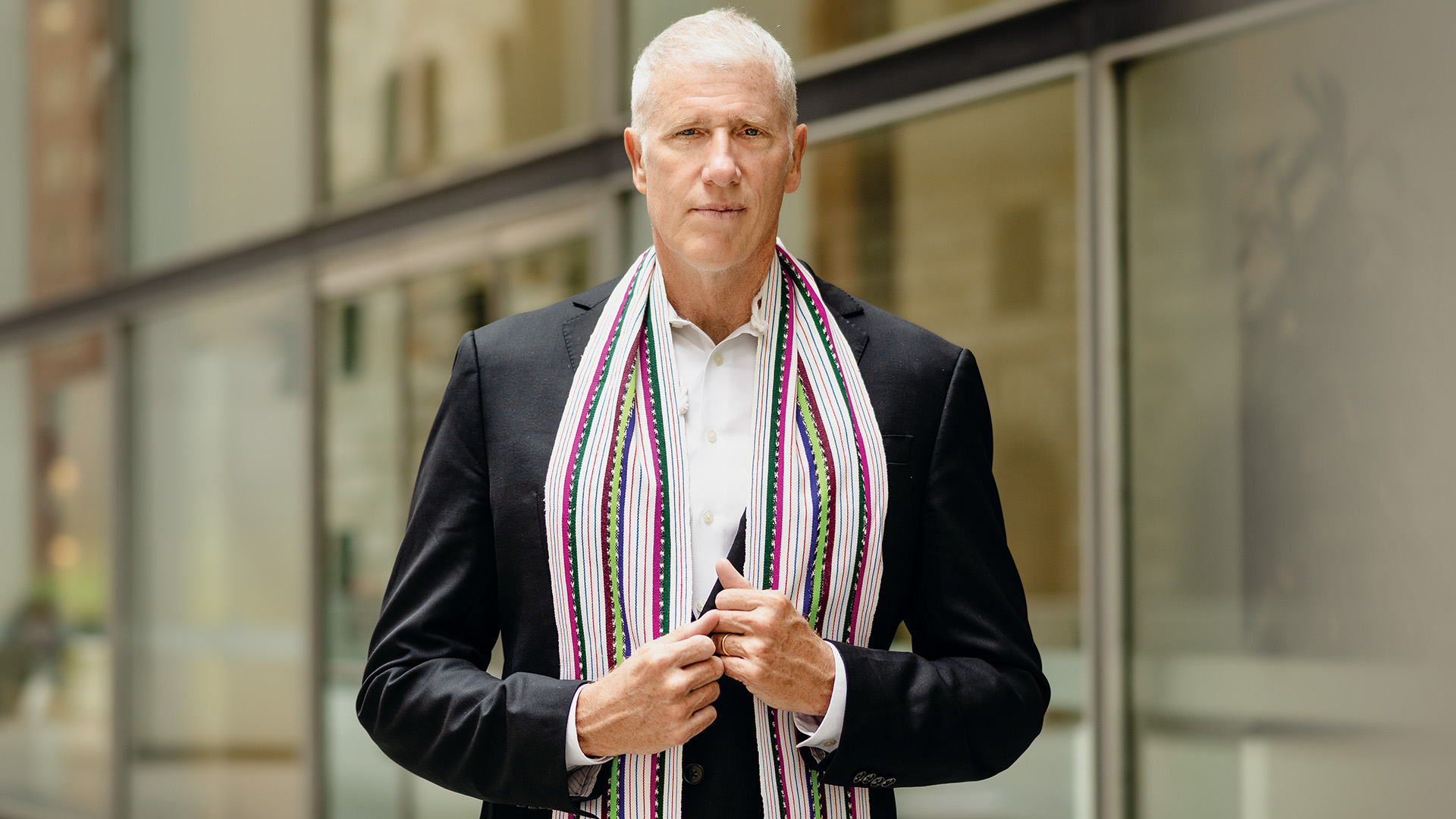
For Interfaith Alliance’s current president and CEO, Paul Brandeis Raushenbush ’86, this work is all the more important in today’s political climate when white Christian nationalists are weaponizing their idea of “divine sanction” to consolidate political power.
“The First Amendment is very clear that there is no privileged religious position in America,” Raushenbush says. “We’re insisting that there should be freedom—true freedom—for people to exercise their faith in whatever way they feel called to.”
Two of Interfaith Alliance’s goals this year are to train at least one hundred thousand people in nonviolent mobilization and resistance and to organize a twenty-eight day, national The Vote is Sacred bus tour to locations where there’s been a threat of election disruption. The group also continues to call attention to the myriad ways religion is used to buoy authoritarianism.
For instance, in February, Interfaith Alliance, along with Muslim, Sikh, and Hindu groups, sued the Trump administration, arguing that the almost entirely Christian members of its Religious Liberty Commission did not sufficiently represent people of faith in the US. Although a federal judge dismissed the case in July, Raushenbush said the lawsuit at least allowed Interfaith Alliance to shine a light on the hypocrisy of the administration, which he considers a win.
“We’ve been able to show that this does not represent religious America, and we’ve been able to rally the religious community,” he says.
This work of promoting social justice and religious freedom runs in Raushenbush’s family ethos. One of his great-grandfathers, Baptist pastor and theologian Walter Rauschenbusch, was one of the most renowned figures of the Social Gospel movement, preaching a theology of salvation that centered more on systemic ills than individual sins. Another of Raushenbush’s great-grandfathers, Louis D. Brandeis—the first Jewish Supreme Court justice—was known for his robust defense of the First Amendment.
In 1932, his paternal grandparents, both economists, drafted an unemployment compensation law for Wisconsin, the first such law in the nation. His mother, Marylu, was a devout Presbyterian engaged in civil and women’s rights advocacy, and his father, Walter, was an agnostic law professor who helped write legislation to end discrimination against Black homebuyers.
When Raushenbush decided to major in religion at Macalester, he wasn’t planning a career in religion. In fact, after graduating, he moved to Spain and became a DJ. After returning to the States, Raushenbush began attending Judson Memorial Church in New York City, a congregation with a long history of inclusivity and social justice. It was on the advice of Howard Moody, the pastor there, that Raushenbush went to visit Union Theological Seminary. He ended up enrolling in a Master of Divinity program and then, while Raushenbush was serving at a Baptist church in Seattle—working with youth both at the church and at the LGBTQ+ youth center—he was ordained in the American Baptist Churches USA denomination.
After leaving pastoral ministry, Raushenbush was hired as the music editor at Beliefnet, one of the digital media boom’s first religion and spirituality sites, in 2000. Three years later, Raushenbush became the associate dean of religious life at Princeton University, where he was responsible for hiring Sohaib Sultan, the school’s first Muslim chaplain. Then, for six years, Raushenbush was the executive editor for global spirituality and religion at The Huffington Post.
He came to Interfaith Alliance in 2022, drawn by the opportunity to use the skills he’d amassed over his varied career in ministry, media, and multifaith spaces. “This position combined all of those skill sets that I had into one job,” he says.
A large part of what Raushenbush sees as his job is to bring what he calls “the best of religion” to US democracy—which might seem difficult at a time when the nation’s religiosity is declining. According to a 2025 Gallup poll, only 49 percent of US adults say religion is an important part of their daily life, a drop from 65 percent in 2007. But Raushenbush says he actually sees signs of a spiritual revival taking place, albeit not in the way revivals have historically been understood.
“It’s not about one religion, but it’s about, ‘What does it mean to actually show up for our democracy? What does it mean to love our neighbor?’” he says, noting that in the past year and a half, Interfaith Alliance’s local affiliates have increased from eight to forty.
The goal, however, isn’t to simply invert what the Religious Right has done and impose progressive religious values on everyone.
“No one has a monopoly on faith,” Raushenbush says. “The America that I dream of includes very conservative religious people who are able to practice their faith exactly how they want—but they don’t get to dictate to the rest of us how to practice ours.”
Dawn Araujo-Hawkins is a religion journalist based in Kansas City, Missouri.