



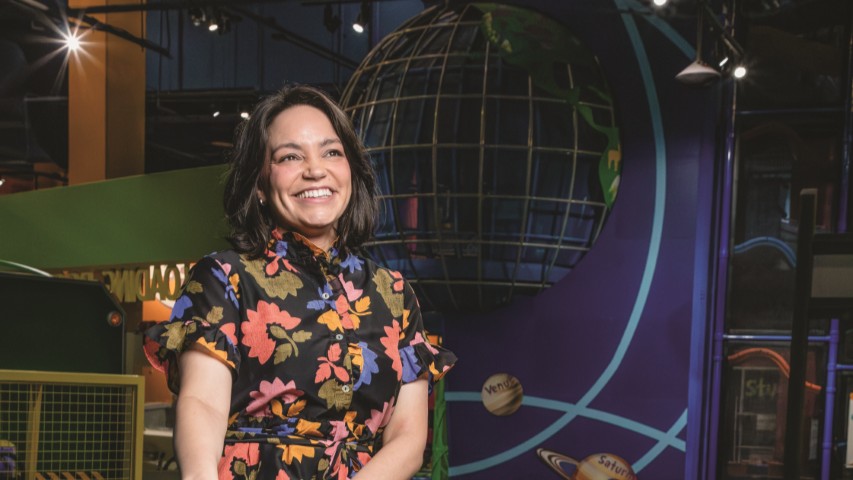
Rebecca Morelo Jackson ’13 is director of marketing and sales at the Children’s Museum of Atlanta, where she explores play as an idea and play as a practice. Play is one critical way children investigate, interact with, and learn about the world around them, says Morelo Jackson, adding that it also can lay a foundation for a better, brighter future for everyone.
What brought you to the Children’s Museum?
I got to the Children’s Museum less through children and more through an interest in play. I was new to Atlanta and looking for a “chill job” while I figured out a more serious “adult job.” I started in 2019 as a play facilitator—leading field trips, engaging in play with kids and their families—and moved into my current position in 2025. Like a lot of Mac kids, I’m very at home in the world of ideas, and the Children’s Museum is a very stimulating place in that world.
At Mac, I double-majored in media and cultural studies and Latin American studies, and I studied in Bolivia at a radio station that had developed out of a theater troupe—it was a playful, highly creative environment. It made me wonder where we find those kinds of spaces in the US.
What is it about play that interests you?
I like the autonomy to follow your own curiosity that’s inherent in play. I visited the Minnesota Children’s Museum in St. Paul during Mac’s senior week, and it struck me as a really effective type of learning—hands-on and playful. Mac was a place where there was very rigorous work but where we were also encouraged to go into the world, play with our ideas, and figure out how they live in a real environment.
Why is play so important for children?
Play is crucial for kids’ healthy development. It generates lots of skills, psychologically, emotionally, and physically. Kids need a safe environment where they can become comfortable with trying things that don’t work out and be like, “That’s actually fine—that’s great.” You have to learn a lot of ways things don’t work to figure out how they do work.
Describe some of the exhibits/play spaces at the Children’s Museum of Atlanta.
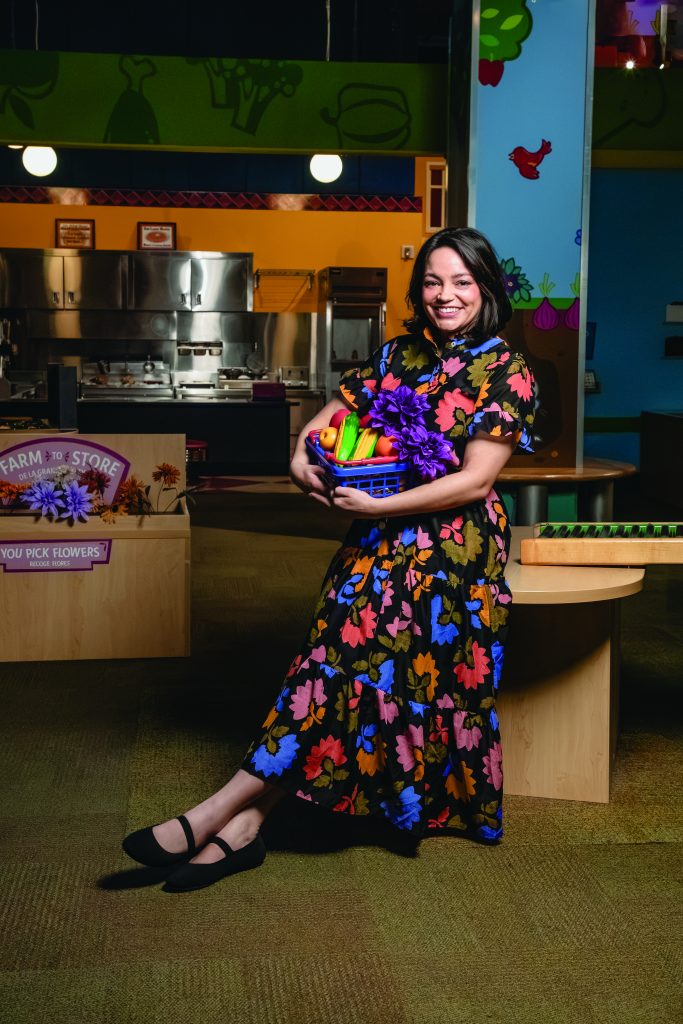
We have over 20,000 square feet of immersive environments designed to activate play’s many modes: imaginative, object, physical, etc. Some are mini-models of real-life places like cafés or kitchens, where kids can role-play being adults; some lean into “loose parts”—the pieces don’t have designated uses but are open for experimentation. We also lead more facilitated activities so folks can deep-dive into natural phenomena, scientific processes, and art practices.
How does being in Atlanta enhance the museum’s mission?
One of the things I love about Atlanta, and one of the things that I loved about the Twin Cities, is that it’s very diverse. There are people from a lot of different walks of life.
If you have a robust children’s museum, all these families have the chance to meet each other in a place structured around having fun and new experiences. I can’t think of a better social soup for inoculating kids against prejudice, against fear of people who are different from themselves.
On the flip side, it helps kids learn the feeling of “I belong here.” It’s not even a question—they sense that, “This place was built for me. I get to make choices. I get to listen to myself about what’s interesting to me.”
What do you—and the museum—actually mean when you say you want to change the world?
We want to explore ways to create an environment of social possibility. What can we do now to make a better future possible? In the world of adults, we talk policy and rules—but we need to look at the foundation those are built on. In that way, I think the work of the museum is like “pre-advocacy”: It’s about the fundamental values we want people to have—namely, deep respect and compassion for yourself and others. If you have that, you’re not going to harm yourself or others.
How do you do that through play?
You look for opportunities to tell kids that they have autonomy—they get to make choices. In the case of a three-year-old at the museum, that might look like honoring their desire to make a mess on Messy Thursdays and supplying the materials. You help them work through conflict by modeling healthy ways of disagreeing or acknowledging that difference exists, and that’s okay. I want them to know that the world is vast, and there are infinite ways to move around in it—and, actually, you’re the best person to figure out how you should do that.
My hypothesis is that if you invite people into a safe place where they’re treated with respect, allowed to make autonomous decisions, and enjoy themselves, they end up learning a lot of useful things for living life—for how we should do life for ourselves and towards one another.