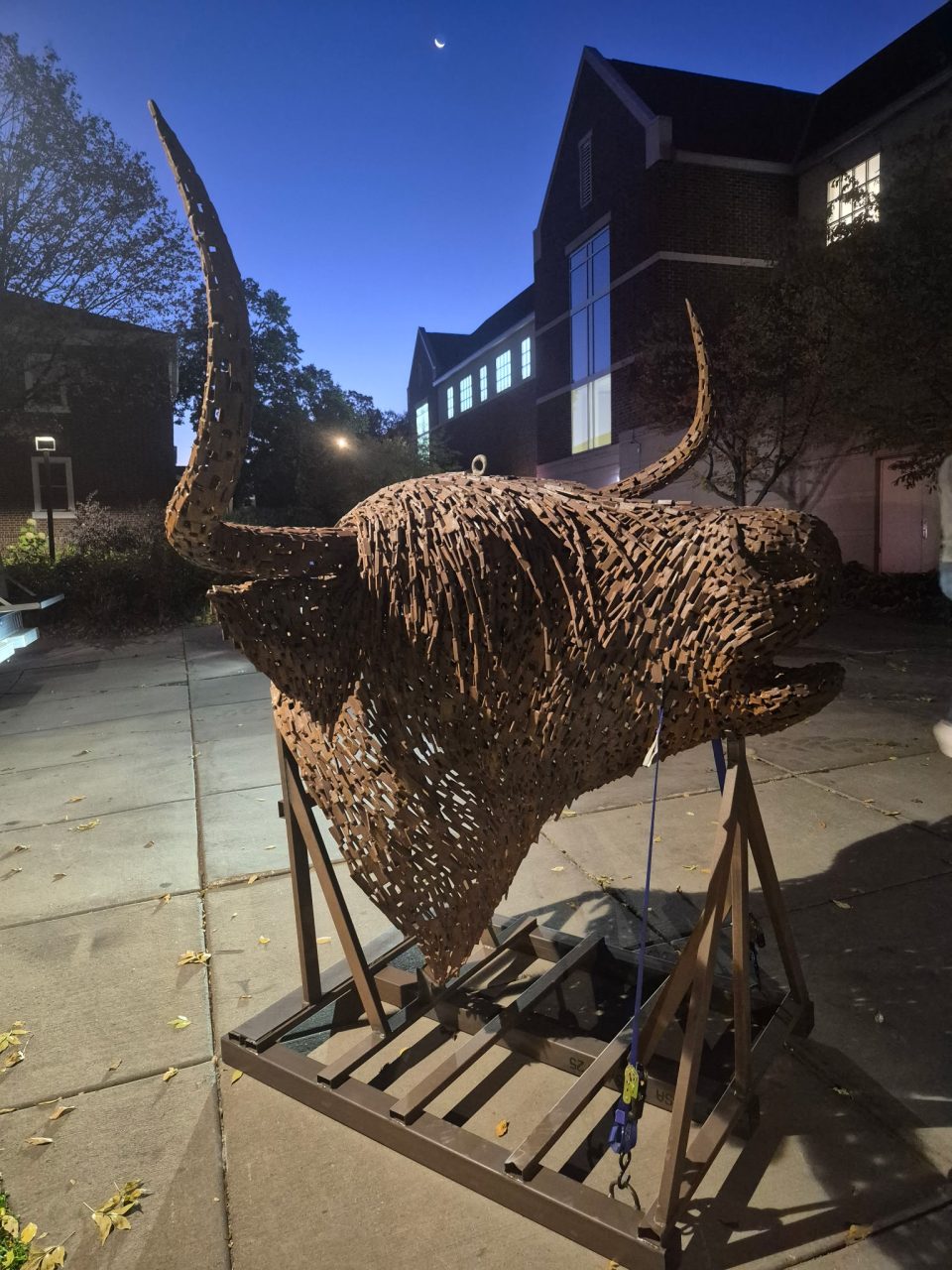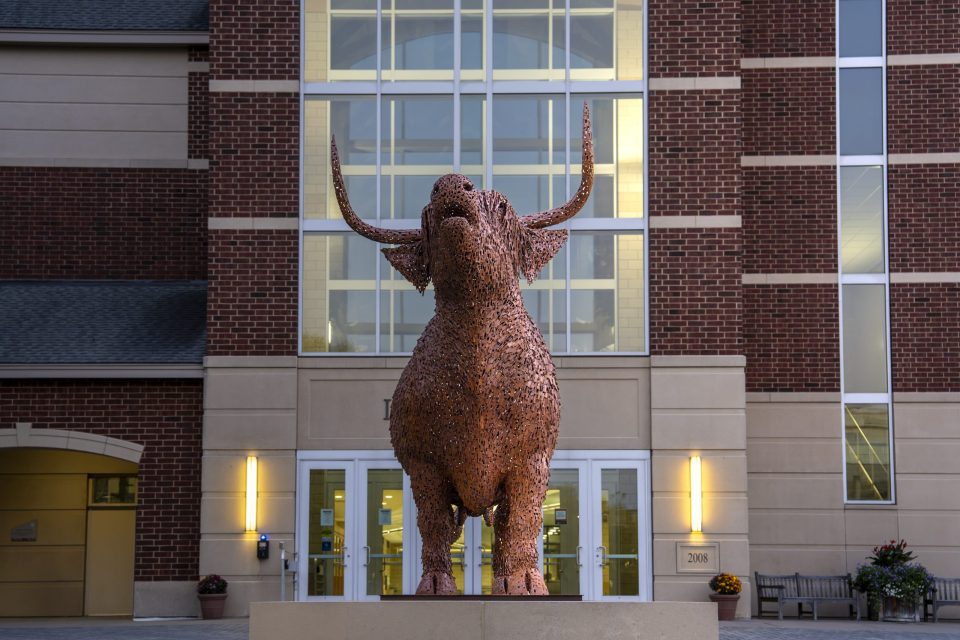




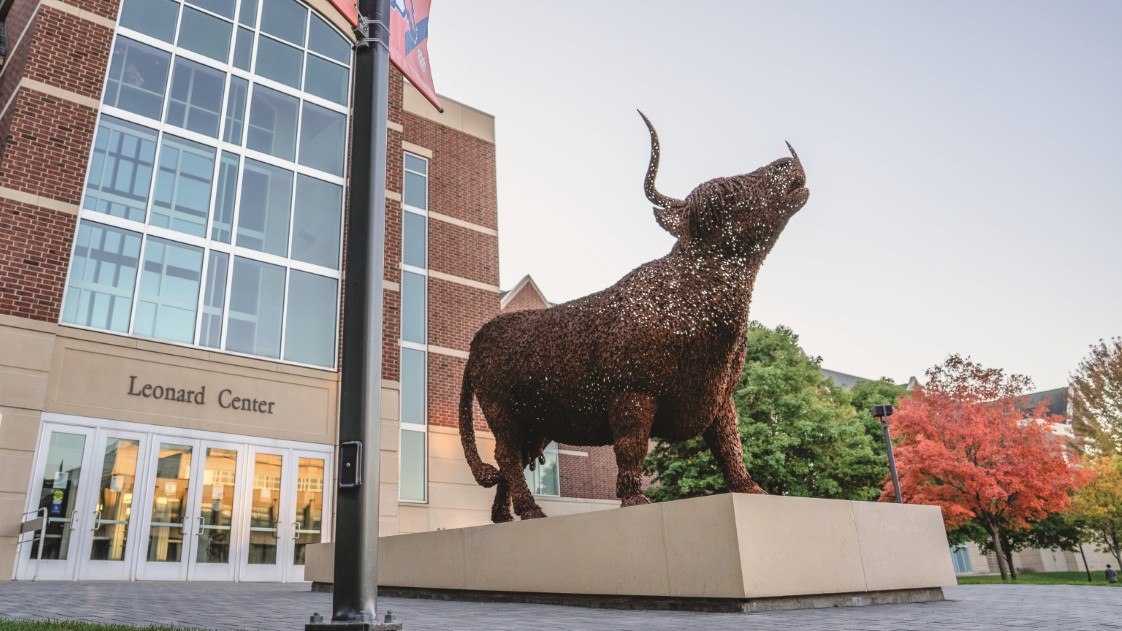
Created from a single sketch and welded together by hand with nary a computer in sight, an outsized Highland coo—poised with head held high and mouth open mid-bellow—came to life in a Los Angeles sculpture studio.
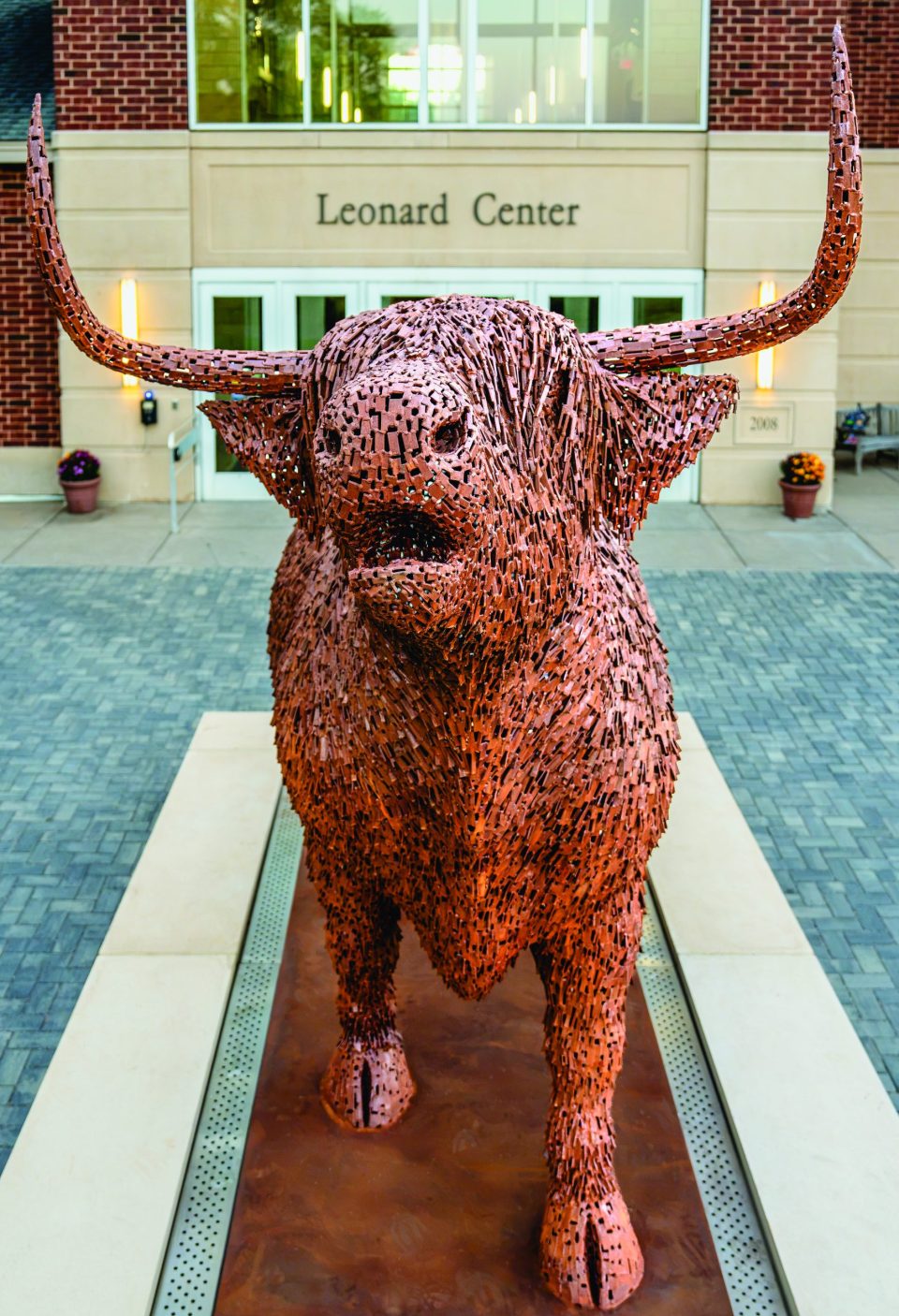
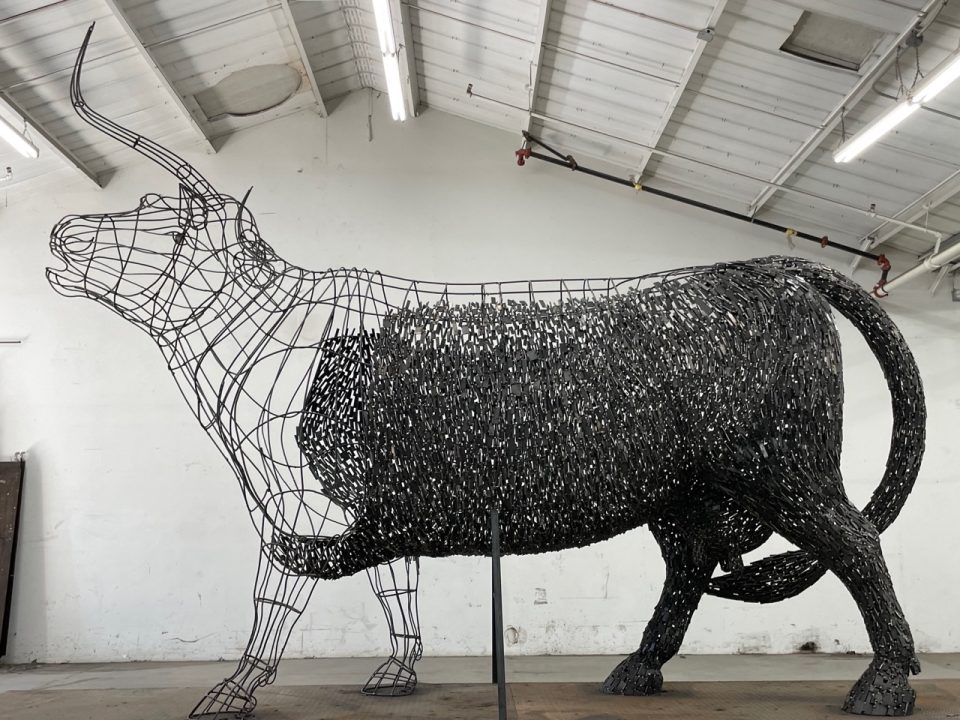
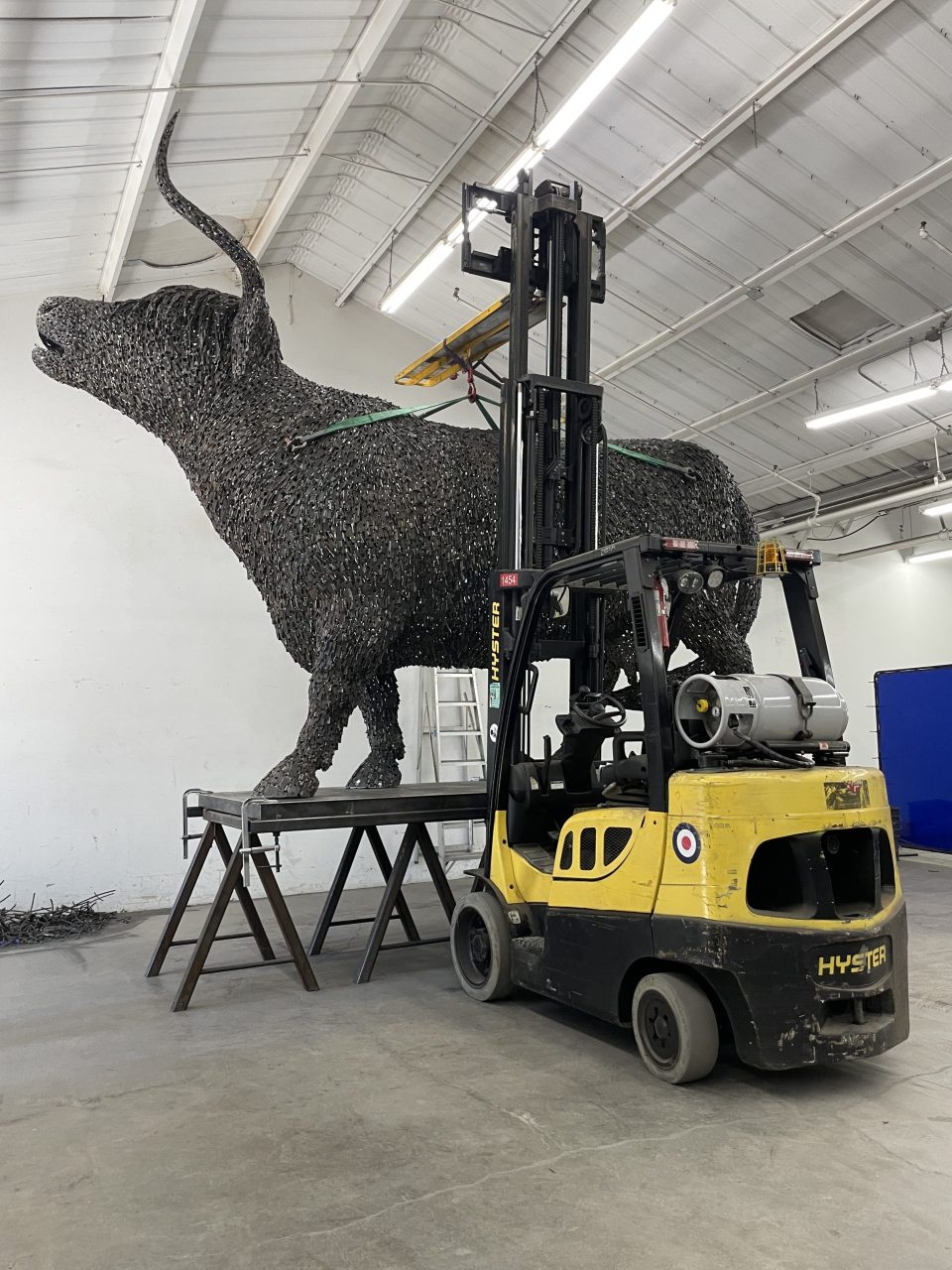
In April, that sketch served as the basis for a skeleton outline made of steel bar. By summer, she had a shaggy coat, a fringe of bangs, and a sweeping set of horns (and yes, this coo is a lady, udders and all). By early October, after a cross-country ride on a specialized semi-trailer, Coo, as she’s simply called, was lifted onto a large pedestal in front of the Macalester College Leonard Center. A new member of the fold had arrived.
For Andy Scott, a Scottish sculptor who holds the prestigious Officer of the Order of the British Empire designation, or O.B.E., it was a poignant arrival. The figurative sculptor had spent six months welding the spitting image of Mac’s new mascot into life.
“You begin to sense that a character starts to appear in the beast, especially when you shape the eyes,” Scott says. “She quickly became a big, powerful bovine watching over us every day in the studio. And it creates a sense of loss when it finally rolls out the door and there’s a big empty space where she once stood.”
Bittersweet, yes. But Coo clearly and joyously found a new home. Just an hour or so shy of her big reveal during a Mac Fest unveiling ceremony, the sculptor watched silently, unbeknownst to members of the Mac Theater and Dance Department, as they erected a custom screen to temporarily hide the massive cow. The screen would later drop to much fanfare, but, on such a windy fall day, and with such a large sculpture to hide (Coo tops out at twelve feet tall), it was a risky and unusual attempt at concealment.
“People don’t usually try this,” Scott chuckled while lounging on a nearby patio. “That’s dedication.”
Unveiling ceremonies for Scott’s works typically skip the specific “unveiling” part. And it’s no wonder. He’s known for monumental pieces like The Kelpies, the 100-foot steel horse heads in Falkirk, Scotland, and, much closer to Mac, The Calling, the soaring 89-foot loon outside Allianz Field on Snelling Avenue in St. Paul. There’s rarely a curtain big enough.
For the artist, who grew up on the south side of Glasgow, this new larger-than-life commission was uniquely personal. It’s not often an American liberal arts college with Scottish roots asks you to sculpt one of Scotland’s most beloved animals. The request took him back two decades to the day he brought his future wife and business partner, Hanneke, on a second date to a Highland cattle show.
“If you’d have told me then that some twenty-two years later I’d be standing at Macalester College in St. Paul unveiling a Highland coo,” Scott says, “I would have never believed you.”
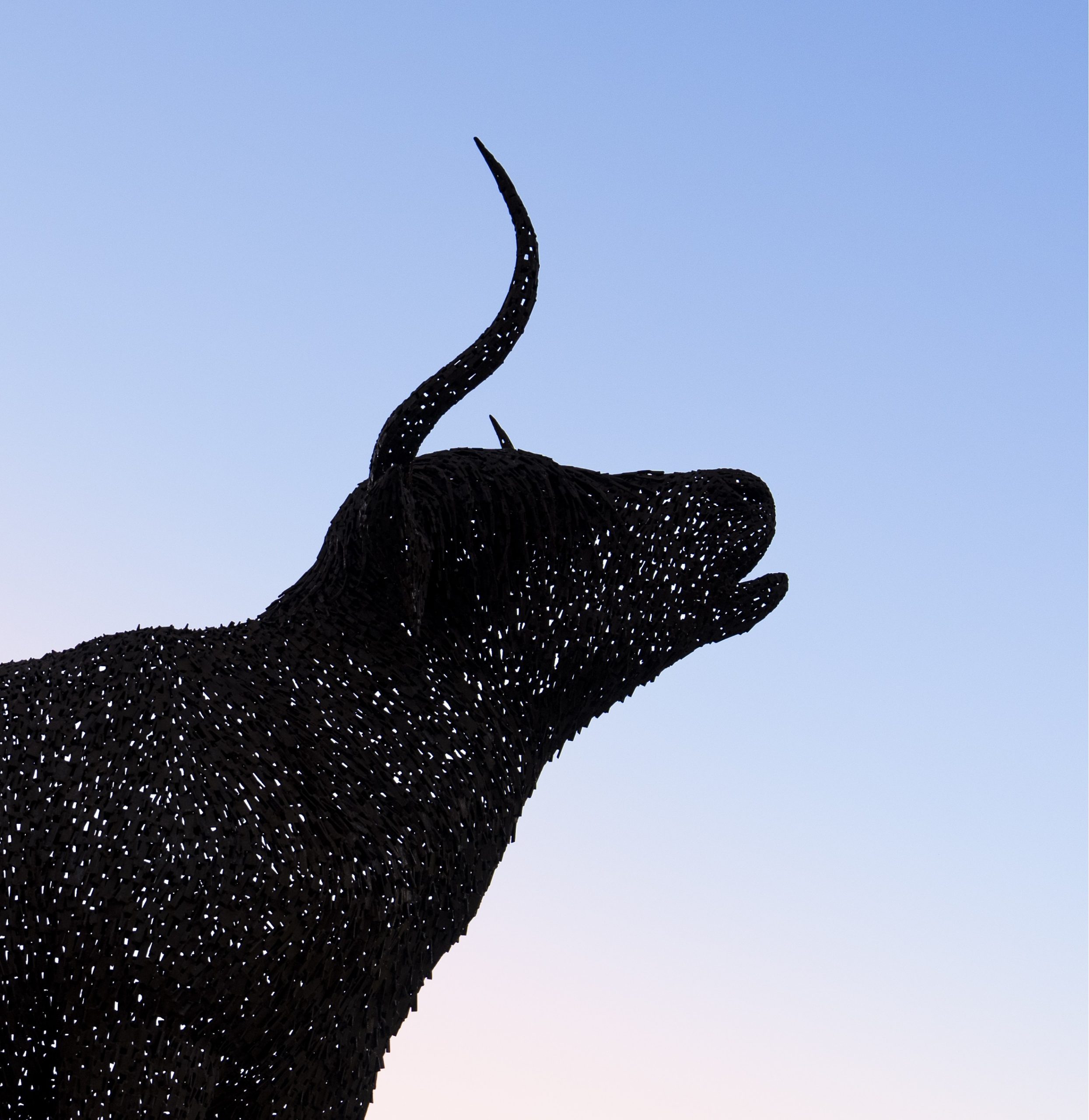
windswept hair overHai-coo by Beth Severy-Hoven, faculty
jaunty horns and laughing eye
steel coo, welcome home

From sketch to steel
The idea to welcome a giant coo sculpture to campus took root after Macalester named the calm and protective beast its new mascot in 2024. Dr. Bill McGuire, whose Minnesota United FC had commissioned The Calling, connected the college with Scott, and The Justin and Jansel Kelly Family Foundation graciously stepped forward to fund the sculpture as a gift honoring Macalester faculty. Scott sent over a single sketch. It was all Mac needed to green-light the project.
The artist and his studio got to work quickly—without the use of computer modeling. “We’re proudly, defiantly old-school,” Scott says. “Sometimes I think we’re the last dinosaurs in town, but I’m determined to stay that way.”
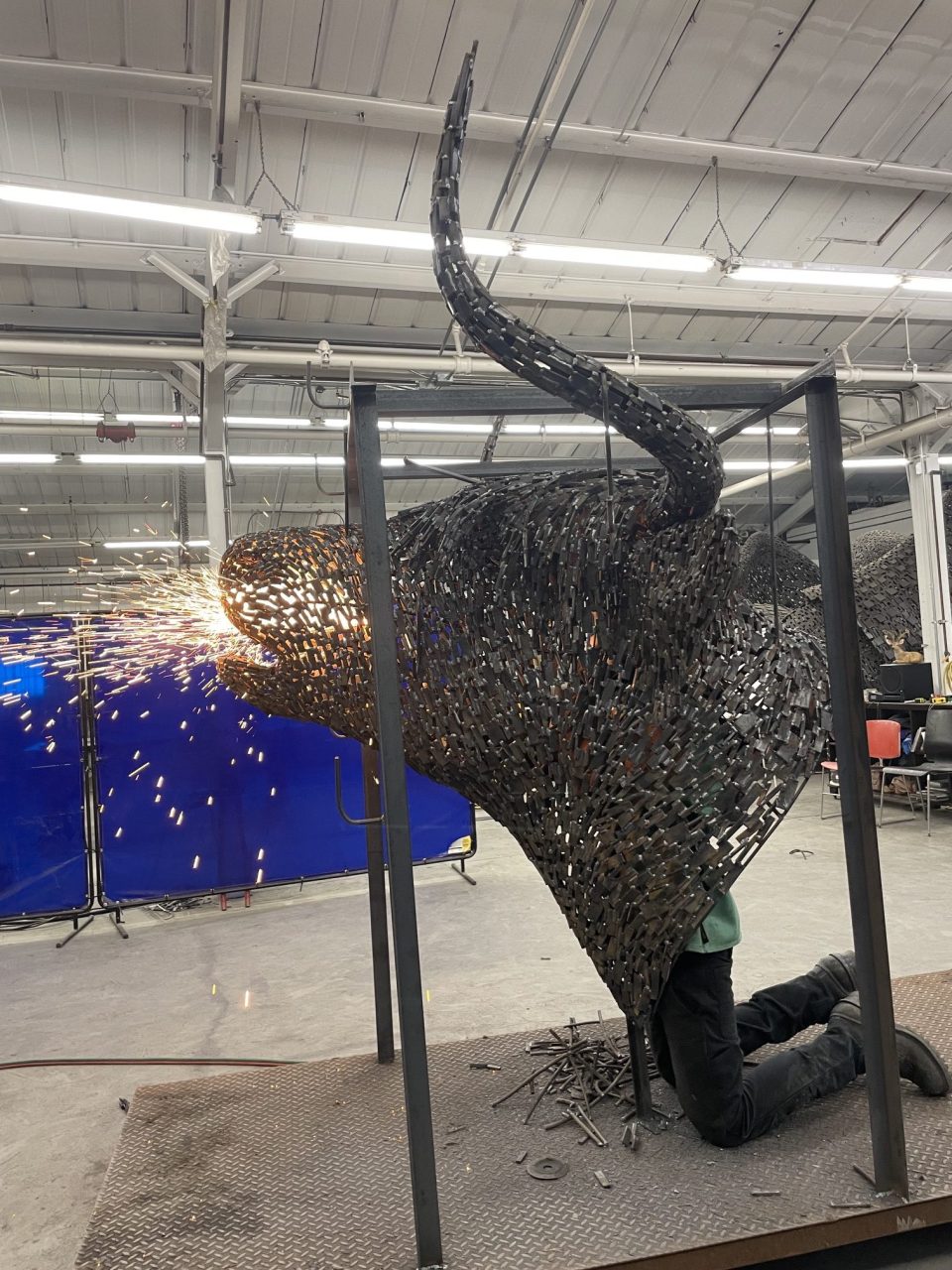
Once a hand-bent frame was complete, seemingly endless sheets of steel were fed through a sixty-ton guillotine, filling bucket after bucket with small steel segments. Then, starting at the hooves, the artist began to weld.
“I basically start at one corner and weld and weld and weld until I get to the other end—there’s no CAD (computer-aided design) drawings—and hopefully by the time I get done, it looks like a cow,” he says. “Most of the time, luckily for me, it does.”
Early on, Scott made the choice to give Coo a bit of Scottish energy, opening her mouth to capture the bovine mid-bellow. “I love the idea that she’s shouting out, ‘I’m here.’”
He also chose corten steel, which rusts to a protective patina that echoes the Highland cow’s rusty coat, and, as it turns out, matches the brick of the Leonard Center. “I wish I could say that I knew it would match the building,” he says. “Pretend that I did.”
It took roughly twenty-five weeks of welding to create Coo. In June, Scott took a single week off, putting down his five-pound hammer to cheer on Scotland at the World Cup in Boston (he wrote Mac leaders as he embarked, “I am off to pack my kilt.”).
Creating a Coo Timeline
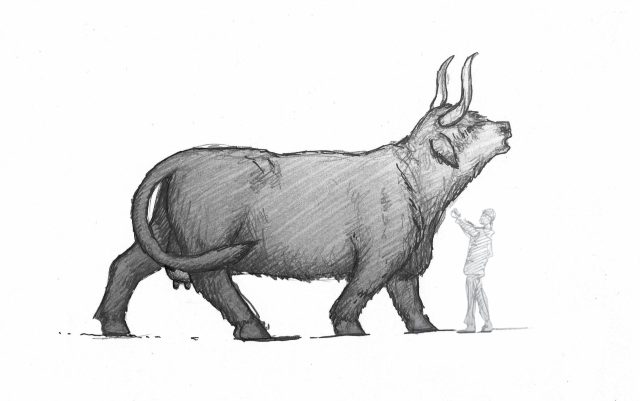
The Sketch
It all started with a drawing. Scott says it was the only sketch he made for the project.
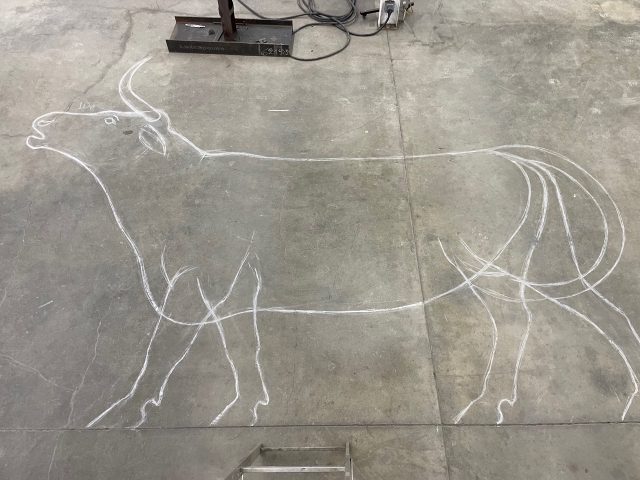
Chalk Outline
Before any steel was cut, Scott used chalk to outline Coo at full size on his studio floor.
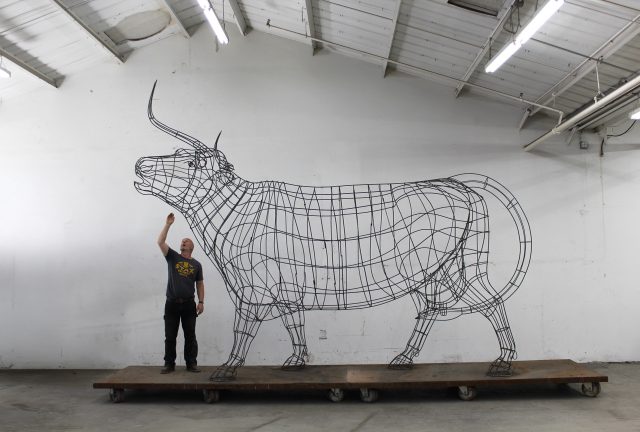
Steel Skeleton
By early April, the hand-bent steel frame was complete. “The pics with me in them give you a nice sense of scale,” Scott reported to campus.
Coming home to Mac
Coo arrived—in two parts, the body and head—on campus at 5 a.m. on Wednesday, October 7. Crane operators carefully assisted Scott and his team as they first lifted Coo’s body into place. Once she found her footing, they then attached the head.
The install, which took two hours, went like clockwork. “I always say I learn a lot from the crane crews and facilities teams, and this process was a breeze,” says Scott.
Scott stayed the week, and Mac put him to work. He visited a sculpture class, had lunch with student artists and student-athletes, and gave an artist talk for the community as part of Mac Fest.
At the unveiling ceremony on October 9, the pipe band played, the crowd counted down, and the curtain dropped—without a hitch.
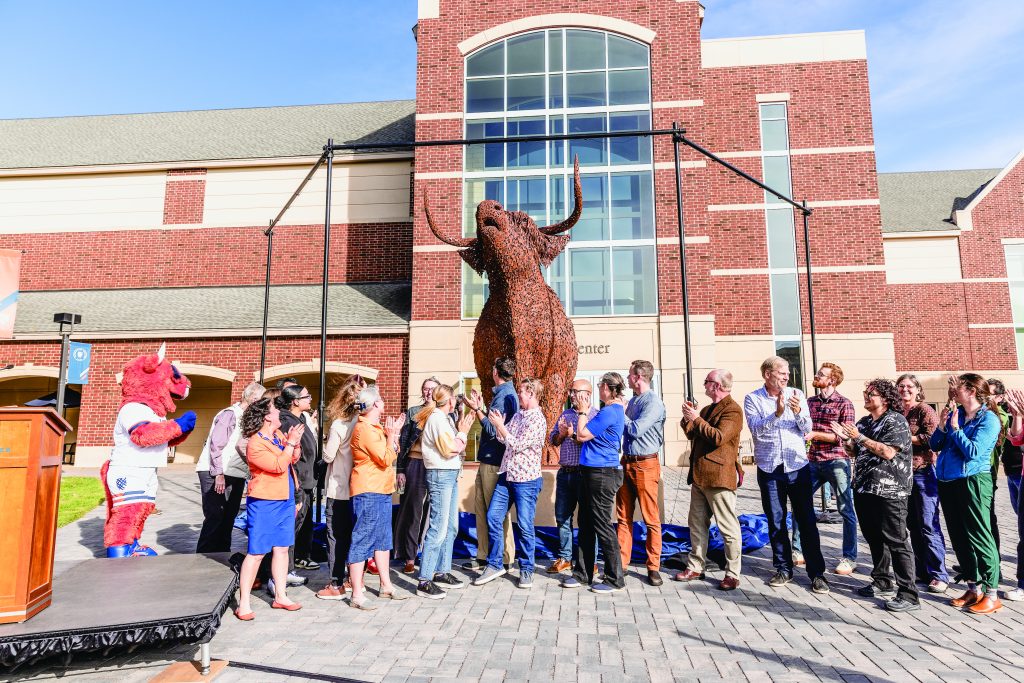
“Holy udders,” Donnie Brooks, associate vice president for Student Affairs and director of Athletics, exclaimed at the podium, welcoming a sculpture he said matches the Macalester temperament perfectly. “We’re welcoming. We’re grounded. And we do not back down.”
Studio art major Ash Granda-Bondurant ’27 told the crowd that they were “100 percent Team Loch Ness” during the 2024 mascot vote but said this shaggier alternative was easy to celebrate. “Coo is a symbol of hardiness, community, and a little bit of stubborn charm.”
Dean of the faculty Tom Halverson accepted the gift on behalf of the faculty. “It’s a bit transparent and a bit vulnerable. And like some of us, it has started to patina.”
At two and a half tons, Coo is a purposeful, sturdy gift to Mac, built to last for generations of Scots (and to withstand possible college shenanigans). “She’s a strong lady,” Scott says. “You could set a battleship on top of her. You don’t need to worry.”
But for all her hardy steel, Scott says Coo’s purpose is a much gentler one.
“Some artworks are full of deeper meaning. This is a simple, proud, bold statement. I hope she lifts your spirits. I hope she becomes a proud member of the Macalester campus.” His final message to the crowd at Mac Fest: “I hope you grow to love and enjoy and look after our cow.”