




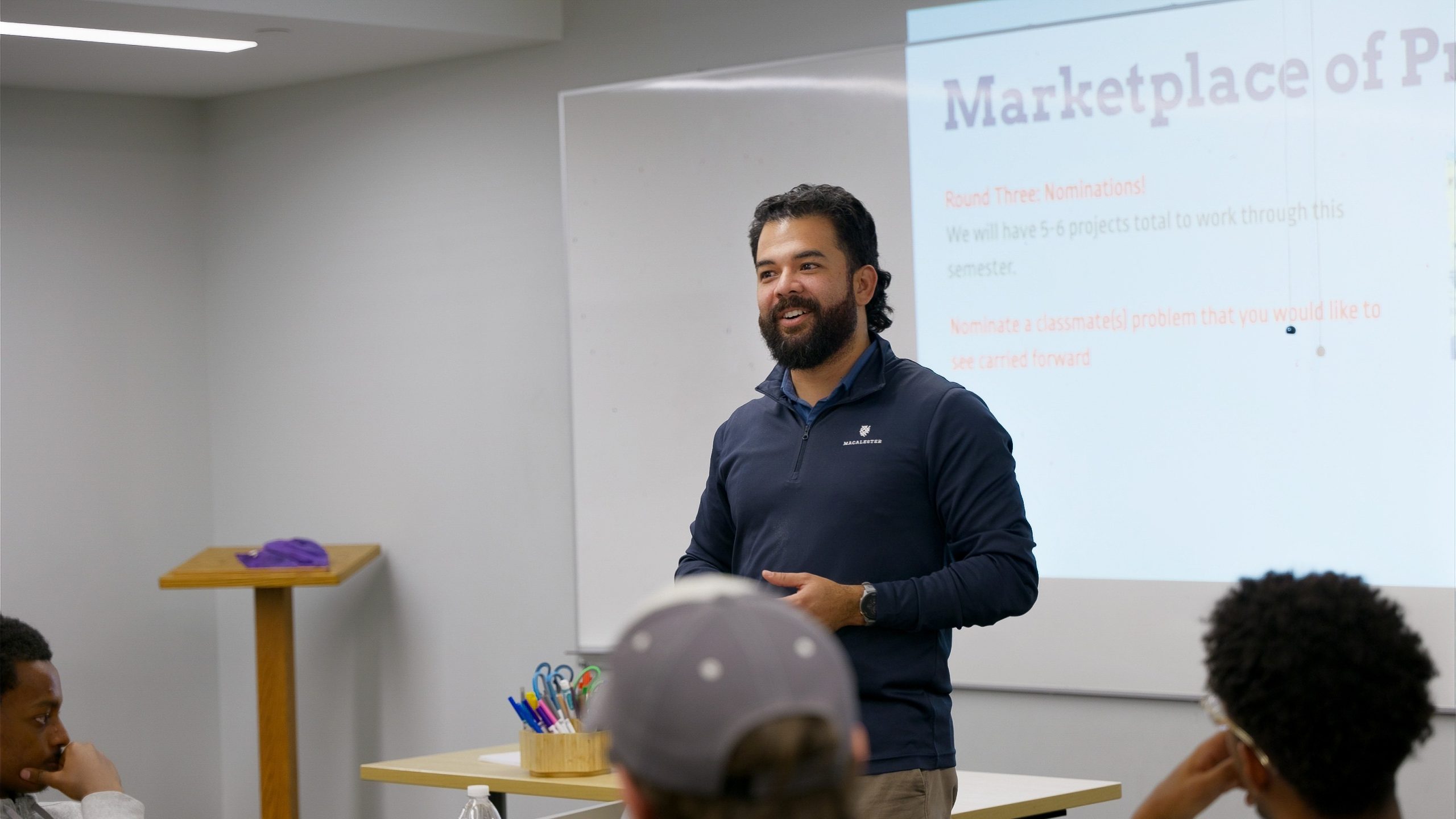
A pile of laundry growing untouched in a dorm room. The anxiety of job interview prep. A lack of reliable electricity available to community members in a town in Somalia. Each is an example of a unique problem tackled by Mac students in Intro to Entrepreneurship—a course that starts with a simple question: What is a problem in the world, near or far, that needs solving?
Co-taught by Erik Halaas, program manager in the Entrepreneurship & Innovation (E&I) Department, and Allan Martinez Venegas ’14, E&I’s director, the course trains students to identify a problem and to understand it deeply. Then, and only then, are they encouraged to think up solutions, create prototypes, and pitch ideas. We sat down with Halaas and Martinez Venegas to talk about their method and how anyone can embrace an entrepreneurial mindset professionally and personally.
Why start with the problem instead of a product?
AMV: We say, “Be obsessed with the problem, not with the solution.” Solutions are flexible. They’re fickle. They are the “how,” not the “why.” They can change. But the problem is what you always need to keep at the forefront. We have found that startups and ventures—even those beyond the realm of business—are most successful when they identify a meaningful problem to tackle and use it as their north star.
EH: The majority of businesses fail. And often, it’s not because the business wasn’t a good idea, but because it wasn’t solving a real problem or meeting a real need for someone. We talk a lot about this triangle of desirability, feasibility, and viability. And you have to start with desirability: Is this a need that actually needs addressing?
When finding a good problem to solve, you reference a “moment of obligation.” What is that?
EH: It’s those moments in your life where you experience something or are exposed to something that irks you, often over and over again, and you’re compelled to act. Many of the ideas our students tackle in the course come from these moments of obligation. Then the question becomes, “Is the problem big enough to matter but small enough to act on, and are you uniquely positioned to do something about it?”
What’s a student project that’s stuck with you?
AMV: We had a group of students who identified one of the most anxiety-inducing moments of a college student’s life: preparing for an internship or a job interview. Through their “inspiration” phase, meaning their research, they also identified that prevalent ways of preparing are not that effective, teaching you to perform rather than to be yourself. Often, you go online and find the ten most common interview questions and practice. After a lot of research and conversations with students and experts, including our Career Exploration team here at Macalester, they acted on the fundamental feedback that if interview prep feels like something you improve on consistently rather than cramming the day before, it’s often more effective. So they developed and tested prototypes. Finally, they learned how to create a persuasive, compelling story that moves people to act, to buy into this solution and the problem it tackles. By the time they presented, people in the audience were asking how they could invest.
What is the “entrepreneurial mindset,” and how might alumni apply it in their own lives?
AMV: When teaching at Mac, the entrepreneurial mindset is less about venture creation and more about embracing an action-oriented method that goes from identifying your moment of obligation to taking action in a way that creates meaningful value for yourself and others. Anyone who follows our five action steps—identify a meaningful problem (framing); learn from real people about that problem (inspiration); come up with lots of ideas and select your best ones (ideation); craft and test increasingly more developed prototypes and devise a plan (implementation); and tell a great story about your work (storytelling)—can embrace an entrepreneurial mindset.
What does it mean to embrace entrepreneurship at Macalester?
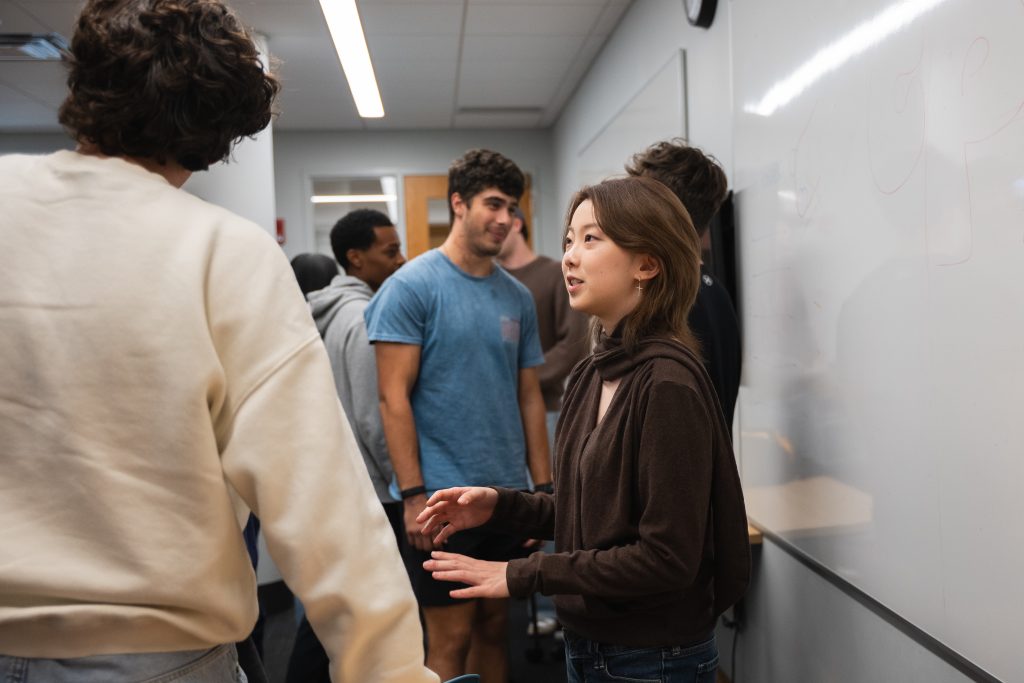
EH: Entrepreneurship, at its core, is about problem-solving. It’s about heeding your moment of obligation, conducting effective research, incorporating multiple perspectives, crafting bold ideas, and encouraging counterthought to your narrative. You take all of that information and go out into the world and take action with purpose. That’s what we’re trying to teach our students, of any major, to do with their Mac education.
We love the energy that comes with the breadth of students engaging in entrepreneurial thinking. Especially in this course, we get to see what happens when you pair someone working in linguistics with someone in computer science or the fine arts. We get to see what collaboration looks like when those same folks work together to tackle a meaningful problem—it’s liberal arts at its finest.
Why does this kind of course matter for career readiness, even for students who never start a business?
AMV: One reason this all fits at Macalester is that it’s another way Mac offers students a chance to take action on something they care about. The entrepreneurial mindset teaches a specific, action-oriented methodology for doing that—no matter what direction you go. If you go into a social impact organization, you’ll be better equipped to identify problems, be innovative with the resources available, and rally others to your cause. If you’re in a corporate setting, you’ll be able to make a really good argument as to why this is the right thing to invest in. Entrepreneurship is a way to stay curious, take initiative, be bold, and create value for yourself and others.