



Theodore Mitau Lecture
Alyssa Battistoni delivers the 2026 Mitau Lecture “‘Free Gifts’: Capitalism and the Politics of Nature” in Macalester’s Mairs Concert Hall [2/19/2026]
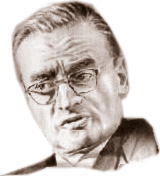
Theodore Mitau was born in Berlin in 1920 to a well-established Jewish family. By the age of fourteen, he had to adorn the Star of David to the clothes he wore to school, and soon thereafter realized that further educational possibilities would be severely constrained by Nazi policies toward the Jews. During the mid-1930s, German Jews primarily feared increased discrimination and exclusion; no one had yet thought of genocide. Accordingly, he left for the United States, where he completed his undergraduate studies at Macalester College, and earned a doctorate in Political Science at the University of Minnesota. No other member of his family survived the Holocaust. Despite all efforts to get his mother to safety in the United States, Rosel Mitau eventually perished in the Theresienstadt concentration camp near Prague.
Though he buried within himself much of this personal tragedy, even from his wife and children, his daughter Andrea Mitau Kircher notes “ It made him that much more determined to accomplish something, to try to make the world a better place.” No doubt, the energy and passion with which he threw himself into his teaching and research stemmed from this intensely personal sense of mission. One can see it captured in photographs of Mitau the teacher; one can sense it in the anecdotes alumni recount of this small, wiry man with boundless enthusiasm who, in a probing but joyful Socratic manner, invariably managed to elicit from them the best, individually and collectively. Under Theodore Mitau’ s leadership, Macalester’ s new Political Science Department flowered into one of the most preeminent at the College, and soon generated both state and national attention, given its association with Hubert Humphrey, Mitau’ s colleague, and Walter Mondale, a student of both.
Unlike older German academic expatriates who were formed in a tradition at once culturally brilliant but politically and pedagogically autocratic, Mitau fully embraced American democratic institutions and values. His scholarly interests largely centered on U.S. Politics, primarily the areas of state and local government, and the Supreme Court. His major books include: Politics in Minnesota (1960); Proximate Solutions: Case Studies in State and Local Government (1964); State and Local Government: Politics and Processes (1966); and Decade of Decision: The Supreme Court and the Constitutional Revolution (1967). He addressed similar topics in numerous articles published in professional journals of law and the social sciences. Mitau’ s intense commitment to democratic institutions was also reflected in an active public life quite unusual for otherwise busy and engaged academics. He was a consultant to governmental agencies, commissions, and committees, as well as to public service associations (U.S. Civil Service Commission; U.S. Department of Health, Education and Welfare; U.S. Senate Committee on Constitutional Revision; Minnesota Legislative Commission on Election Laws; and the Minnesota Historical Society). In March 1968, he left Macalester to become Chancellor of the Minnesota State University System where he instituted innovative methods of teaching and reached out to a broad spectrum of non-traditional students. In 1976, he was appointed a Distinguished Service Professor by the Board of Trustees of the state system, recognizing his manifold contributions as well as his desire to pursue his teaching and research interests. That same year, he returned to Macalester College as an adjunct professor of Political Science. At the time of his untimely death in 1979, Mitau was working on a new volume entitled Constitutional Frontiers in Personal Privacy.
Lectures
2026 Mitau Lecture
Alyssa Battistoni
“Free Gifts: Capitalism and the Politics of Nature”
2025 Mitau Lecture
Charmaine Chua
“What Does Anti-Imperial Working Class Internationalism Mean Today?”
2024 Mitau Lecture
Omar Wasaw
“Narrative Power: How the Civil Rights Movement Overthrew Jim Crow”
2023 Mitau Lecture
Adom Getachew
“The Universal Race: Garveyism and the Practices of Pan Americanism.”
2022 Mitau Lecture
John Ikenberry
“Does the Liberal Order Have a Future?”
2021 Mitau Lecture
William Darity Jr. and A. Kirsten Mullen
“From Here to Equality: Reparations for Black Americans in the Twenty-first Century”
Tiffany Willoughby-Herard
“I’m Really Sorry about What Happened to You but, You’re Not One of Us, You’re a Foreigner’: A History of Afrophobia in Contemporary South Africa”
2020
- Patrick J. DeneenThe Case for Illiberal Democracy
2019
- Cathy Cohen
Race, Race, and Vulnerability: The Politics of millennials in the Era of Trump
2018
- Jill Locke
The Trump Presidency and the Death of Shame
2017
- Jennifer L. Hochschild
Here They Treat Us Like a Different Race: Political Implications of Class-in-Race Inequality
2016
- Ian F. Haney López
Trumpeting Racism: Race, Politics, and Economic Jeopardy for All
2015
- Adolph Reed
How The Left Redefined Social Justice: Capitalist Class Power and Inequality from FDR to Obama
2014
- Alfie Kohn
Many Children Left Behind: “School Reform” and Corporate-Style Education Policy
2013
- Harold Hongju Koh
International Law As Smart Power
2012
- Lani Guinier
Rethinking Race and Class
2011
- Rogers Smith
Christopher H. Browne Distinguished Professor of Political Science, University of Pennsylvania
2010
- Paul Light
Paulette Goddard Professor of Public Service, NYU Wagner
2009
- Wendy Brown
Professor of Political Science At University of California, Berkeley
2008
- Alexander Wendt
Mershon Professor of International Security At The Ohio State University
2007
- Derrick Bell
Visiting Professor of Law At New York University School of Law
2006
- Ann-Marie Slaughter
Dean of the Woodrow Wilson School of Public and International Affairs At Princeton University
2005
- Kathryn Sikkink
Arleen Carlson Professor of Political Science At the University of Minnesota
2004
- Orlando Patterson
John Cowles Professor of Sociology At Harvard University
2003
- Michael Ignatieff
Director of the Carr Center for Human Rights Policy At Harvard University
2002
- Jeffrey Rosen
Associate Professor at the George Washington University Law School
2001
- Michael Walzer
UPS Foundations Professor and Executive Officer of the School of Social Science, Institute for Advance Study, At Princeton University
2000
- Martha C. Nussbaum
Ernst Freund Distinguished Service Professor of Law and Ethics at The University of Chicago
1999
- Michael J. Sandel
Professor of Government at Harvard University
1998
- Randall Kennedy
Professor at the Harvard Law School
1997
- Jean Bethke Elshtain
- Laura Spelman Rockefeller Professor of Social and Political Ethics, University of Chicago
1996
- Theodore J. Lowi
John L. Senior Professor of American Institutions, Cornell University
1994
- Nancy Fraser
Professor or Philosophy, Northwestern University
1993
- Andrew Ross
Professor of American Studies, Princeton University
1992
- Richard Mohr
Professor of Philosophy, University of Illinois
1991
- Sylvia A. Law
Elizabeth K. Dollard Professor of Law, Medicine, and Psychiatry, New York University Law School
1990
- Benjamin R. Barber
Professor and Walt Whitman Chair of Political Science, Rutgers University
1989
- Robert Ellis Smith
Editor, The Privacy Journal
1988
- Frances Olsen,
Professor or Law, UCLA and - Patricia Williams
Professor of Law, City University of New York at Queens
1986
- Philip B. Kurland
Professor of Law, New York University
1985
- Howard Zinn,
Professor of Political Science, Boston University
1984
- Ruth Macklin
Professor of Bioethics, Albert Einstein College of Medicine
1983
- Fred W. Friendly
CBS Broadcast Journalist
1982
- Alan F. Westin
Professor of Law and Government, Harvard University
1981
- Arthur R. Miller
Professor of Law, Harvard University
1980
- Stephen K. Bailey
Professor of Public Policy and Education, Harvard University
1979
- The Honorable Walter F. Mondale