



Swinging into New Territory: The Baseball Class
By Jizelle Villegas ’26
The Words sat down with Professor Matt Burgess and Fiona Candland ’26 to discuss the English and history cross-listed course: Baseball: History and Literature. Matt and Professor Ernesto Capello, in the history department, co-teach it, and Fiona was a Research Assistant in preparation for the course.
Matt and Prof. Capello shared a bond of baseball games, specifically Mets games, which Matt described as having “a kind of tortured fanbase,” and they started watching them together and talking about baseball. Matt said: “It’s fun to talk to Ernie, period. And [we] were like, ‘How do we get paid for this? How do we turn this into a whole class?’”
The process of brainstorming for this class happened pretty fast. “We had the idea to teach the class and then we were like ‘Okay, if we are going to do it, let’s do it in the Fall.’” There is a grant through Macalester, where people associated with the college provide endowments, which was able to fund this class. Robert Warde, a former professor in the English department, who actually had Professor Peter Boganni’s office, taught a baseball class that was really popular. Warde is a contributor to an award to fund historical English courses and “it was the perfect opportunity for [this],” Matt shared. “We had to hustle to figure out what we were going to do. So I had Fiona Candland, she was a Research Assistant for me, and I had her read a ton of baseball stuff I gave her and some that she sought out on her own.” Fiona provided very useful feedback to Matt about which readings were good, which ones were kind of boring and “shouldered a lot of the load” of that preliminary work.
When sitting down with Fiona, she said “I love baseball and I watch a lot of baseball, but only in its raw form but never interacted with the cultural responses to baseball.” Matt gave her two big baseball anthologies—which contained 800 pages—and then a shorter creative nonfiction book. Through reading, she had the choice to stop if something was not interesting enough and prioritize other short stories or poems that were exciting to read. She had a notebooking process: works that she felt were necessary to be added to the class syllabus, works that she would like to talk about more, felt iffy about it or didn’t finish it, and didn’t feel like it would benefit the class. The two of them met once every two weeks, sharing laughs, and Fiona expressed how this research felt like “fake research.” Matt reassured her that this is what research is: reading things thoroughly, having fun and talking about those things.
“I was trying to read with intention,” Fiona said, as Matt pushed her to read the different literary works thoroughly and provide analysis on why she had a certain opinion about each work. Another motivating factor for this research position was just the fact that she loves baseball and wanted the students taking the class to also love it, so great consideration, passion, and thoroughness went into her reading and analysis. Though Matt and Prof. Capello were the main ones configuring the syllabus structure, Fiona shared that she “tried to stick her foot in a little bit” and try to suggest where certain works of literature could be placed into the syllabus.
Fiona did extraneous research for this class and although she’s not currently taking it (even though Matt wanted her to), she is still impacted by the experience. “It feels like I was a part of something bigger. Again, I tried to stick my foot in creating the class and I hopefully think I did a little bit,” Fiona jokingly said. Whenever she sees Matt, she asks about the class and it’s nothing but good things and how they’re reading a certain work that she read. “It feels really gratifying, and I feel really happy [about] the intersection of sports and literature.”
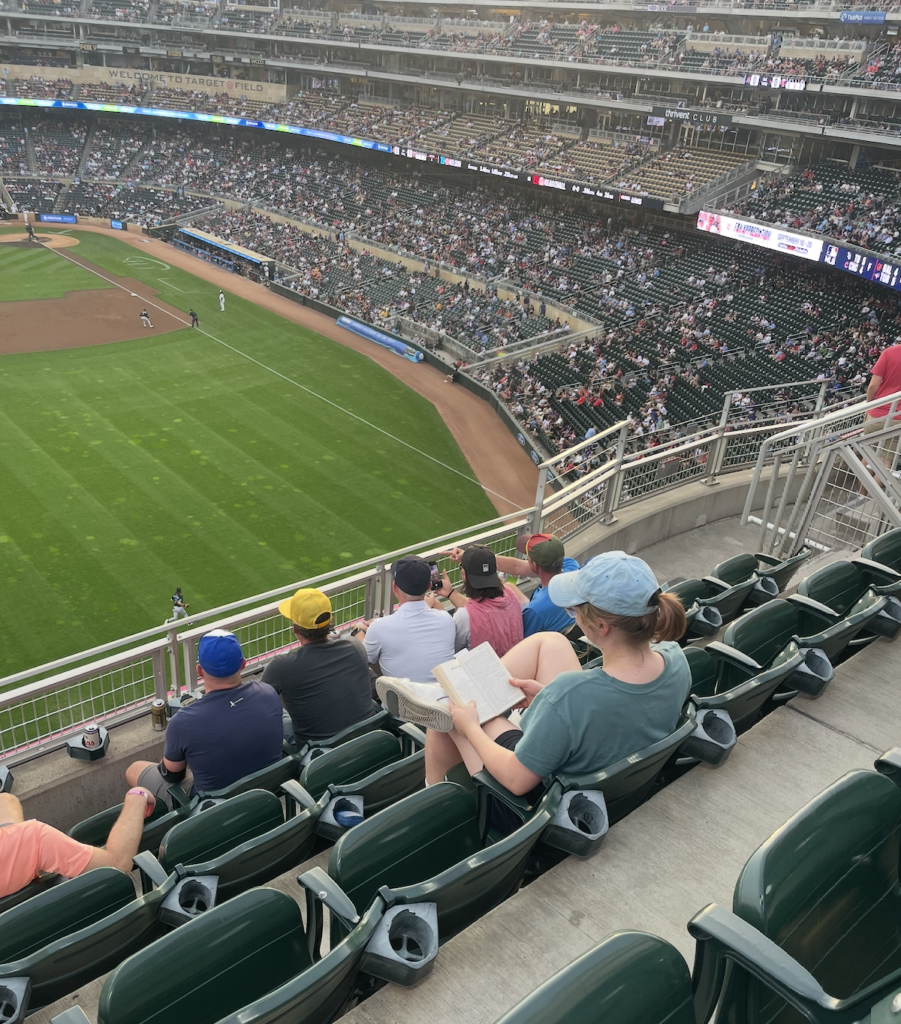
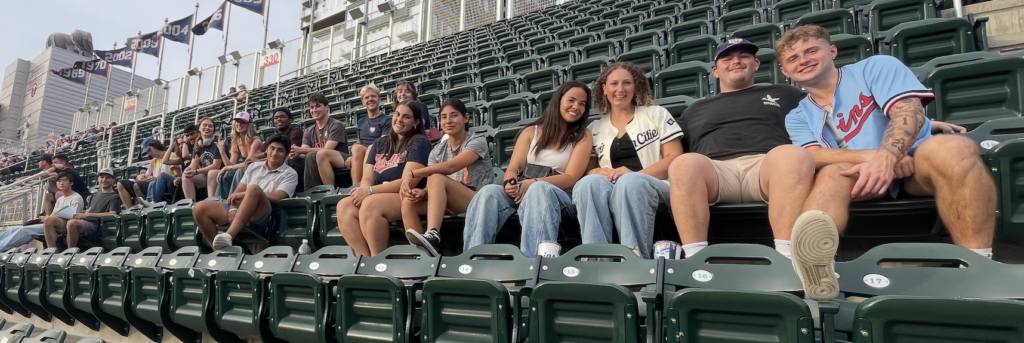
The class itself includes many different intersections: going to actual games, like a recent Twins Game, getting tours of the stadium, and writing supplemental creative nonfiction pieces about the games and biographical essays about baseball players. It is a good blend between getting historical background and writing different works throughout the course and what’s to come. For some of the assignments, Matt shared: “It’s three creative nonfiction pieces and then at the end they write a historical fiction piece. They[’ll] generate their idea for the historical piece through a journal for baseball literature that was started by a former Macalester student who took the class with Robert Warde.” The intersections in this class go way back and it sounds like a fresh take on the former baseball class, while still honoring those who either created or took the class. The student who created the journal will come to the class to speak to the class!
They divided the semester into fourths: writing and thinking about going to a baseball game, player profiles, a memoir piece (which they haven’t started yet), then the historical fiction short story. They’ll also watch Field of Dreams and Amazon Prime’s show A League of Their Own, which Matt and I shared disappointment over its untimely cancellation. After hearing all of this, I wish I had taken the class.
To end the conversations I had with Matt and Fiona, I asked them the same question: What do they hope for the future of this Baseball class?
Fiona has such a passion for baseball (and softball, which she used to play for two years at Macalester). She shared how sports doesn’t always allow for emotions to come to light, except if it’s a “man crying with a beer.” She recalled a work of writing that she read about an orphanage house for people who were brought up from the farm system (feeder system in baseball) to play for one of the Chicago teams and they became a family through this experience of living together. “My hopes are that people start to recognize athletics, just like any other community oriented experience, is deeply emotional and deeply personal,” Fiona said, and the literature chosen for this class speaks to that love and passion that goes into sports and also writing about sports.
For Matt, he started off by saying “It’s such a Macalester-specific class in that we want to embrace the liberal arts. Here’s two disciplines and here’s a way of thinking about the world and interacting with the world through different ways of thinking.” Also, Macalester is situated within the Twin Cities, which has a lot of access to baseball games and generally fun things to do. “If we can make use of going to a Twins games, let’s do so. Let’s have experiences for students like that, engaging with this robust community,” he shared. The mode/approach that he and Prof. Capello took: just two professors that have a similar adoration for something and deciding to teach a class with similarly passionate students could be applied to any type of cross-listed course, which is one of the main hopes Matt has.
Great conversations were had with Matt and Fiona about the various work and fulfillment that came from working on this Baseball class. Hopefully in the near future Matt and Prof. Capello will teach it again, and Fiona’s work and hopes will transcend for future Macalester students in either the English and Creative Writing department, sports, or any other disciplines.