



Catching up with Professor Coral Lumbley
by Jizelle Villegas
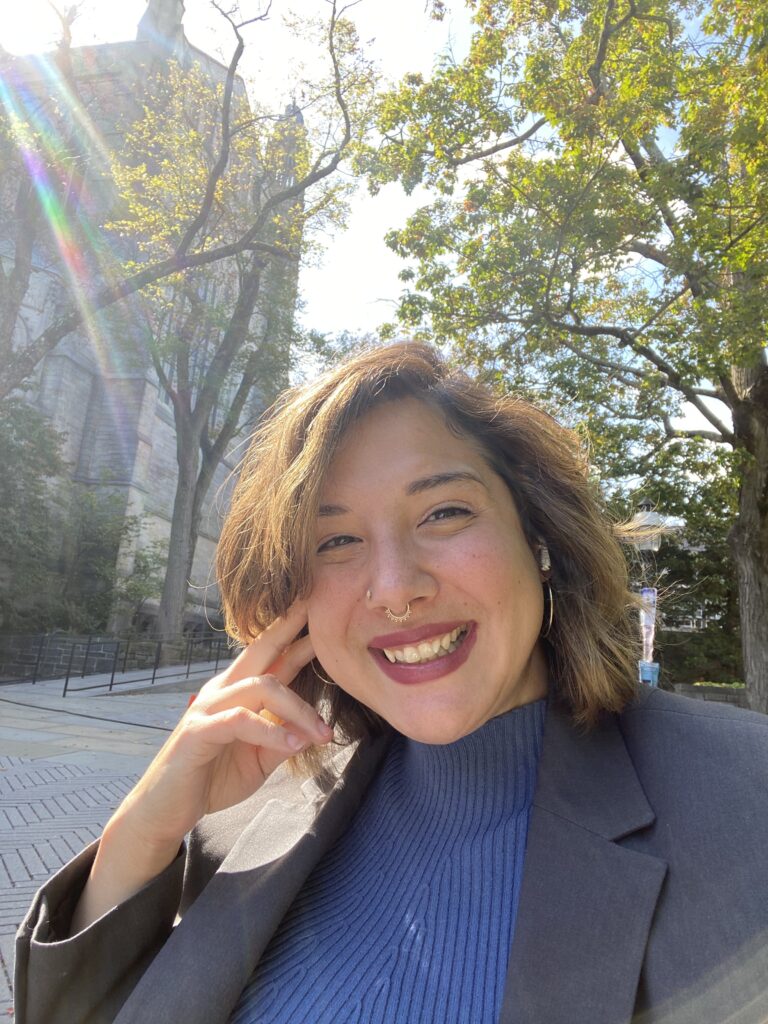
The Words got in contact with Professor Coral Lumbley, who is currently on sabbatical, and is a member of the Institute of Advanced Study (IAS) in Princeton, New Jersey this academic year. We asked her some questions about what she’s been up to!
1) How did you feel when you were notified about your selection to be a part of the Institute of Advanced Study?
I felt incredibly honored to be selected. Many of my intellectual heroes have been members and faculty, so I felt confident that the IAS would push my research and writing onto a new level. The timing is lovely as well, since our current IAS director, David Nirenberg, is also a medievalist!
2) I see on the IAS website that you’re writing a monograph about environmental thought and colonialism in medieval England and Wales. How did you get to this focus in environmental thought? How has the monograph been going? What texts have you been working with/drawing inspiration from?
My book began as a project on race and race-making in medieval England, and as I worked longer and more deeply with the Welsh materials, I realized that these medieval conversations about power and identity were really lodged in the landscape itself. Welsh writers embed histories and cultural identities in mountains, valleys, rivers, and seas, and this non-urban focus resonates with my own rural background. At the IAS I get to write every day for up to ten hours, so I am rediscovering my love of writing as exploration. Right now I’m very inspired by the nature-focused poems in the Book of Taliesin, Geoffrey of Monmouth’s Life of Merlin, and everything by Donna Haraway.
3) How has being in Princeton, New Jersey and amongst other scholars in the program helped with your own research? Have you gained new skills thus far?
Working in Princeton has allowed me to access an extremely expansive set of library collections, including incredibly rare and valuable texts. Yet the IAS is also nestled up against the Institute Woods, where I am inspired every day by the magic of oak, hazel, deer, fungus, lichen, and hawks. In terms of research, I’m improving my Middle Welsh orthographic skills. The spelling in medieval manuscripts isn’t regularized, so it can be a bit like solving a puzzle.
4) What does it mean for you to be a Member in the School of Historical Studies at IAS? How has taking on this prestigious research opportunity changed, if any, your outlook on research and historical/English studies?
The opportunity to gather and share ideas with colleagues from around the world is simply invaluable. I have realized just how much love we have for our fellow humans, and that this love is expressed in extremely different ways. As a literary historian, I can’t help but notice how the human experience is constantly interpolated by layers and layers of stories, some oral, some textual. I am also awed by the sheer multilingualism of all the scholars here, and feel confident that we should all be studying language all the time.
5) How is the program structured for researchers and scholars?
The program is structured differently for each School; some researchers work in labs, while others work independently. The School for Historical Studies prioritizes individual time for research and writing, but we also have a weekly Colloquium where a Member presents their work. We also have area-focused seminars, which meet a couple times a month. In seminars, we may discuss readings or distribute our own research for workshopping. This year, there is a new program called Interdisciplinary Lunches, where specialists present their research for the whole IAS, including non-specialists. It has been a wonderful opportunity to discuss big topics like AI with mathematicians, geologists, social scientists, and astrophysicists.
6) What are your hopes for this research/monograph you’re writing? What are you looking forward to with the remainder of the program?
First of all, my main goal is to simply publish a book that I would like to read. Anything else is just icing on the cake! I hope that this monograph will push my field (medieval literary history) to consider Welsh literature more seriously, and to consider the land that they study and live on with greater depth. I hope that choosing texts from both England and Wales and that blending historicist, philological, and theoretical methods will help build bridges between various fields that don’t always interact (like Celtic studies, English literary studies, political historians, and environmental historians).
7) Do you think this research will influence a future class you’ll teach at Macalester? If so, how?
My research at the IAS will definitely influence the classes I teach at Macalester! I am planning a course on how time intersects with landscape in Celtic Otherworld narratives, a course on Chaucer and question of Truth, and a class on mortuary genres of Britain (which would include things like the Welsh “Stanzas of the Graves.”
8) Anything else you’d like to share about your time there? (maybe a favorite coffee shop you’ve been to, bookstore, favorite memory)!
A perfect Princeton afternoon is a stop into Labyrinth Books, then ham and pineapple pancakes at PJ’s Pancakes. Don’t knock ’em till you’ve tried’ em!
We hope the rest of Coral’s time there is wonderful. We are looking forward to her being back for the 26-27 academic year!