



Alum Spotlight: M.L. Kenney ’18 on Graduate School, Teaching, and Risk-Taking
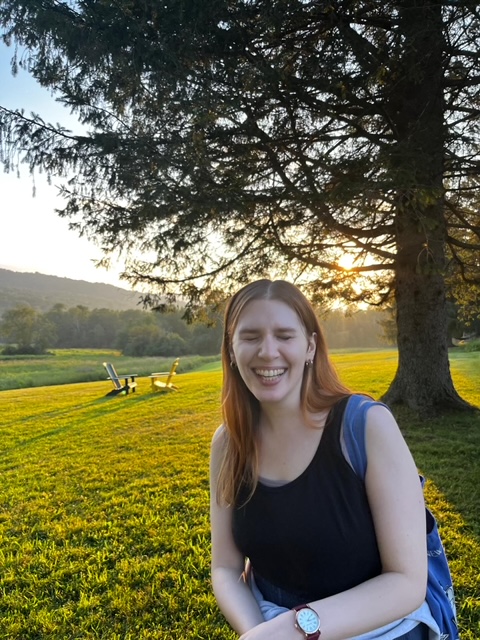
by Paul Wallace ’27
This month, The Words caught up with Macalester graduate M.L. Kenney ’18 to talk about life after graduation. While at Macalester, M.L. studied English Literature and Critical Theory. Outside of her studies, she pursued several internships in public humanities and English teaching. After graduation, M.L. continued in public service and teaching English while earning an M.S. in Secondary Literacy and Special Education from Johns Hopkins University. M.L. currently divides her time between pursuing a Masters degree in English from Middlebury College’s prestigious Bread Loaf School of English and teaching English to students with learning disabilities.
M.L., like many college graduates, felt nervous about her future. Though she excelled at Macalester and in her undergraduate internships, she still felt uncertain about her career goals. She knew, however, that she needed to tease out her ambitions not just through reflection, but through action. To build on her experience teaching English to young people, M.L. worked for AmeriCorps in Minneapolis, an endeavor which inspired her to move to Washington, D.C., and apply for the Urban Teaching Program at Johns Hopkins University’s School of Education. This moment replicated a pattern that began during M.L.’s time at Macalester and has continued since: the cultivation of her own education and others’ through simultaneous learning and teaching. These experiences helped M.L. recognize three key aspects of her desired career: equity, literature, and working with people.
Upon completing her first masters degree, M.L. began teaching English to students at a D.C. area school. At the same institution, she became a case manager for Individualized Education Plans, legal documents that outline accommodations and specialized support for students with learning disabilities.
While M.L. felt fulfilled by the importance of her work, she missed the challenging intellectual life of higher education. While a friend of hers had informed her about the masters program at Bread Loaf years earlier, M.L. felt intimidated by the application. She admitted that for several years, she opened the application but became overwhelmed and failed to start it. After encouragement from her partner however, she worked up the courage to develop an application. M.L. credits current and former Macalester English and Creative Writing professors Penelope Geng and Amy Elkins with proofreading and providing feedback on her application essays. Geng’s and Elkins’ knowledge of academia and the Bread Loaf program imbued their feedback with critical insight.
To M.L.’s joy, the Bread Loaf program accepted her. During the school year, M.L. continues to teach English to students with learning disabilities. In the summers, she relocates to Vermont to study English. In many ways, Bread Loaf echoes M.L.’s time at Macalester.
She praises “the small community [which is] very liberal arts-like—intimate, [with] lots of traditions [and] very literary and engaged people.”
Courses M.L. enjoyed include ‘The Wild(e) 1890s,’ ‘Plays and Politics on the Global Stage,’ ‘Using Theater in the Classroom,’ and ‘Anna Karenina and The Brothers Karamazov.’
M.L. also appreciates“the deep focus and sense of achievement, in part due to how easy it is to unplug on a tiny campus when you can leave your phone in a dorm room all day and don’t have a full-time job to do.” She read “well upwards of two thousand pages last summer.”
Alongside enhancing M.L.’s intellectual life, Bread Loaf also supports her work as a teacher through its Teacher Network which, as she describes it, is “all about building community with each other across school contexts that can feel isolating and frustrating.”
For current Macalester students and recent graduates, M.L. stresses the importance of taking risks and trying different jobs.
“You have to do it to know it,” she says. “The more you put off deciding [what’s right for you], the more decisions are made for you.”
She also encourages students to “build your academic stamina” in the age of short-form content and tools like generative artificial intelligence which prioritize instant gratification and efficiency over persistence.
“Put your phone away,” she said. “Take on that big project.”
In order to stay grounded, M.L. reminds herself and her students to turn to literature. When writing and reading feel daunting, she says, “let the words wash over you.”
Thank you to M.L. for her time and wisdom and thank you to our readers for letting The Words “wash over” you! For any readers interested in learning more about teaching and graduate school, please feel free to reach out to M.L. directly at [email protected].