



MacSlams’ winning trifecta at the Midwest Poetry Mash-up
by Callisto Martinez ’26
This past weekend, MacSlams, Macalester’s competitive slam poetry team, upheld their title as reigning champions at the third annual Midwest Poetry Mash-up. During April 25-26th, MacSlams co-leaders Adrien Wright ’25 and Veronica Kruschel ’25 joined with Tommy Fowler ’25 and former co-leader Kendall Kieras ’24 competed together against nine other teams at OpenBook, a Minneapolis-based literary center.
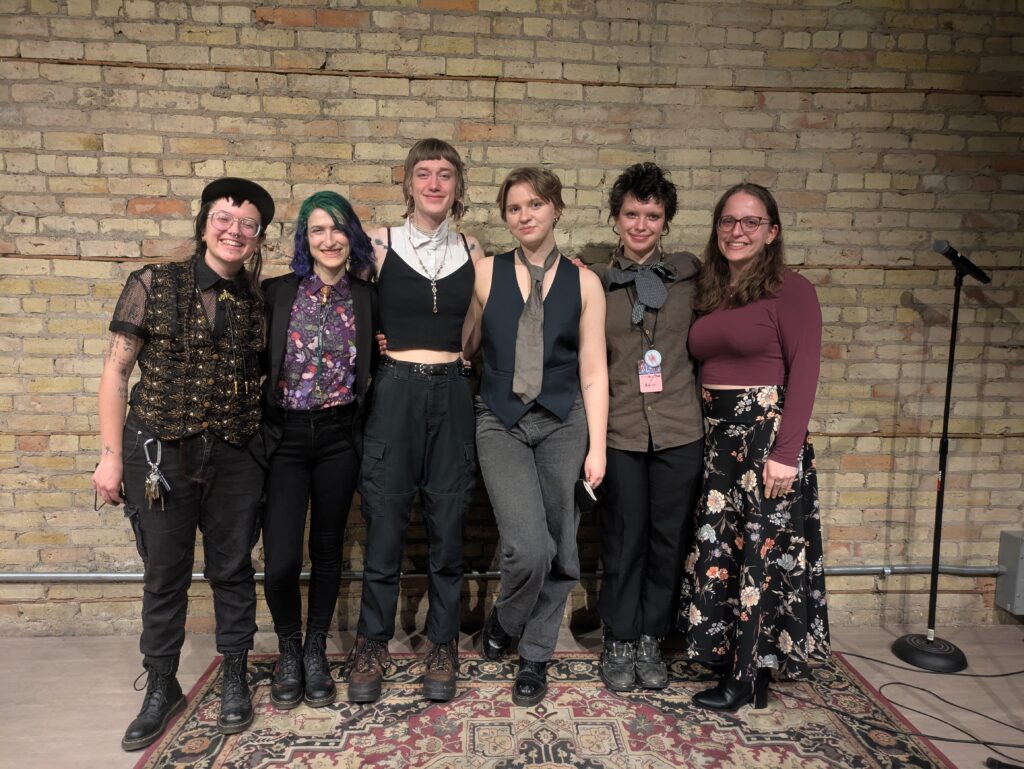
Aside from members of the MacSlams team, the Midwest Poetry Mash-up was teeming with creative talent from Macalester. Ollie Schminkey ’16, who founded and runs the Midwest Poetry Mashup, and Natalie Kaplan ’16 coached MacSlams to their victory. Alumni James Hartzer ’20 wore many hats in the tournament, serving as a non-competing (sacrificial) poet, a host, and a scorekeeper. Other former alumni, such as Neil Hillborn ’11, whose poem “OCD” currently stands as the most viewed slam piece on YouTube at 16 million views, and Anna Šverclová ’23, who took third place with the BuckSlam team, competed against MacSlams.
Though these alumnus all have taken different paths to bring the Midwest Poetry Mash-up to fruition, they all have one thing in common: their formative years in slam were based in MacSlams!
For those unfamiliar with slam poetry (often casually referred to as just ‘slam’), I’ll give a brief rundown of the team’s journey to victory from my perspective as a former member of MacSlams’ traveling tour team.
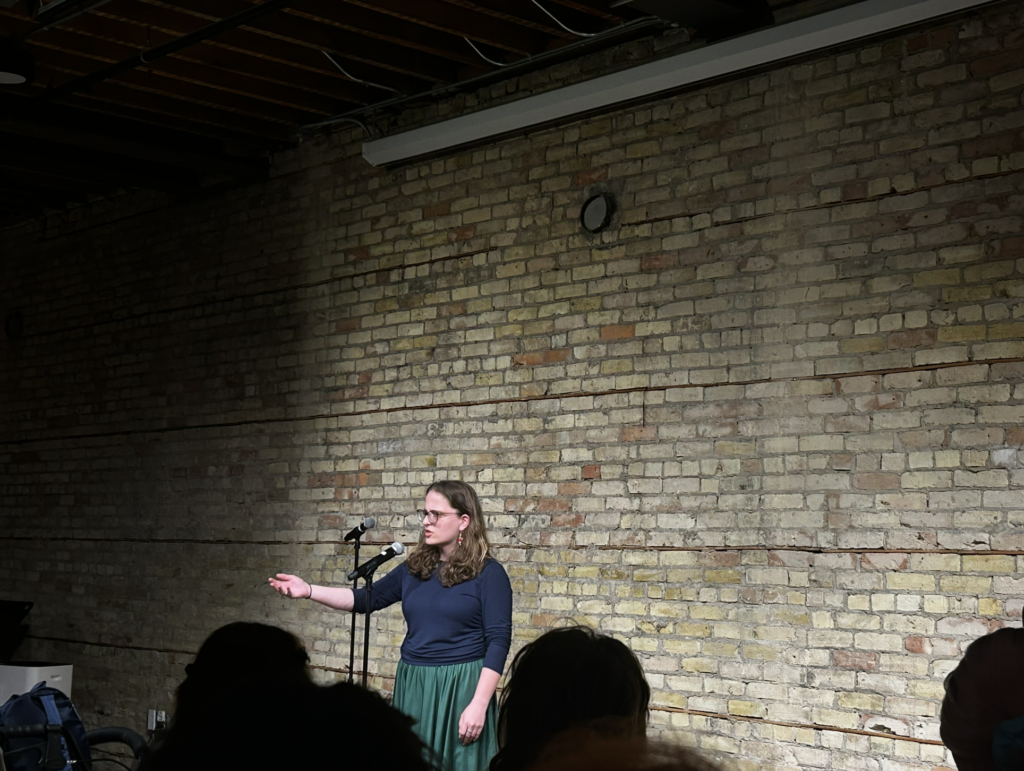
Unlike the Midwest Poetry Mash-up, most slams do not operate as tournaments with teams, but as competitions between individual poets. Before each slam, three to five random audience members, typically with no judging credentials, are selected to score each poem from one to 10.
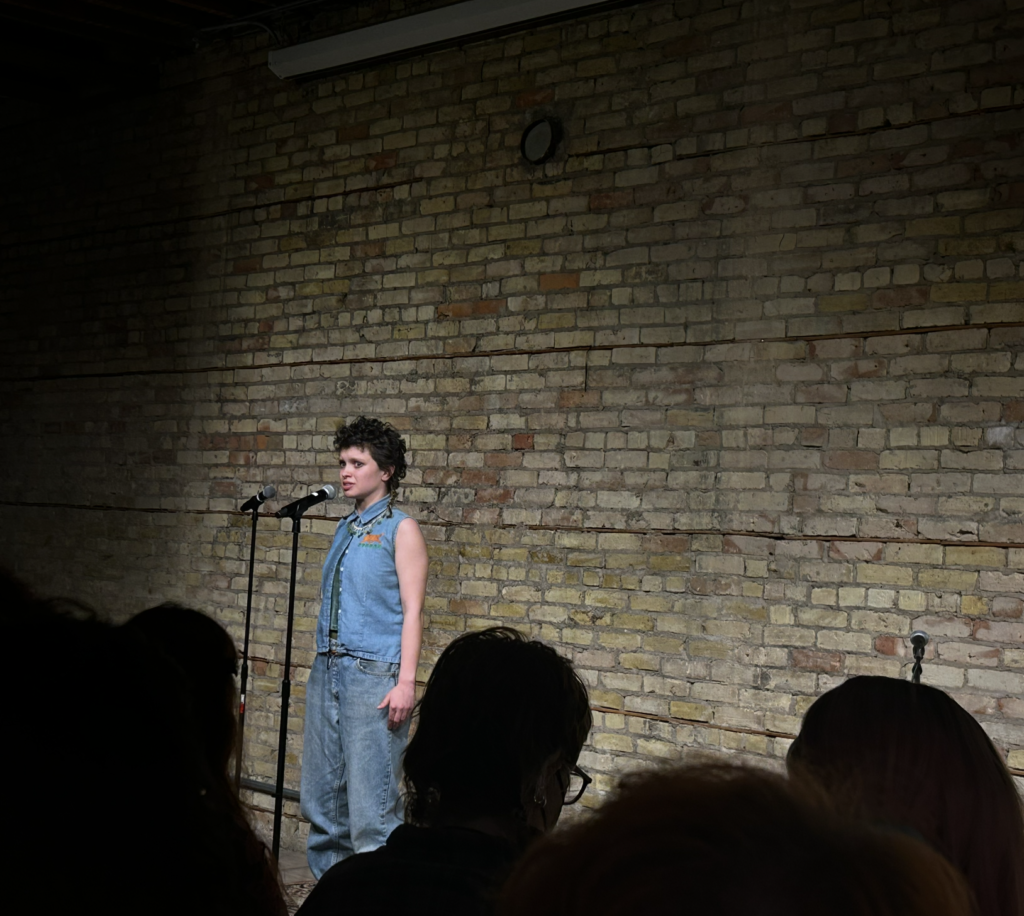
Though it may seem (and totally is) antithetical to assign art a numerical score, audience members ensure poets step offstage feeling heard by delivering thunderous applause and occasional shouts of “Go in, poet!” during and after poems.
During MacSlams’ monthly slams, performers who don’t wish to compete can still take part in the unscored open mic. At slams here on campus and at the Midwest Poetry Mash-up, judges warm up their score pallets with a scored ‘sacrificial poet,’ who competes for no team, but acts as a reference for judges to score future poems against.
In such a tight-knit community, competitors often focus more on snapping or stomping their feet at the perfect point in another poet’s work than the scores themselves. Even following late evening bouts—a group of four consecutive rounds where teams compete against each other for about two hours—poets spilled out into the greeting space and may have remained sharing compliments until the wee hours of the morning, had they not been limited by OpenBook closing at 10 p.m.
The Midwest Poetry Mash-up is the culmination of more than a semester’s worth of writing and performing for members of MacSlams’ competitive team. To even qualify to join MacSlams’ competitive team, members need to remain one of the top ten highest scorers during MacSlams’ monthly slams throughout the fall semester and compete in MacSlams’ Grand Slam in December.
The team then spent December to April preparing for the mash-up under the guidance of slam legends Schminkey and Kaplan. In addition to weekly practices, the team has an annual writing retreat where they polish their poems and fine-tune their performances. Outside of coaching, Schminkey and Kaplan both continue their creative aspirations, with Schminkey’s latest poetry collection Where I Dry The Flowers (2024) released last summer.
This year, each member of the competitive team participated in at least one group piece, which is a poem performed and composed by multiple poets. Group pieces can be powerful and riveting, but require a lot of practice to coordinate speech and movements so that they align to achieve the proper effect. MacSlams group pieces experimented not only with drastic changes in volume that kept audience members on the edge of their seats, but also with visual components. In one group piece, Fowler stood directly in front of Kruschel before starting their shared poem, emulating the feeling of defending a friend behind their back; their innovation paid off, as the poem earned the highest score in the round!

Although slams are filled with joy and anticipation, they can also contain heavy and difficult topics, particularly those that are being targeted and shut down by our current political climate in America. This can make slams a complicated place of contemplation, introspection, empowerment, grief, healing, and joy for both audience members and poets alike. With this in mind, we’ve chosen not to share specific details of the winning work that brought home the champion title and $300 cash prize. Besides, slam is a medium best beheld in-person.
In addition to competing on MacSlams traveling team and organizing monthly slams at Macalester, co-leaders Wright and Kruschel also host a weekly poetry writing workshop on Tuesdays at 4:45 p.m. For more opportunities to get involved in the slam community off campus, you can also check out Schminkey’s online writing workshop Well Placed Commas or attend BuckSlam’s monthly slam at Moon Palace Books on the second Wednesday of each month.