



Some Honors Insights with our English and Creative Writing Seniors
by Jizelle Villegas ’26
This year, the English and Creative Writing department has six seniors, Carling McQuinn, Katherine Norquist, Liam Lynch, Sofia Vaz, Rachel Kelly and Birdie Keller, doing Honors projects, all varying in topics and genres. The Words were able to get some information about their projects. You don’t want to miss out on knowing what their projects encapsulate.

Carling McQuinn’s Honors is titled A Slight Pinch. Her abstract is: “This project is a short story collection featuring four independent stories that each explore what it means to embrace the chaotic independence of adulthood and to confront, often for the first time, an inescapable sense of self-awareness. The first story, “Ghost Town,” follows a 19-year-old ghost confined to the Airbnb where she died, forced to face the self-destructive behavior that led to her death. Next, “Camilla” depicts the volatile friendship of college student Lexi and her best friend Camilla as it forms, shifts, and inevitably implodes as the years pass. The third piece, “A Slight Pinch,” explores the complexities of sisterhood and social class through the fantastical lens of impending vampirism. Finally, “Water for the Fish” is a direct-address piece from college senior Izzy to her mother, both an apology and explanation of her actions after learning her mother’s cancer is returning. As a whole, this collection seeks to address the second wave of growing up that happens in our late-teens and early-twenties—how it manifests itself in all relationships, but most intimately in the one we have with ourselves. A Slight Pinch, the project’s title, is typically what is said just before the pain comes, which is at the heart of each of the four stories.”
Carling also provided answers to questions about the good and bad about doing an Honors project. She responded: “Because my project is a short story collection, this means I had to create four unique stories—with four unique plots with four unique protagonists…you get the idea—in a relatively short amount of time. This sort of project can be taxing on the creative process, and at times I experienced creative burnout. Still, I’m glad I decided to do an Honors project because it allowed me to dive deeper into short fiction and push myself to make each story complete and cohesive. I learned so much about myself and about fiction writing.”
Lastly, we wanted to know if Carling recommends someone doing an Honors in the major. She responded with: “A creative writing Honors project is different from an Honors project for most other disciplines. You’re not building on pre-existing literature in the sense that you have a clear thesis and research component. You’re creating a lot of material of your own, and you’re (most likely) starting from scratch. It’s a daunting experience. Like with any creative endeavor, sometimes you will feel elated and fulfilled, and other times you will feel discouraged and disappointed. I recommend doing an Honors project if you want to be held accountable to create a non-trivial amount of writing, and you want to push your creative abilities in a way you wouldn’t be able to on your own. Unless you pursue an MFA in creative writing, you probably won’t get an opportunity to get this level of one-on-one, constant feedback from a professor again. All in all, if you’re considering a creative writing Honors but can’t decide, I think you should go for it.”
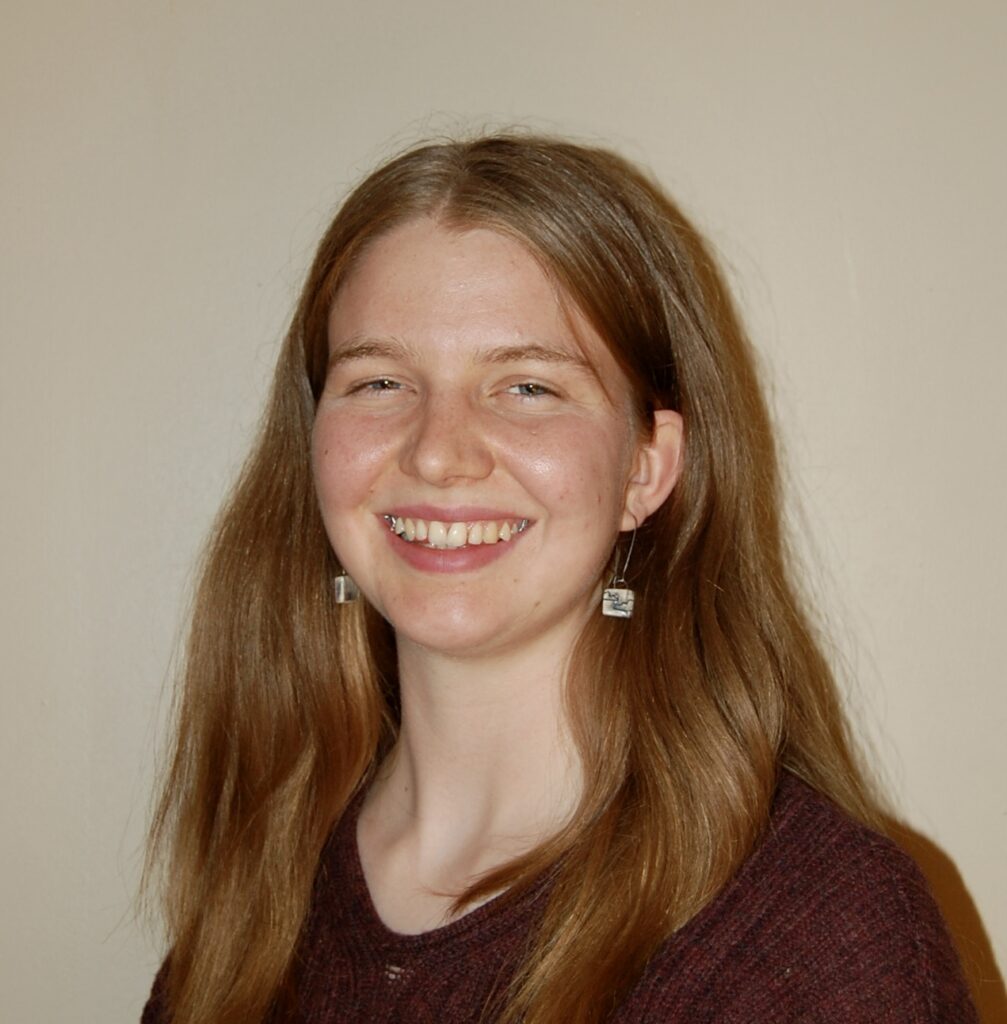
Katherine Norquist’s Honors is titled Crowded Air. Her abstract reads: “This project is a collection of poems which draw from my experiences as a women’s basketball player to explore the personal and political resonances of sport, centered around themes of time, physicality, and connection. The poems document the intimate metamorphoses through which the body passes to reach the edges of its possibilities, and examine structures of nationalism, gender bias, and racism that are inextricable from the sporting world. In creating this poetic landscape, I fuse two worlds which I’ve kept separate in my mind, but continually find their way towards a kind of interweaving — my creative self and my life as an athlete.”
Katherine has this to say about what’s been good during her project: “The honors project has enabled me to understand my own creative process better and understand what goes into an extended project of this nature. It’s a gift to get to work through a larger-scale project like this with the support, feedback, and guidance of amazing faculty.”
Liam Lynch’s Honors is titled Timeless. His abstract reads: “For my honors project, I will write an urban fantasy novel that seeks to interrogate the ideas of acting in service of the “greater good” and what it means for powerful people to act “morally.” The goal of this novel isn’t to arrive at a specific conclusion about what is moral, but rather it is to provoke thought and force the reader to confront perspectives on morality that they have never considered before.”
As for the good and bad about the Honors process, Liam responded with this: “There’s a lot of good in doing an Honors project, such as being able to work at my own pace, getting experience taking on such a large project, being able to explore something that was not offered in any classes curriculum, etc. However, it is a lot of work that comes at a time in the semester when someone is already busy, so it can be really rough towards the end. Additionally, I would definitely caution someone to think hard about it if they didn’t think they would be able to dedicate some of their spring break to their project.”
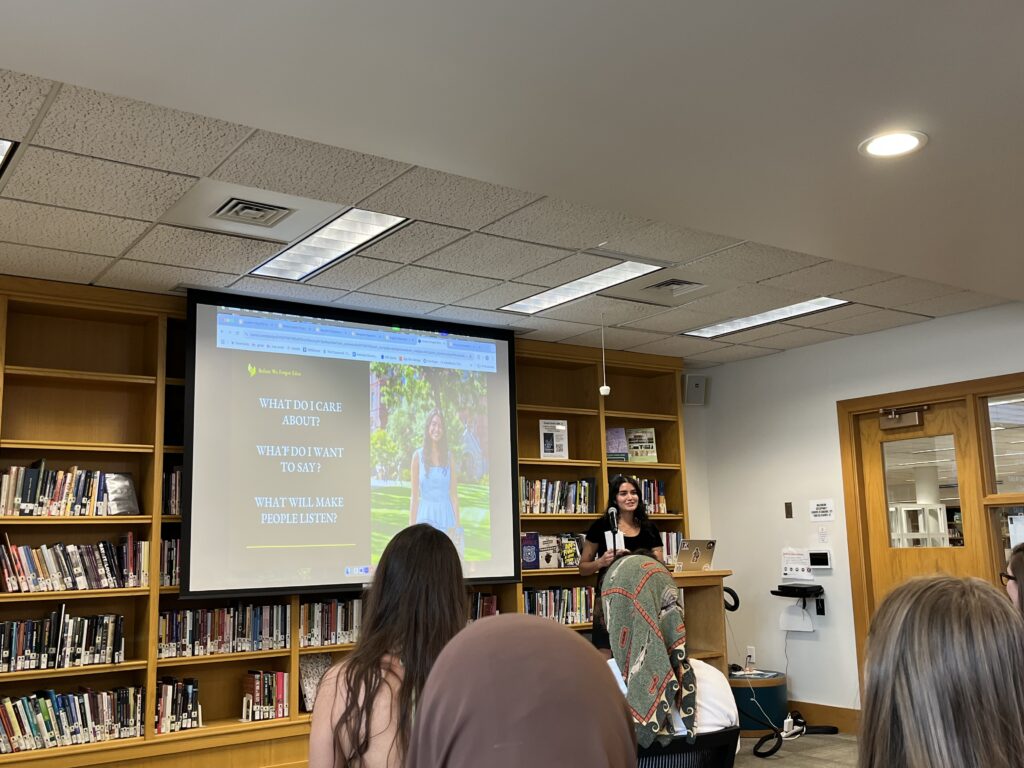
Sofia Vaz’s Honors title is Before We Forget Eden. Her abstract is: “This is a climate fiction novel that details the intertwined narratives of Avani, (Mother Earth) and Eden, her daughter (the Planet’s Heiress). Employing dual timelines, the novel juxtaposes Avani’s past of rebellion, love, and betrayal with Eden’s present as she flees the US government’s exploitation of Earth’s power. Drawing inspiration from Andean and Hindu traditions, this novel explores themes of love, motherhood, human nature, and consequence. Using a family tragedy as a rich metaphor for the climate crisis, this project aims to provoke its audience’s humanity and deepen our understanding of the human race’s responsibility in Earth’s destruction.”
Sofia says this about the good and bad parts: “Pursuing an honors project has been an incredible opportunity to challenge myself through a self-directed process. I’ve really valued the independence it offers, and I’ve enjoyed the creative process, as the extended amount of time has given me the opportunity to take the project in whatever direction feels most meaningful.”
Here is what she says about the motivation behind the project:“Climate change is obviously one of the biggest issues we’re facing, and I wanted to find a way to make people feel that—not just understand it logically, but actually connect with it emotionally. That’s what really motivated this project. I began asking myself: what if the Earth could speak for herself? What would she say to us? That question led me to explore personification as a tool, and I drew a lot of inspiration from sacred interpretations of Earth—like Pachamama in Andean tradition and Bhumi in Hinduism. These powerful, nurturing figures helped shape my main character, Avani. I also looked to Walden by Thoreau, especially his use of language and his relationship with the natural world. In the end, I wanted to create something that blends the spiritual with the personal and political—something intimate, even when dealing with an issue as massive as the climate crisis.”
Sofia enthusiastically says “YES!” to doing an Honors project.
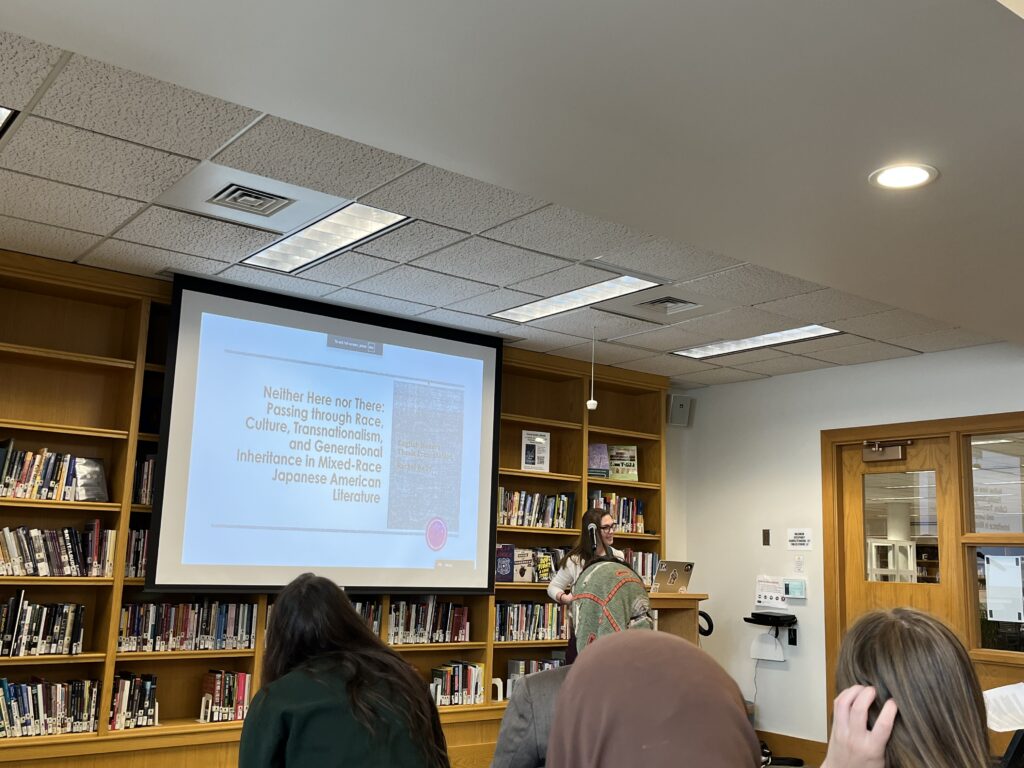
Rachel Kelly’s Honors is Neither Here nor There: Passing through Race, Culture, Transnationalism, and Generational Inheritance in Mixed-Race Japanese American Literature. Her abstract is: “My honors project explores the concept of passing in Japanese American mixed-race literature written after World War II by examining how acts of passing are racially, transnationally, and formally represented in Ruth Ozeki’s novel, My Year of Meats; Asako Serizawa’s novel-in-stories, Inheritors; and Brian Komei Dempster’s poetry collection, Topaz. Through my analysis, I seek to expand traditional notions of racial passing by reconceptualizing the term’s connection to physical and spatial mobility, generational inheritances, and literary forms in order to recognize and celebrate mixed-race Japanese American voices within larger conversations by and around Asian American and BIPOC American writing. The first chapter of my project interrogates physical manifestations of mixed-race identity in all three texts, inspecting the ways the experiences of these books’ narrators, characters, and speakers, through their shifting understandings of their own mixed-race identities, evoke the discursiveness and instability of social constructions of race. My second chapter considers transnational identity, investigating how movement across the Pacific and within the U.S. impacts sense of self and explorations of family history. Finally, my third chapter analyzes these authors’ use of varied literary genres and forms as not only reflecting Japanese American mixed-race experiences, but also as resisting the notion that mixed-race individuals are fractured by their multiple coexistent racial identities.”
Rachel also had this to say about her Honors: “I chose to endeavor on this project because the questions this thesis explores are central to my own identity. My grandmother immigrated to the US from Tokyo in the 1950s and I wanted to focus my project on the portrayals of mixed-race Japanese American people in literature. It was an amazing opportunity and I learned a ton about myself, my community, and the study of literature itself.”
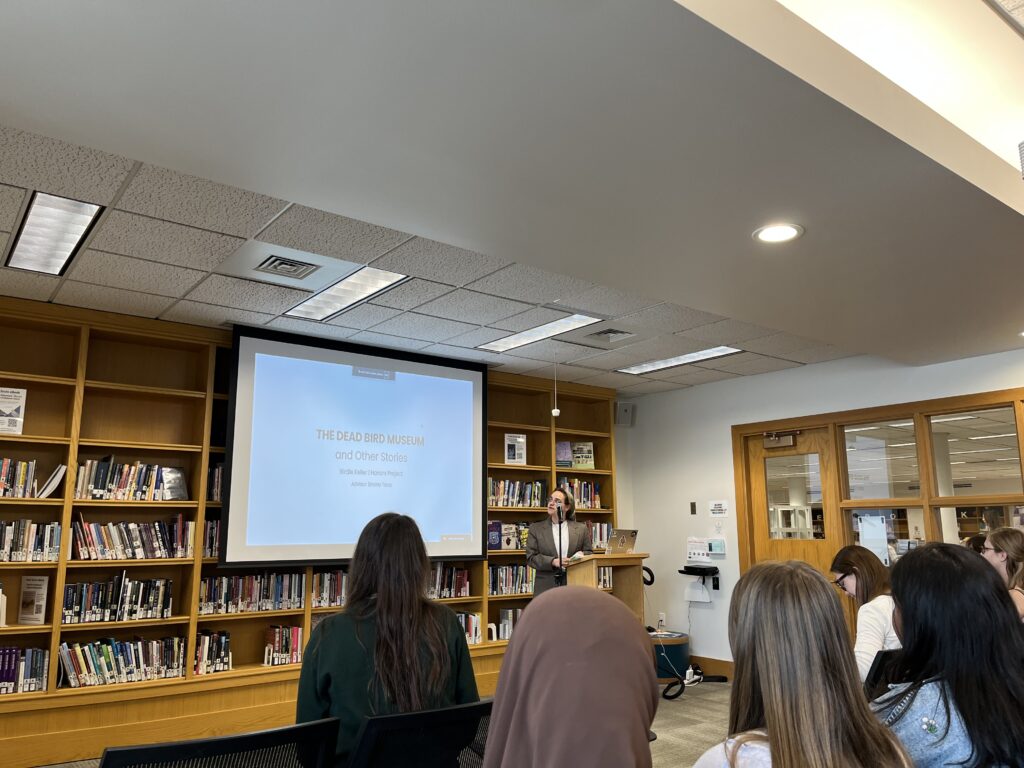
Birdie’s Honors is titled The Dead Bird Museum and Other Stories. Their abstract reads: This honors project builds the skill of drastic revision through a lens of character, plot, and speculative elements. This project contains four short stories: “The Mountain Split and It was Born,” “Sugar Birch Lake,” “The Dead Bird Museum,” and “The Smell.” In writing these stories and reading the work of Kelly Link, Sofia Samatar, Adam Haslett, Alix Harrow and more, I gained a deeper understanding of my own writing process and the methods of thinking that revision demands.
For the good and the bad of doing an Honors, this is what they wrote: “The best part of doing this honors project has been the sheer amount of time to write it has given me! Being able to actually prioritize writing so much this year has been incredible. The other best part was being in the capstone in the fall! I absolutely adore the friends I made in that class and loved the experience of all working on our projects together. I did have to learn to also make time to recharge creatively and just in general, in order to be writing in a sustainable way. It also can be a little strange and isolating to work on one project for so much time, especially once I was not in the capstone class (in the spring semester).”
This is what they wrote for recommending an Honors: “I would absolutely recommend doing an honors project if you are looking for lots of time to write. Definitely consider also doing the capstone class as part of this experience – I am so glad and grateful to have had that group as support and encouragement! (And I LOVED getting to read my friends’ work).”
Congratulations to our current seniors for pursuing an Honors this year. We hope their defenses went well.