



Get to know Visiting Assistant Professor Karen Soto
By Callisto Martinez ’26
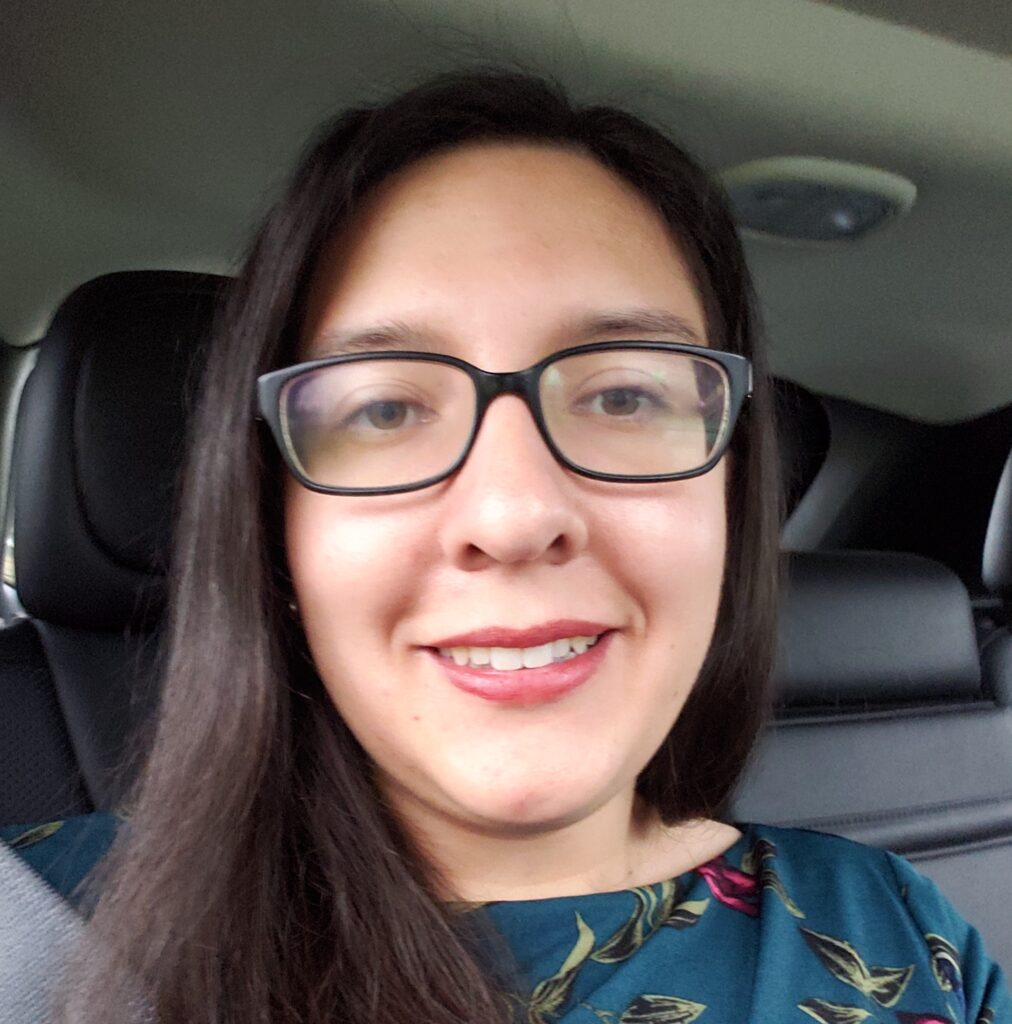
The English & Creative Writing faculty, staff and students warmly welcome Professor Karen Soto to the department! Karen, who specializes medieval literature, will be teaching two classes this fall: ENGL-294: The Curse and the Cure: Literature, Magic, and Medicine and ENGL-294: Medieval Horror. Read on to learn all about Karen and her amazing work!
How has your first semester at Macalester been?
So far, my first semester here at Macalester has been wonderful. So far, everyone has been so welcoming, and I really like the classes that I’m teaching this semester. I’ve never had my own office, so this is a first for me, and it’s really nice to have my own space to work in and meet with students. I’ve been enjoying it a lot.
So both of the classes you’re teaching, Medieval Horror and [Curse and the Cure: Literature, Magic, and Medicine], sound super interesting. Would you mind giving a summary of what they’re about and also what excites you most about each of them?
Medieval Horror was a class of my own design, original, first time teaching it, and it’s essentially looking at the ways that medieval peoples and medieval cultures—because medieval is a huge term that covers a 1,000 year period and a huge geographical area—are expressing their cultural anxieties, their fears, and how that might connect to the ways that we today also express our anxieties and fears through the genre of horror film or horror literature. We’re looking essentially from early medieval Iceland, and we’re moving geographically all the way over to medieval Japan. So we’re going to get to read a lot of great texts, a lot of texts that I think students haven’t even heard of, which it’s always very exciting to introduce people to new material. I’m particularly excited for the creative writing assignments that students will have the chance to work on at the end; they can write their own horror story as their big culminating project. I find that the creative pieces are always fun to read.
For the Curse and the Cure, that class was developed by Professor Penelope Geng, who is on sabbatical, and so I stepped in. Usually that course is early modern, but since I’m a medievalist, we kind of pushed the timeline backward. We’re looking at the sort of hybrid approach to health that was taken in the medieval and the early modern eras that combines a version of the scientific method based on observation and based on natural remedies, with magic and faith too. A lot of different religious beliefs tie into this, and how people use those to really effectively, for them, treat their ailments or treat their injuries. Then [we’re also investigating] how that’s depicted in literature: How are people thinking about doctors? Do they trust them? Do they mistrust them? Why or why not? For that class, I’m just really excited to get to talk to students about the unit we just finished, which is on Old English metrical charms. [Metrical charms] are poems that would have been sung as part of imbuing some of these cures with power. They’re just great things to talk with students about. They’re really exciting.
What drew you to study medieval literature?
I was actually an accountant in undergrad, that’s what I studied. I studied accountancy, and then I was an accountant for three years after I graduated, and I didn’t find that career particularly fulfilling. I’d always enjoyed reading. I’d always enjoyed art, the more creative humanities fields. So I went back to take classes at Portland State University, and one of those was an introduction to Latin course. One of them was a medieval literature course. I took some classics, Greek literature, and from there, I was like, ‘This is interesting, and I’d like to go back to school for it,’ so I applied to a master’s program in medieval studies, and that kind of got the ball rolling, especially around early medieval languages like Old English and Old Norse and Latin. I studied all three of those in my master’s, and that’s now sort of my field of specialty—Old English and Old Norse literature.
I think for a lot of people, you can be committed to what you’re studying in college, because it can be where your whole future lies, but it’s also okay to pivot and find new things that interest you after your four years in college, or however many years you’re in college.
How does Mac compare to other places you’ve taught or even other places you’ve studied at so far?
Class sizes for one, which is one of the great pitches for students, is that you get to know your professors because you’re in smaller classes. From my side, as an instructor, it’s very true. In the larger universities, the R1 institutions I’ve taught at, [there are] much bigger classes. Sometimes I’ve had classes with 30 to 40 students in them, and it’s not easy in those circumstances to keep track of everyone’s name or to dedicate as much time to individual students. I also find here the pace just feels a little slower. I know everyone’s very busy in their own ways, but people just feel a little more relaxed around here. The campus is quieter, which seems nice. I’m used to being like, right in the heart of the city, where everything’s really frantic and cars are zooming through the middle of campus. This has been really wonderful, and all the resources that have been made available to me from administrators, even. I’ve talked for two minutes with the President of the college; that’s never happened at a different place I’ve worked because there’s just too many people for that to happen. So, it’s been a real pleasure.
I noticed that you’re a doctoral candidate at the [University of Minnesota], what [does] your work there and dissertation look like?
Yes, it’s going really well, thank you for asking. Before I was here, I was a combined student and instructor [at the University of Minnesota], so I sort of balanced both, but in the same institution, and that has a lot of benefits in that I’m on that campus doing research [and] writing. I had an office space there as well, where I could store everything, and then I could just go teach from there. It’s been a little difficult finding that balance here, because [I’m figuring out] how much of my material do I bring to the Macalester office so I can work here and not have to travel back and forth across town in order to do my student work versus being here as an instructor.
The project overall, it’s on This Old English poem called “Andreas.” I’m actually teaching it starting Wednesday in the Medieval Horror course. It’s a great story that has lots of cannibals in it. I look at how that particular text and the horror that it produces—the way it kind of appeals to folk horror esthetics—is kind of reflective of a transition period and the faith practices of early medieval English people, and how they’re sort of responding to their particular cultural situation due to Viking incursions and settlement, and this sort of disruption to their political environment. [I’m investigating] how cannibalism [in “Andreas”] helps them express all of those fears they have about being consumed politically by other entities. So, it’s taken me a long time. I’m close to the end; I’ve got about a year left to finish it, and I’m very excited to have it done.
A lot of people think it’s strange—the field I’m in is usually very traditional in the topics that they look at. So, I’m certainly playing a little fast and loose with my use of a lot of contemporary fields, like folk horror studies, which is very new in the last 20 years. But you know, sometimes it’s where the weird parts are that are the most interesting and have the most fruitful ground.
I noticed you got your masters at Western Michigan University. What is just one thing you love about the Midwest?
I’m originally from the Pacific Northwest, where we have a pretty moderate climate with a lot of rain, and in the winters, we don’t really get snow. I’ve always wanted to live in a place where they get lots of snow. So living in Michigan, living in Minnesota, I’ve gotten my wish every winter. Probably more than I could have wanted, but I love it. It’s beautiful, and it’s interesting to see what people make out of all the snow that falls.
Have you noticed any differences between Michigan and Minnesota?
The difference is, for me, I only spent two years at Kalamazoo, [Michigan], where Western Michigan University is, and I go there every year in May. There’s an International Conference on Medieval Studies that’s hosted there annually, and it feels like going home. It’s definitely a smaller town, more so than a city. So again, [there’s] the slower pace of life. It’s a little more isolated from some other bigger metropolitan areas like Chicago or Detroit, but it’s got a pretty vibrant cultural life, lots of interesting arts going on there, and I just have a lot of friends there who I miss. But I’ve certainly made connections in Minneapolis and St. Paul, and I also have a great time going to shows here, like at the Guthrie or the Walker Art Institute, lots of great stuff. It’s just the size; it’s a little too big for me. I’m definitely more of a mid-size city, small town [person]. I like less traffic. I like being able to ride my bike, rather than having to take my car to commute. But I’ve been in the Midwest for a decade now, between Michigan and Minnesota, and I have no intentions of leaving. So I like it, I like it a lot.
That’s amazing. Is there anything else you want to add?
This is more for my individual students, but I’ll open it up for others too. I’m always happy to talk! People can come knock on my door, and even if they’re not in one of my classes, I’m happy to chat for a few minutes to get to know people and talk about, potentially, what might be happening in the spring. I don’t know what class I’m teaching yet, but I will still be here then. So, if people want to see who I am, my door’s open.