



The Words, March 2014
ACTC Poetry Reading: Ghassan Zaqtan & Fady Joudah
By Rudy Henriquez ’14
On Monday March 3, an audience of around fifty people sat in John B. Davis Hall to listen to two global poets. The audience included special friends of the poets, English department professors, current students, and recent alums. What they experienced was an amazing contribution to the Macalester literary community.
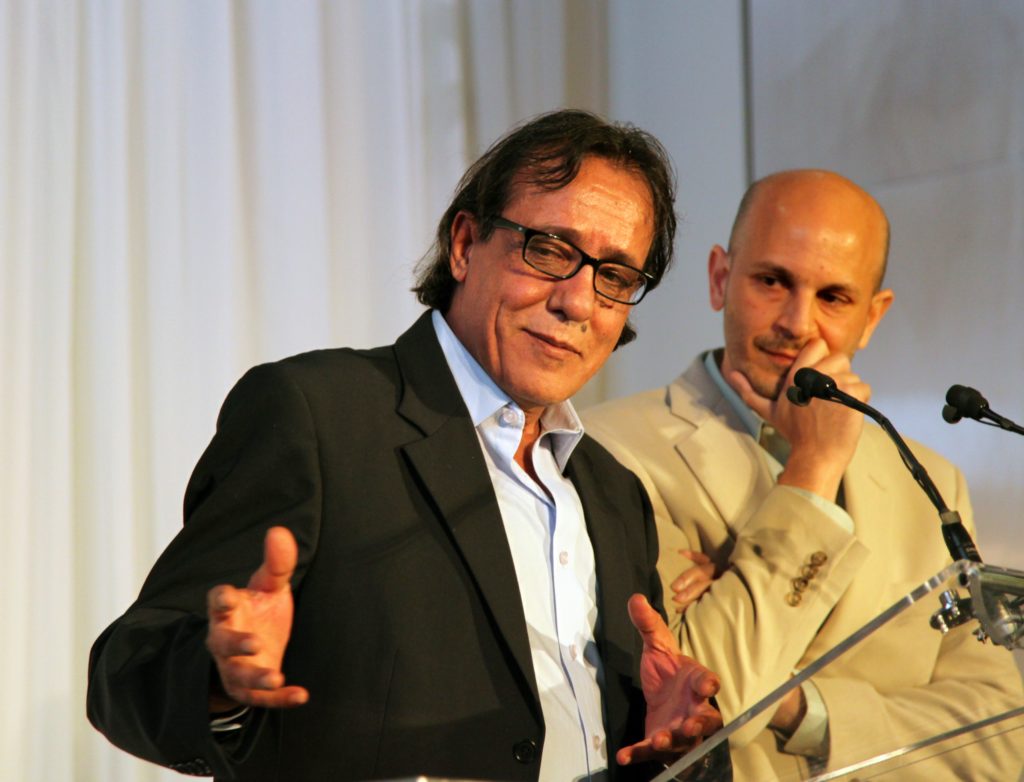
Ghassan Zaqtan is a Palestinian poet, novelist, and editor who has resided in countries like Jordan, Lebanon, and Syria. Most recently he authored Like a Straw Bird It Follows Me, which won him the 2013 Griffin International Poetry Prize. Zaqtan’s work is respected both in his home country of Palestine (as proven by the medal of honor given to him by the president of Palestine) and in the global poetry community.
Fady Joudah is a Palestinian-American poet, translator, essayist, and physician who has translated poet Mahmoud Darwish’s last three poetry books (Darwish is widely recognized as the Palestinian national poet). In 2008, he was a finalist for the PEN Award for Poetry in Translation and most recently he released a poetry book in August 2013 titled Textu. Textu is a collection of poems that work within the 160-character limit commonly seen in text messages.
These men were our two guest poets. After a student introduction given by Scott Gannis ’14 and Abbie Shain ’14, English Professor Wang Ping took over and gave an introduction of her own. Ping told the crowd that Zaqtan’s “poetry awakens spirits hidden in the garden” and also spoke on the challenges and the positive feelings that one can get from translating poetry. Then, Zaqtan and Joudah took the stage, as a team, to recite some of Zaqtan’s poetry.
After some issues with the microphone, Zaqtan and Joudah began trading off reciting Zaqtan’s poetry – switching from Arabic (Zaqtan) to English (Joudah). This gave the audience a truly bilingual experience. Their teamwork was impeccable. The experience of listening to a poetry reading that is not completely in English and that avoid western-centric images and storytelling techniques was exciting and fulfilling. It was an experience similar to when the Latino poets visited Macalester last spring, but this reading was unlike anything that has come to Macalester in my four academic years here.
Ghassan Zaqtan’s deliberate pace, rhythm, and the movement of his hands brought meaning to his Arabic words. He spoke to the audience as if we understood the words that were coming out of his mouth – with a familiarity that was endearing. In “Tires” he showed us the power of repetition, in “A Picture of the House at Beit Jala” he got personal with his narrative and took us to his hometown, which does not exist anymore. Zaqtan showed us his “bed, sheets, pots, picture frames on the wall” and also revealed the “dust” that gnaws at his memory there.”
In “The Camp Whore,” he again showed us a catalogue of simple nouns that construct his images and setting within the poem. Zaqtan’s style in this poem is reserved and distant, but like a photograph with a large depth of field this style manages to be distant, while also very detailed and precise in its wide scope. In his reading of “Happy With My Things,” Zaqtan reminded us all of the simple joys in life. As he writes, “happy with my hand/happy with my voice.” His talent is taking these little things and transforming them into bigger and sometimes very personal pleasures. His reading was a delight.
Then, the evening strayed away from the bilingual experience and transitioned to poems read in English. Then, Fady Joudah took over the stage and read his poetry from his phone. Joudah read almost exclusively from Textu, his collection of poems written by phone and dominated by themes of faith, struggle, and identity. In all of these poems, Joudah plays with the idea that character count replaces meter as a crafting tool for poets. Character count, in essence, becomes a modern adaptation of meter. As Joudah said himself that night, focusing on word count as opposed to punctuation reveals an “Interesting way to not see punctuation as architecture” for the poet. His reading was a refreshing and engaging experience for the audience.
At the end of the night, both poets left the Macalester community with a unique experience. We hope to be lucky enough to host more poets like Zaqtan and Joudah in the future and we hope to see more current English students in attendance.