



Honors in Geology
What is Honors in Geology?
Completing an Honors thesis in Geology is an opportunity to engage in original mentored research, deepen your expertise, and contribute meaningfully to the field. Students who pursue Honors will write a significant, original contribution to the field of geoscience, complete a public talk to the department, and explain their work to a committee of faculty members during an Honors thesis defense. Students who complete an Honors project fulfill the senior Capstone requirement through writing and presenting their Honors thesis.
Capstone vs. Honors – Who Should Pursue Honors?
Students who are very interested in research and have the time and drive to dedicate lots of time during their senior year to an in-depth project. There is no GPA requirement, but students pursuing Honors should have a solid record of previous academic performance, be willing and able to work independently, and be consistent in meeting deadlines and maintaining high-quality work in both courses and in their thesis. Many (if not most) students have begun research prior to their senior year, and students should anticipate enrolling in at least one semester of Honors Independent Study (4-credits).
Important: Honors is an opportunity to go above and beyond your regular coursework. The department reserves the right to revoke Honors approval if performance declines or if thesis work interferes with coursework.
Honors students should be prepared to:
- Work independently on your project throughout your senior year.
- Devote significant time to the project (8-12 hours/week at a minimum). For this reason we recommend enrolling in some independent study credits during the senior year. Think of your Honors thesis as the equivalent of a 4-credit course each semester. Be thoughtful about your workload before you jump in – you don’t want either your classes or your thesis to be compromised if you are too busy to balance your workload.
- Meet regularly with your Honors advisor to stay on track.
- Write a thesis that includes a substantial literature review of background information. The final thesis (> 8000 words) requires the citation of at least 30 relevant references (many of these sources will help you flesh out the background/literature review component of the thesis).
- Give a public presentation and complete a final oral thesis defense
This page outlines the process, deadlines, and expectations that will guide you through a successful Honors experience.
Geology Honors AI Policy
The goals of completing an Honors thesis include learning to write, to critically analyze data, to read and use papers, and to be creative. Often, synthesis of ideas and arguments takes place while you are editing your work. While there are ways that AI can be helpful in this process, these tools don’t always attribute or cite the work that they draw from. AI tools also diminish the agency you have as a developing scientist to practice being original and creative. For these reasons, you may not use AI to develop your first complete thesis draft, and any use of AI in your subsequent drafts must be acknowledged/cited in the thesis.
Timeline and Key Milestones
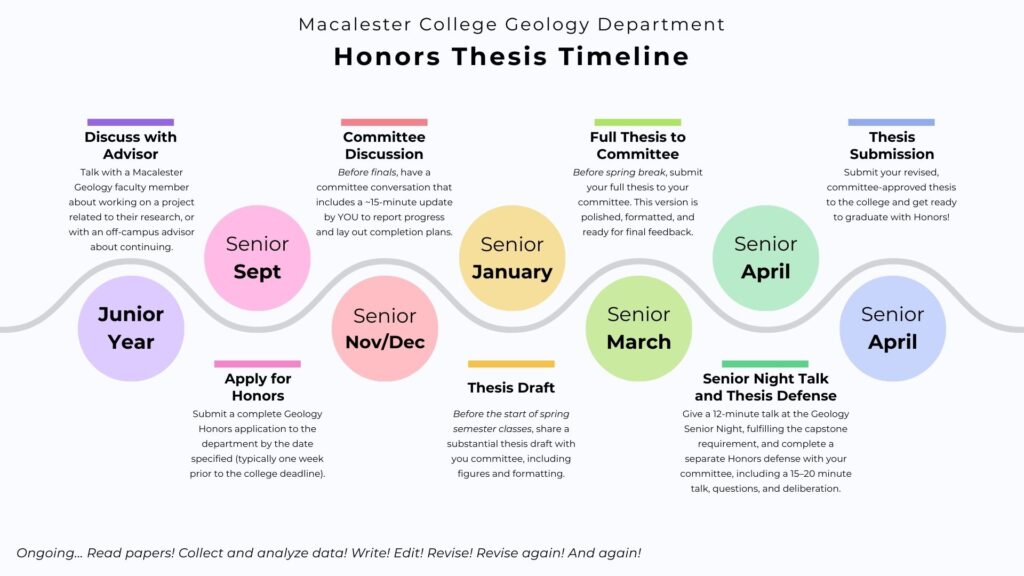
Junior Spring/Summer Before Senior Year
To pursue Honors in Geology, you have to kick off your senior year ready to work independently on your research project (mentored by a Macalester Geology faculty advisor). The best way to do this is to begin your thesis process in the summer before your senior year. While summer research is strongly recommended for preparation, motivated students who did not conduct summer research may still pursue Honors. Progress and feasibility will be assessed on an individual basis.
Here’s how to prepare:
- On-Campus Research:
Talk with a Macalester Geology faculty member about joining their group for a project related to their research. Do this before senior year. - Off-Campus Research:
An Honors thesis may also result from research that you have completed elsewhere (e.g. through a summer REU). Meet with a Mac geology faculty member to discuss continuing that project during your senior year. Note: this is only feasible if your off-campus advisor agrees to allow you to use their data and to stay involved in mentoring your work throughout the senior year.
Senior Year Fall Semester
By the third Friday of September: Submit your Geology Honors application. This is intentionally earlier than the college-wide deadline at the end of September so that the department has sufficient time to review your proposal ahead of that deadline.
Strongly consider registering for Honors Independent Study Credits (1-4 credits, depending on your time/schedule). If you are starting the Honors process in the fall (e.g., no summer research), you should register for four-credit independent study in the fall semester. This simply allows you to reserve some time each week to focus solely on your thesis.
Honors thesis students are strongly encouraged to register for the Geology Senior Seminar in the Spring Semester (1 credit), which provides time for writing, workshopping, and practicing your talk with your peers.
End of Fall Semester (before classes end): Give a short (~15 minute slide-show) update to your Macalester Honors Advisor and at least one other geology department faculty or committee member to report on your progress thus far and plans for remaining thesis data collection and writing for January/Spring Semester. At this point, students should:
- Demonstrate an understanding of relevant foundational concepts and knowledge – what is the context?
- Articulate goals – what is the question or the problem?
- Demonstrate an understanding of methods – what tools are used to collect relevant data?
- Present the data they have in hand – how do these data relate to goals, questions, hypotheses?
- Provide a timeline of the work plan for January and the Spring semester.
A student who does all of these things will pass the mid-term evaluation, and will be permitted to continue on their Honors journey. If there are concerns, the committee may determine that the student is not in a good position to finish the Honors, and will recommend conversion to a capstone.
Before Start of Spring Semester: share a solid draft of your thesis with your committee. This draft should be substantial, with writing and figures solidifying into a near-final draft. You may still have some work to do, but this draft should be work you are proud of. Your committee will review the draft and determine whether you are approved to continue your Honors ahead of the college deadline.
Senior Year Spring Semester
Be sure you are registered for the Geology Senior Seminar (1 credit).
By Spring Break – Polished Draft of Thesis and Draft of Talk Submitted to Committee. This draft should be polished and ready for submission, formatted correctly according to college guidelines.
Early April: Senior Talks and Thesis Defenses
- Submit Abstract to Academic Programs
- You will give a 10-12 minute talk (followed by a few minutes for audience questions) at our Geology Senior Night event.
- The Honors defense is a separate meeting with your committee. The defense consists of a brief introduction by the advisor, a 15-20 minute talk by the student (can be the same, or a slightly modified version of the talk you give at our Senior Night), followed by questions from committee members. The defense concludes with the committee deliberation and a decision. You may receive additional edits to the written thesis at this time, which must be incorporated before final submission to the college.
End of April: Final Thesis Submitted to the College, Graduate with Honors!
Application
All students wishing to pursue a Geology Honors thesis must submit an Honors Application. The purpose of this application is to ensure that students have a feasible project, adequate faculty mentorship, and a clear work plan for the academic year.
Deadline: Third Friday in September. Late submissions will not be considered.
Applications will be reviewed by the department faculty, and students will be notified of approval within a week of their application.
Application Requirements:
Applications should be concise but thorough and will include:
- Student name
- Majors/minors/concentrations
- Proposed Geology Department Faculty advisor (does not need to be your academic advisor)
- A list of 3 to 5 potential geology department committee members, including at least one faculty/staff person outside the department. This committee ensures that you have access to additional guidance, such as statistical support or cross-disciplinary expertise.
- If your project was completed off campus with a non-Mac Faculty member (e.g., NSF REU, Keck Project, Internship, etc.), your off campus research supervisor must approve the thesis proposal (via the Research Mentor Approval Form), and agree to serve as a primary mentor for the continued work required to complete the thesis. In these cases, Geology Faculty will ensure students are aware of deadlines and help mentor through Macalester-specific requirements. Research mentorship and editing will not be their primary responsibility.
- Proposed project title
- Project synopsis (1-2 pages maximum) that includes:
- Driving question (1 sentence)
- Background (<300 words)
- Methods (what instruments/techniques are required? What are the required sample(s)? Is there anything that you will need help with? (<300 words))
- Proposed timeline for project completion that meets the department’s requirements – what are key guideposts for your specific project? You may use a list/bullet format.
- Preliminary bibliography of at least 10 consistently formatted primary references. At least five of these sources should include annotations that highlight the connections of each paper to your specific project. Here is an example
Note: Submitting an application does not guarantee approval. Projects may be denied due to insufficient proposals, lack of faculty expertise, or missed deadlines.
Thesis Format
- Overall length: Minimum 8,000 words (excluding figures, captions, tables, and references). In Times New Roman, 12-point font, a single double-spaced page contains about 250 words. Thus, the thesis text itself would be at least ~32 pages long.
- Rare exceptions to various formatting requirements may arise. The Geology Department faculty reserve the right to evaluate such cases individually and to approve alternatives when appropriate.
- Bibliography/Literature Cited: Minimum 30 references
- Students are encouraged to follow professional scientific formatting conventions and ensure clarity, coherence, and completeness.
- Pages should be double-spaced, written in an easily legible font. Font size should be around 12-point (the exact size chosen will depend on the font used).
The contents of the thesis should include, in this order:
Title Page
- Thesis title
- Your name
- The words “An Honors Thesis Submitted to the Geology Department at Macalester College, Saint Paul, Minnesota, USA”
- Your Macalester Honors advisor’s name and department
- Date submitted
Abstract (on its own page) – 100 words is the college requirement. If you have submitted an abstract to a conference, you may use that longer abstract instead.
Table of Contents
Acknowledgements
The Body of the Thesis (minimum of 8,000 words, excluding figures, captions, tables, and references)
- Theses usually include an Introduction, Literature Review, Geological Context, Methods and Materials, Results, Discussion, Conclusions, and Literature Cited. Your sections do not have to have these exact titles, but your thesis should cover the material expected in such sections.
- Tables and Figures can be embedded in appropriate pages of the thesis and described with appropriate legends, or appear in sequential order (Figures first, followed by Tables) at the end of the thesis.
- Ensure that tables and figures use a sans serif font (e.g., Arial). Maps, field images, photomicrographs, etc. should have a scale bar.
- Appendices (if needed)
- These may be the equivalent of Supplemental Online Materials, including additional data tables, figures, etc.
Macalester’s formatting guidelines for binding Honors theses:
Each of you will receive a bound copy of your thesis, and the department will order an additional copy for our records, meaning that all theses must be formatted for printing and binding. The edge that will be bound must have a wider margin, as specified below. All theses should be printed single-sided.
- Left margin – 1-1/2 inches
- Right margin – 1 inch
- Top & bottom margins – 1 inch each (page number should not print outside this margin)
Note that Macalester encourages Honors students to submit their Honors theses to the College’s Digital Commons; however, if your findings will potentially be published at a later date, you need to be sure that your thesis remains inaccessible to outside researchers. Consult with your Honors advisor about how to handle this issue.