







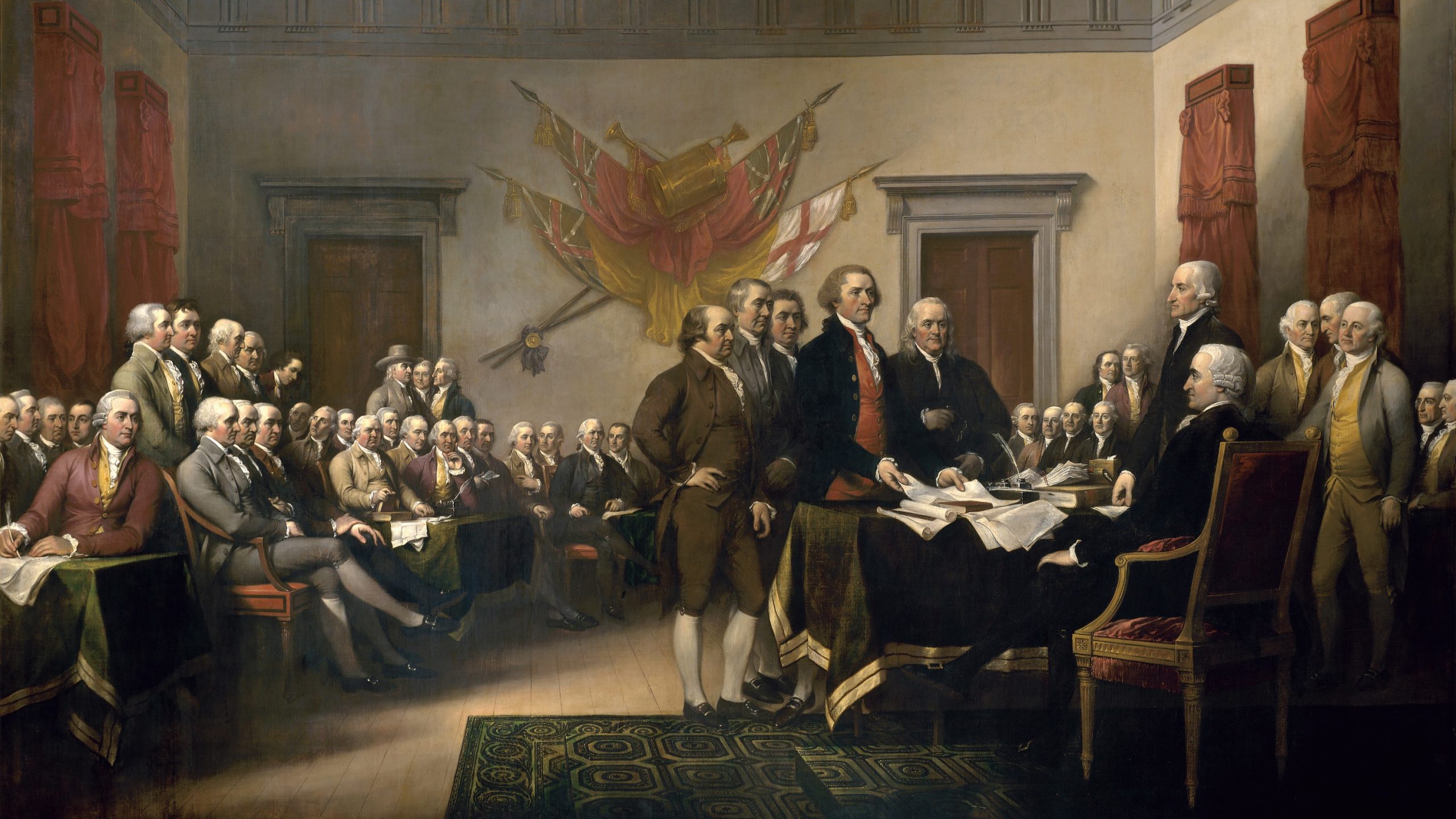
The Declaration of Independence has always loomed large in American consciousness, but it is perhaps especially resonant during its 250th anniversary in 2026. In the wake of unprecedented immigration enforcement across the country, efforts to eliminate birthright citizenship, and a violent reckoning with what it means to be—and who gets to be—an American, political science professor Dr. Patrick Schmidt’s The Declaration at 250 course was a once-in-a-lifetime teaching and learning opportunity on the concept of constructing historical memory.
“The class was driven by a desire to match the ownership of people who are trying to claim the Declaration of Independence, thus contextualizing the class itself as a participant in the battle for culture memory in the United States,” says Schmidt.
The various tales told about the history of the Declaration—and what erases or elevates certain features of that history—have a particular urgency in its 250th year. The document has been lifted up by Americans of varying political backgrounds in recent months, some at No Kings marches, others at Save America rallies.
“There’s a tendency in current political discourse to assume that only those who display a certain kind of patriotism and nationalism get to claim the Declaration. But historically, that’s not supported,” Schmidt says. “In many cases, it has been the most progressive figures that have found ways of championing the Declaration—women in the suffrage movement, enslaved and then freed African Americans. They have made the argument about how we live up to the values rather than how we critique those values.”
Before examining the present, Schmidt led his course on a global history lesson, examining the document’s origins and its enduring impact throughout the world. Macalester students studied the original ideas of the Declaration, which could be found first bubbling up in the Dutch Republic in the sixteenth century. Then came an examination of the British context in the seventeenth century up to the later drafts of America’s defining document in 1776, drafts that were largely dominated by issues of race. The Declaration’s primary architect, Thomas Jefferson, who enslaved hundreds of individuals during his lifetime, debated with others at the Continental Congress whether to reference the transatlantic slave trade in its final iteration.
“There was a phrase that had condemned England for perpetuating the slave trade that got cut. And there’s a good reason: because it was necessary to keep the Southern states on board,” Schmidt explains. “It was, of course, also hypocritical to keep the domestic slave trade while criticizing Britain’s role in it. But the founding fathers knew that slavery couldn’t be touched—that if they talked about it, the convention might break up.”
In this 250th year of the Declaration’s life—as the Supreme Court takes up cases that surround birthright citizenship and racial profiling—how do Americans see the document today? This discussion and debate made up a significant portion of the class.
“There’s no debate to be shied from, and in the liberal arts, we are committed to always come at it from a holistic responsibility to understand and listen—and also to knowledge and facticity,” Schmidt says. “There are ways to ground debates in the concrete, in the real. Debates aren’t just hot takes and social media posts—they are a process of reason, discourse, thoughtful reflection, and engagement.”
While debates like these grow in the classroom, they truly bloom in the broader community. Students created and participated in various community engagement projects, including teaching classes at a local elementary school, hosting podcasts, and collecting a plethora of opinions on the Declaration—which you can read on pages 22 and 23. For one of their final projects, students wrote opinion pieces on a topic related to the Declaration at 250, inserting themselves into the vital, historical, and contemporary tradition of public discourse.
Ultimately, Schmidt says, whether you critique it, support it, or feel ambivalent about it, one of the most important things about the Declaration is its relationship to the ever-evolving construction of cultural memory.
“It reminds me of a saying that the United Church of Christ hangs on their banners: ‘God is still speaking,’” Schmidt says. “It reminds us that history is not closed—it is always an ongoing process of interpretation.”
Declaration, Debated
As the nation marks the 250th anniversary of the Declaration of Independence, Americans are wrestling with questions about the country’s founding document.
Sabri Abdusalam ’28, a student in this spring’s The Declaration at 250 course, asked her classmates and Mac community members to debate its relevance today, what history leaves out, and the contradictions that were visible even at the founding.
Here’s what they had to say.
Is the Declaration of Independence worth celebrating in 2026?
“Absolutely, we need to celebrate the Declaration. We’re in a moment where there are competing ideas of what we’re about, so I’m of the mindset that if we don’t insert our voice, if we don’t uplift it and engage in civic engagement, that other vision will win out. I’m a big fan of us celebrating what this country said it was supposed to be about and using their language to remind them, ‘Hey, remember when you said this? Even if you didn’t have me in mind, I’m here whether you like it or not.’”
—Dr. Gonzalo Guzmán, assistant professor of educational studies
“No. I think that as much as possible, we need to resist getting caught up in celebrations on the Fourth of July if we’re going to be critical of America the rest of the year. We shouldn’t take our hats off and put our hands over our hearts even if it’s America’s founding. The American Revolution was not a revolution of the people, and things got considerably worse for many people on the North American continent. It’s more of a time for reflection, not celebration.”
—Mack Williams ’26
“It is worth celebrating with clear eyes. We can celebrate it as a milestone while naming its contradictions honestly. Thomas Jefferson wrote of liberty while he owned six hundred enslaved Africans in his lifetime. The Declaration of Independence excluded women, Indigenous people, enslaved people, owned by many of the people who signed it, and so celebrating means grappling with the gap between rhetoric and reality.”
—Dr. Duchess Harris, DeWitt Wallace Professor of American Studies
What have we typically excluded from our discussions around the history of the Declaration that we should talk about?
“I think the process of drafting the Declaration of Independence is oversimplified. We’re made to see that Jefferson wrote this document and everything was fine and widely accepted, but in reality the Declaration was a widely debated and revised document.”
—Leila Zuckerberg ’29
“The context and compromise that went into the founding. Really, the founders were normal people that had a bone to pick with who was in charge. We should pay attention to that in the modern day, because no two founders had the exact same ideas, but it was the power of compromise that ended up helping them achieve a finished product over time.”
—Daniel Powell ’27
“The lack of recognition of other countries speaks volumes. For example, the United States went nearly sixty years without recognizing Haiti’s 1804 independence out of fear it would inspire uprisings of enslaved people in the American South. I think it makes us reflect on who independence was really intended for.”
—Lillie Perez ’29
What should we do today with the contradiction that enslavers were proclaiming a right to life, liberty, and the pursuit of happiness?
We should be taught that the founders had ideals that were worth celebrating and aspiring to, that they didn’t live up to those ideals, and that they didn’t want to. As Jefferson was drafting the Declaration and writing that all men are created equal, he was using the enslaved labor of Africans on land that they murdered Indigenous people for. We can say, ‘They were correct in their diagnosis—all men are equal—but they didn’t live up to it,’ and focus on people who did.”
—Navi Clark ’28
“We cannot be naive and willfully ignorant of historical facts. But the point I would make is that the country has made progress toward its ideals. Are we there yet? No. But are we a lot closer today than we were in 1776, and 1789 and 1860? Yes, we’re a lot closer. Part of the reason is the leverage those ideas gave us. We can use the documents they left behind and say, ‘This is a promissory note, and I’d like to cash it in now.’”
—Dr. Andrew Latham, professor of political science
“The Declaration of Independence isn’t unique in that there’s contradictions. For example, the people the founders were inspired by, like John Locke, helped codify chattel slavery into law. The way I look at it is that the ideas are important, but the founders also had their self-interests, so to a certain degree we need to separate the ideas from the people and look plainly at what they wrote. We can expand those ideas to make them still applicable in 2026.”
—Paramitha Pratha ’29