

2025-26 Newsletter
How would you like to view the newsletter?
-
-
2025-2026 Newsletter
Physics and Astronomy
MacalesterGreetings from the chair, Jim Doyle
Hello Mac Physics and Astronomy Grads! Welcome to the second annual Macalester College Department of Physics and Astronomy newsletter! This has been an eventful year for the Department. First some very sad news. Professor Sung Kyu Kim passed away unexpectedly in November 2025 at the age of 86. Sung Kyu taught in the Department for 51 years. His Contemporary Concepts course (Con-Con) was legendary, as was his Summer Physics Institute for pre-med students. It’s very likely Con-Con was taken by more Macalester students than any other course at the College! Sung Kyu was an award-winning teacher who was nationally recognized by inclusion in the 300 Best Professors by the Princeton Review. He was a wonderful colleague, and we will miss his infectious love of physics, his practical wisdom, and his great sense of humor. The family obituary is here and the Macalester obituary is here.
But now for some very good news. I am very happy to report that Professor Anna Williams has been promoted to Associate Professor of Physics with tenure! While not at all surprising, it is very gratifying that Anna’s wonderful teaching and research accomplishments have been fully recognized by the College. Thanks to all of you who wrote letters of support on her behalf (and indeed, it has been quite a year for Anna who has been out on parental leave after welcoming her second daughter into the world in July).
Otherwise, the Department is humming along, with continued good enrollments and major numbers. This past year we started requiring Computational Physics for the major, a course developed and taught by Tonnis ter Veldhuis. In our Physics Seminar this past Fall had the good fortune to have three alums visit and give talks: Trevor David Rhone (Mac ’05), Justin Johnson (Mac ’99), and William Setterberg (Mac ‘20).
I begin my last semester of my three-year term as Department Chair this Spring, with James Heyman taking over on June 1. As always, I am very grateful for my wonderful colleagues in the Department, but most of all for the privilege to work with such amazing students such as you all! The Department is always happy to hear from you – let us know how you are doing if you get a chance!
Best Wishes for the New Year!
Expert Advice
Dave Bailey is a shared talent for the sciences in Olin-Rice, and invents, builds, and improves on all manner of things in the Ken Moffett Machine Shop. Dave also is involved with Macalester’s High Power Rocketry Club as a technical advisor. This fall Dave participated with club members to earn his Level 1 High Power Rocketry Certification, issued by the Tripoli Rocketry Association.
Prof. James Heyman
Hello everyone! 2025 was another good year at Macalester. In the spring I taught Optics for the first time in many years and it was great to be able to offer this intermediate level course to a class of interested students. I also taught Statistical Mechanics, one of my favorites. I continued experimental research on Perovskite Semiconductors during the summer with Mac students Sten Gustafsson and Zoli Lauko, focusing on how these technologically important materials degrade with light exposure. We combined IR and THz spectroscopy (which probe molecular bonds) with Electron Dispersive Composition (which probes elemental composition) to identify a self-catalyzed degradation process. In the Fall, 2025 I taught Modern Physics (another favorite) and my first year course Nanoscience. This last year was very good for my family and I as well. Our oldest daughter got married, my middle daughter continued her work as an educational psychologist and my son started graduate school in Chemistry.
Prof. John Cannon
Highlights from John:
My spring 2025 “Be A Star!” class involved 49 students from all MACRO institutions
I led the second “MACRO Summer Program”. More than a dozen participants from all schools worked on data from the RLMT, the VLA, and the Chandra x-ray telescope.
My fall 2025 “MACRO Preceptor Training” class involved 11 participants from all MACRO schools (press release)
The first MACRO publication (Gunderson et al. 2025; https://iopscience.iop.org/article/10.3847/1538-4357/ae0d7e; press release)
I published 8 peer-reviewed scholarly journal articles (3 with Macalester student co-authors)
MACRO Consortium members were awarded telescope time on competitive observatories
Read the most recent MACRO Consortium’s Annual Newsletter
Prof. Jay Gallagher
In 2025 I enjoyed mentoring four of students who made significant contributions to research in extragalactic astronomy. Their insights, progress, results, and interactions with each other and their cohorts, along with the enthusiasm about astronomy stemming from MACRO, made for a fine year. Our teams worked in 2 main areas using both archival imaging data from the Hubble Space Telescope, and forged new ground on a novel type of study. Caeden Miller’s (`25) Capstone pioneered a study of stars with 10 or more times the mass of the Sun in a nearby galaxy, work based on measurements of the brightness and colors of individual stars. Following Caeden’s graduation, this investigation was taken up by Elliott Lewis (`27) who is seeing it to completion as an independent research project, aided by experience gained in last summer’s U. Wisconsin-Madison Research Experience for Undergraduates. This work is part of a study of properties of binary stars that emit x-rays by dumping gas onto a companion black hole that is led from U. Potsdam (Germany). Caeden’s Capstone in the Macalester digital archives contains the initial results, while Elliott presented further information in posters at undergraduate science symposiums and at the January 2026 national meeting of the American Astronomical Society. We are finding that NGC 3109 is a bit of a disappointment in not recently producing massive stars with black hole companions that are sources of luminous x-rays.
Lila Schisgal (`25) and Will St, John (`26) worked on the dark side by mapping distributions of dusty gas in the centers of galaxies containing compact obscured nuclei (CONs). CONs are the most extreme cases of a galaxy nucleus being embedded in massive, dusty gas clouds that obscure optical light and can feed the growth of central black holes and associated nuclear star clusters. CONs are the focus of the CONquest research collaboration led from Chalmers University (Sweden). Will applied statistical methods to show that galaxies hosting CONs have rather normal properties; thus, production of CONs does not highly disturb the host galaxy. Lila’s map of the inner regions of the CON galaxy NGC 4418 showed the CON is at the center of a larger, chaotic dust disk that could feed it gas. Both studies were published during 2025 in the Research Notes of the American Astronomical Society. As part of her work, Lila discovered a previously undetected tiny region of very high dust dimming in the CON galaxy IC 860. This led us to a follow-up study where we found this source was not at the position of the CON. IC 860 therefore is an example of a rare type of system with two compact, luminous central sources hidden by dense screens of dust. We are submitting a refereed paper reporting these unexpected results with myself and Lila as lead authors and Will as one of the co-authors.
Location, location, location may apply as a key factor in cosmology as well as real estate. Will’s Honors Capstone, currently in progress, seeks to determine if low mass galaxies in the dense cosmic filaments have the same properties as similar classes of galaxies in low density cosmic voids. Stay tuned next year for his results!
Prof. Jim Doyle
It’s been a busy year but I’m still having fun! Last February I attended the Biophysical Society Meeting in LA, and presented a poster on Uditi Chandreshekar’s (Mac’ 24) honors work on the Hodgkin-Huxley equations. Sylvia Greene (Mac ’24) drove down from grad school in Santa Barbara and presented her honors thesis on surface polymerization of biomolecules. In other work I continue to collaborate with Mike Anderson in Biology on simulations of seed dispersal, aiming to submit at least a conference abstract this year. I am also currently working with students on models of passive cooling in buildings, and stochastic effects in the Fitzhugh-Nagumo equations (an alternative to the Hodgkin-Huxley equations for modelling neuron action potentials). I continue to enjoy teaching my staple courses Laboratory Instrumentation and Science of Renewable Energy, in addition to anything else the Department needs me to teach! This coming May I will begin my 2026 sabbatical (May-January), most of which I will be spending in the Denver-Boulder area of Colorado. Let me know if you are in the area – happy to grab a coffee!
Hello from the office
Hi everyone! I’m in my second year at Mac and continue to enjoy working with both the Geology and Physics & Astronomy departments. I was able to attend the senior talks last spring, and have learned so much from both students and faculty. I especially appreciated Lila Schisgal, ‘25 who worked as an office assistant all of last school year, and patiently helped me understand a little about astronomy. Over the summer 2 awesome student researchers were kind enough to walk me through their work with James Heyman on Perovskite Solar Cells. I’ve gotten to know many members of the rocketry club – all of whom are amazing. I love receiving and sharing alumni updates with the department, so please shoot me a message ([email protected]) and say hello, or tell us what new with you!
Prof. Michelle Milne
I just joined the department this fall as a visiting associate professor and have really enjoyed getting to know the Macalester community. This past semester I taught Principles of Physics I and Electromagnetic Theory I, and I’m looking forward to teaching Principles of Physics 2 and Mechanics this semester. My research interests include acoustics, as applied to ultrasound imaging, and physics pedagogy, and my personal interests include learning how to adapt to the Minnesota winters after living in subtropical Maryland for over a decade!
Congrats to class of 2025
In May of 2025 we celebrated our 13 graduating majors, five of which had an astronomy emphasis. Throughout the Spring the seniors took turns presenting their capstone and honor projects. You can see the graduates and titles of their projects here. Grads – best wishes, we miss you, and we’d love to hear from you!
Physics Seminar
Each fall the department invites a variety of speakers to campus for the Physics Seminar. Here are some of the highlights from Fall 2025:
Professor (and alum) Trevor Rhone, Department of Physics, Applied Physics and Astronomy, Rensselaer Polytechnic Institute: “Atoma: An artificial intelligence to spark the next materials age”
Jay Tasson, Associate Professor of Physics, Chair of Physics & Astronomy, Carleton College: “General Relativity, LIGO, and a One Hundred Quintillion Mile Race”
Alum Justin Johnson, Senior Scientist, National Renewable Energy Laboratory: “Controlling spin in photoexcited molecular and nanoscale systems”
Bixin Guo, Assistant Professor of Philosophy, Macalester College: “The Direction of Time: Making Sense of Statistical Mechanics”
Alum William Setterberg, UMN PhD Candidate: “Studying high-energy aspects of solar flares as a grad student”
Recommendations for future speakers are always appreciated ([email protected]).
Tea Time
The department continues its tradition of co-hosting a weekly tea with the geology department. Wednesdays, just before Physics Seminar, students, faculty, staff and guests join in snacks and socialization in the OLRI atrium. We wrapped up the final tea of 2025 with a taste test between white and yellow popcorn and discovered both are great!
Image Captions:
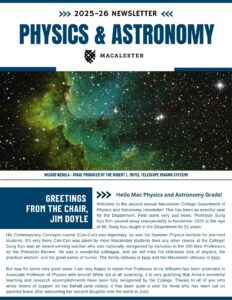
Wizard Nebula – Image produced by the Robert L. Mutel Telescope Imaging Systems
NGC 2359 – Image produced by the Robert L. Mutel Telescope Imaging Systems
Student Elliott Lewis (‘27) presenting her work in a poster titled “Charting High Mass Stars in a Nearby Dwarf Galaxy at Macalester during MacFest