

Collaborative Campus Resources
Resources
-
The Sustainability Office funds small on-campus projects that promote sustainability through creative action, advance Macalester’s Sustainability Plan, and uphold the core values of the College.
Projects should encourage collaboration between staff, faculty, and students. An individual or group can apply for up to $1,000 in funding. Applications are rolling but funding is limited. If you have questions, contact the Sustainability Office at [email protected].
- Projects that have a lasting effect on the community have a higher priority than those that benefit an individual once
- Students, Faculty and Staff are all encouraged to make requests
- Budget figures submitted should be accurate; the Sustainability Office may request documentation about the budget figures before approving the request
- Requests for travel funding will not be approved; if an exception is to be made and travel funding is approved, it will be solely and exclusive through the college’s van pool, without exception
- Funds will not be approved if the request is a donation to an outside organization
- Funds to be paid to an external individual vary in approval; stipends for on-campus speakers open to all will be approved more often than funding for consultants working from afar
- The Sustainability Office reserves the right to make the final decision about the allocation of funds
Complete the Small Project Fund Application with your request if you feel it aligns with the above guidelines.
-
Why major in Environmental Studies at Macalester?
In a word: Action.
For nearly fifty years, Macalester has had a dedicated and deeply interdisciplinary focus on Environmental Studies. We use case studies, problem-solving, and a community-centered approach to address environmental problems at the local, national and global levels.
Our faculty bring expertise from the humanities, social sciences, physical, and biological sciences. Our affiliated faculty in other departments come from all corners of campus, including anthropology, biology, chemistry, economics, education, geography, geology, GIS, philosophy, and physics.
Learn more by visiting the Environmental Studies Site
Join our community
We don’t just talk about environmental issues here, we also take part in them.
- EnviroThursdays—bring your bag lunch and join the community to hear from local and national experts at one of Macalester’s longest running public seminars
- EcoHouse—a living and learning residential option where students test various green technologies and lifestyle choices
- Green@Mac—aims to promote all aspects of holistic sustainability and urban gardening
- Mac Bike—bike advocacy and a repair workshop
- MacShares—a student-run cooperative that sells produce and dry bulk goods to the Macalester community at weekly pop-up sales
- Mac Sunrise—a local chapter of the Sunrise Movement, a youth-led movement promoting student advocacy around climate justice and equity
- Outing Club—offers adventure in the great outdoors through inexpensive trips and reasonable gear rental
-
A student-run cooperative that sells produce and dry bulk goods to the Macalester community at weekly pop-up sales. They purchase produce in bulk from local producers or food hubs and sell everything by the pound, at-price. Any food that remains unsold is purchased by Macalester’s Cafe Mac/Bon Appétit. It’s a convenient and affordable way for students to access fresh produce. Sale dates are posted on their Instagram @Mac.Share and in the Mac Daily.
You can visit their sale on Friday’s throughout the school year from 3:30-5pm in Jwall!
Email: [email protected] or check out their linktree page
-
-
A reusable menstrual cup program offered free to students. Complete a request form to receive yours through the campus mail. This program is provided in collaboration with The HAMRE Center and Sustainability Office.
A Brief History
Macalester College launched a free tampons and pads program in during the 2018-19 school year as a result of a Macalester College Student Government (MCSG) led initiative. Currently, Facilities Services maintains the tampons and pads machines and budget. The Campus Center and the Library have free products while all other buildings continue to have paid dispensers. In 2018-19, they purchased 8250 tampons and pads for $1106. This budget number is unlikely to change substantially.
In addition, Macalester Activists for Reproductive Justice has held a menstrual health student panel which hands out free menstrual supplies for the past few years. MCSG has held similar events as well. These events consistently hand out as many reusable pads and tampons as are made available. In talking with students on campus, many female bodied individuals had already accessed menstrual cups prior to the launch of SustainaCup in October 2019.
Why It Matters?
- Economics: The average menstruating person spends $60 a
year on period products. - Social Justice: Menstrual cups are a discrete solution for gender
non-conforming people to manage their periods. - WellBeing: Tampons contain harmful chemicals known to
cause conditions such as Toxic Shock Syndrome –
menstrual cups eliminate this risk. - Environment: Macalester alone in past years has discarded around 350,000
tampons/pads a year, which don’t biodegrade and often pollute our lakes and ocean
- Economics: The average menstruating person spends $60 a
-
Veggie Co-op
The Veggie Co-op is an intentional meat-free living community, located on campus in the football stadium and is open to all rising sophomores, juniors, and seniors. The Veggie Co-op has space for 20 residents, including one Resident Assistant.
Co-op residents live together in the manner of a cooperative. They share meals and each participate equally in the work required to maintain an active and healthy community experience. This has traditionally been a very close-knit group who take seriously their responsibilities toward the creation of a family atmosphere where each member has an equal and important role in the growth of the community.
Common meals and weekly meetings are a mandatory part of the experience. Each resident is required to contribute $500 per semester to the general pool for buying food and other provisions for the Co-op. Residents are exempt from the residence hall dining plan.
An application and selection process is conducted each spring before the room draw process. This living option is available for sophomores, juniors, and seniors only.
For questions or more information and an application you can visit the residential life site
Eco-House
Project EcoHouse at Macalester College in St Paul, Minnesota, kicked off in Fall 2007 with the move-in of four student residents. The 1950s-era house underwent significant “green” renovations in summer 2007, including the installation of a domestic solar hot water system, a recyclable steel roof, wall insulation, and high efficiency energy star appliances. While developmental work is continuing, this project has already gained significant attention in the local media, including stories in the Minneapolis Star Tribune, The Villager, Channel 9 News, Minnesota Public Radio, and various Macalester publications.
The EcoHouse gives students a unique opportunity to explore practical green-living lifestyles, to test the effectiveness of new green technologies, and to work with community partners to develop better resources on green renovations and sustainable lifestyles. In addition, once it is equipped with a planned state-of-the-art energy monitoring system, the house will function as a “live-in” laboratory for testing the energy savings and cost-effectiveness of various renovations and green technologies. Such a system will allow the EcoHouse to provide empirical data on the performance of various house systems that we can then share with many others. The house is also rapidly becoming an information clearinghouse, fostering discussions about sustainability by connecting interested homeowners with relevant community organizations and efficiency resources. In the future, EcoHouse residents will host various events, skill-shares, and workshops, and will develop a comprehensive web site to help build connections between on and off-campus resources. Project EcoHouse is in continual development and guided by an ambitious vision.
More information about the Eco-House and other living and learning community locations can be found here
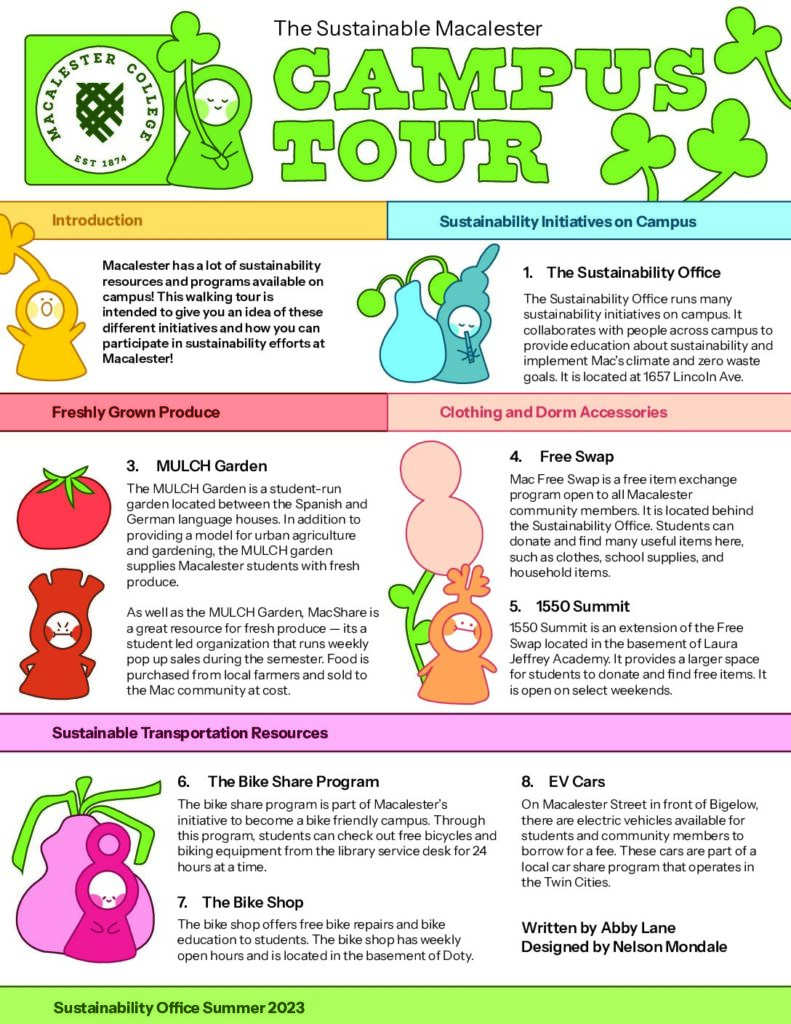
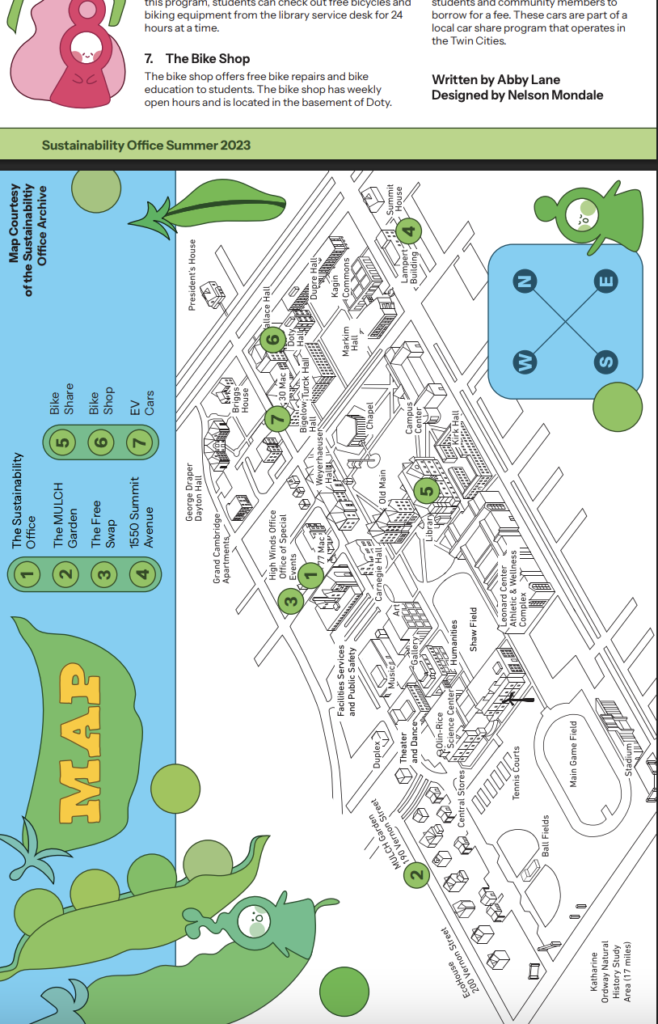
Campus Sustainability Tour