



Innovation Fellows Program Is Reshaping the Classroom
From Silicon Valley to the Neuroscience Lab: How Macalester’s Innovation Fellows Program is Reshaping the Classroom
By Natalie Mazey ’26
In January 2026, Macalester’s Department of Entrepreneurship & Innovation (E&I) sent five faculty members, drawn from biology, environmental studies, mathematics, computer science, and Russian studies, to Silicon Valley for an immersive week of conversations with leaders from Google, LinkedIn, and Stanford University. The trip was about innovation, design thinking, entrepreneurship, and artificial intelligence, and how these principles can be applied in classroom spaces. But for one biology professor, it planted a seed that would bloom closer to home: inside a neuroscience classroom.
Building an Ecosystem
To understand why a trip to California matters for a neuroscience class in Saint Paul, you have to understand how E&I Director Allan Martinez Venegas thinks about his department’s mission.
“One of our missions is to have every Macalester student graduate being a curious and confident innovator,” Martinez Venegas explains. “But to do that, we need to be more than a center for you to come and learn skills. We need to go from being a center to being an ecosystem.”
That idea has driven the department this past year. The Idea Lab and E&I’s own programming can only reach so many students. But the students spend the most hours and build the strongest relationships with their professors. So if E&I wants its methods and philosophies to take root across campus, it has to invest in faculty.
The Innovation Fellows Program was built on that logic. Rather than waiting for faculty to walk through the Idea Lab’s doors, E&I brought five faculty members into a sustained, immersive experience: a week in Silicon Valley, followed by an ongoing relationship with the department. The fellows were chosen deliberately. These fellows are people already predisposed to experimentation, already showing up to panels and programming, and already asking questions about how their teaching could evolve.
Professor Phil Rivera, who teaches neuroscience and already teaches many classes out of the Idea Lab, was one of them.
A Natural Champion
“Phil was selected partially because he was already a champion of this work,” says Martinez Venegas. “He’s one of the faculty that uses the Idea Lab most often. He comes to our panels. He buys into this idea of innovation already.”
The California trip gave Rivera fuel to incorporate more innovation into his classroom. Surrounded by conversations about human-centered design and the role of creativity in solving real-world problems, he began to see a new possibility for his Cellular and Molecular Neuroscience Lab, where his students use neuroscience for good. This class was already oriented toward social impact, but not yet equipped with a structured method for getting there.
Back on campus, Rivera and Martinez Venegas began collaborating. What if they wove the phases of design thinking directly into the neuroscience course?
“I’ve come to believe that our unique capacity for creativity may become our most essential human contribution,” says Rivera. “Creativity is like a muscle. It atrophies without resistance. And my Cellular/Molecular Neuroscience course became an obvious place to strengthen this muscle.”
Five Phases, One Semester
The collaboration was built around E&I’s five-phase design thinking framework. It begins with framing: identifying a meaningful problem and scoping it to something achievable within a semester. From there, students move to inspiration, conducting primary and secondary research to understand the problem deeply before reaching for solutions. The third phase, ideation, translates that research into insights, generates questions, and produces a wide range of possible ideas. Implementation follows: fast, low-fidelity prototypes that eventually build toward something that actually works. Finally, students develop their storytelling, learning to communicate their solution compellingly and clearly.
Martinez Venegas came into the class roughly once a month during their lab sessions, helping students navigate the transition from one phase to the next. In between, they were doing the neuroscience, learning molecular biology, research methods, and scientific content.
“They were learning the science and utilizing the techniques we learned together to move their projects along.”
Blending Disciplines
Blending these two disciplines wasn’t without friction, but that was part of the point. As Rivera describes it, “Students were tasked with an ‘AI Neuro-Equity Venture.’ It is a final project that pushes them to integrate hard science with potentially real societal change by identifying a related social justice issue to explore alongside AI.”
“I think something that was first a challenge but hopefully eventually rewarding — maybe it’s type two fun — was having students balance these two demands,” Martinez Venegas explains. “I’m asking them to be bold and creative and human-centered. Phil’s asking them to be scientific. He wants them to rely on facts, to really understand the concepts, to incorporate molecular-level biology into a social impact problem. Very, very difficult to do.”
The two instructors never disagreed on goals, but they were pulling in different directions, and the students had to hold both tensions at once. It mirrors, Martinez Venegas notes, exactly what awaits graduates in professional life: the need to be simultaneously technically rigorous and boldly imaginative.
“Back in my days as a student, that probably would have been frustrating,” he admits. “But that’s part of the point. Because once you graduate, you will be pulled in those directions too.”
The collaboration also pushed students toward tangibility. In academic settings, it can be easy to stay in the realm of ideas and debate indefinitely. This class required more: teams had to produce actual prototypes, gather feedback from real users, revise their work, and navigate the interpersonal dynamics of collaborative projects within a single semester.
The Idea Lab as a Learning Space
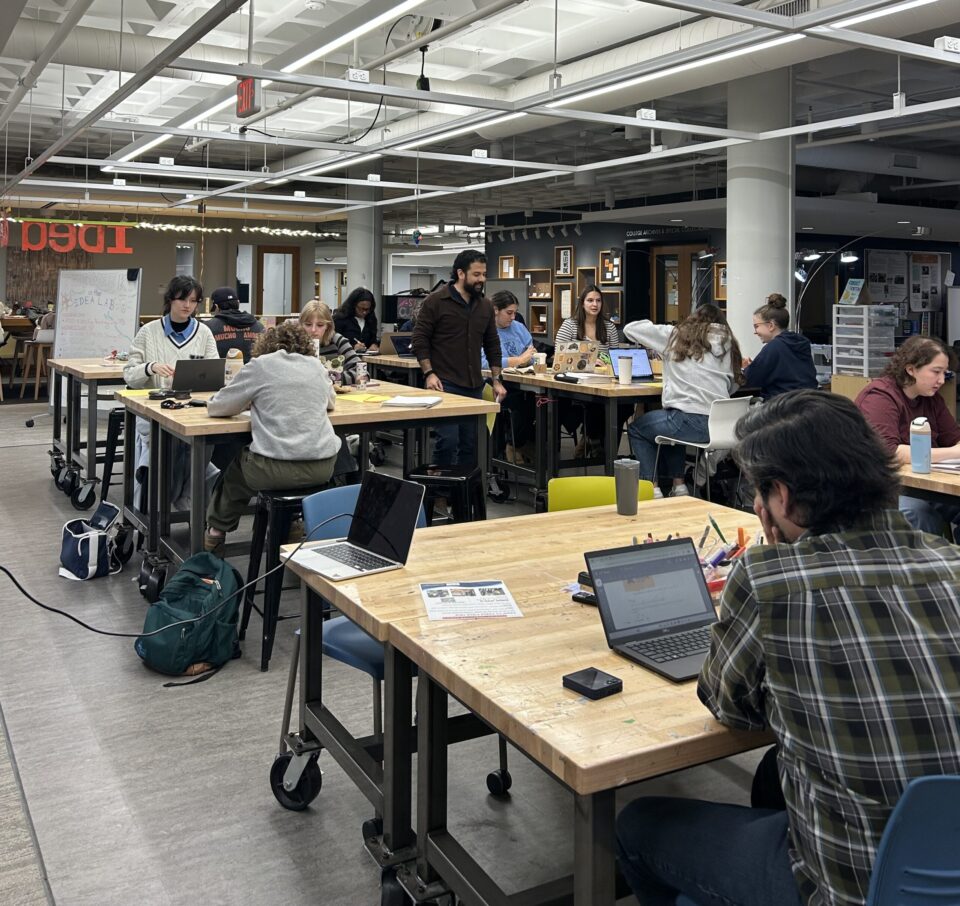
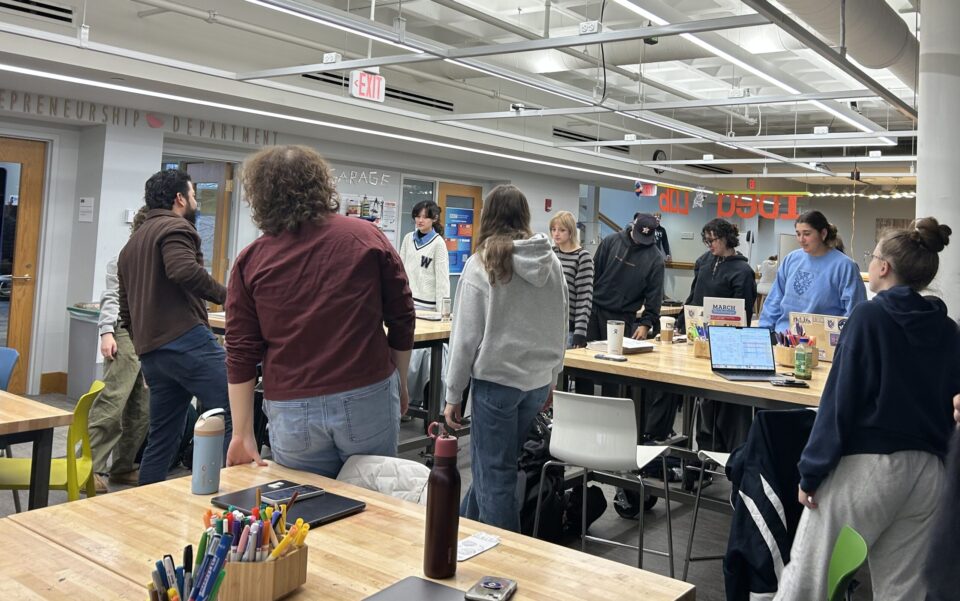
One of Martinez Venegas’s favorite moments from the semester came in its final weeks, when the last sessions moved into the Idea Lab itself.
“For me, it’s very important that people see the Idea Lab as a place of learning — a place where exciting learning happens, where there’s color, there’s craft,” he says. “And it’s also a place where you can deliver a neuroscience class or an English class or a Geology class.”
Seeing the space come alive with neuroscience students, watched by student workers, library staff, and parents on campus tours, was, he says, one of the highlights of the entire experience. It was proof of concept: that E&I’s methods don’t belong to any one discipline.
What Comes Next
Martinez Venegas describes this semester as a pilot. In the language of innovation, a pilot is a source of learning: what worked, what didn’t, what’s worth trying differently.
The presentations, held at the end of the semester, showed the power of blending disciplines. Project topics ranged from mental health resources at Macalester to child development. As Rivera puts, it “The goal was never to teach students to use tools. It was to teach them to become the new information the future requires. We’re trying to grow ecosystems where human creativity is the foundation, not a feature.”
“I hope other faculty are going to want to try this as well,” he says. “Our methods are very discipline-independent. We can try it in any field.”
The broader vision is a campus where design thinking and human-centered innovation aren’t confined to the Idea Lab or E&I’s own courses. A language professor or a sociologist might reach out and say, I heard what you did with the neuroscience class. I’d like to try something like that.
That, in the end, is what the Innovation Fellows Program is designed to produce: not just five faculty members with new ideas, but a faculty culture curious and confident enough to experiment, allowing every student at Macalester to be an innovator.